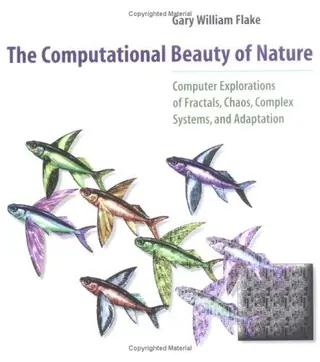
The Computational Beauty of Nature
by Gary William Flake · first published 1998
90% recommend10% neutral
Why HN recommends it
Accessible, visual tour of complex systems: L-systems, boids, cellular automata, fractals, and chaos, all built around computer experiments. Suits curious programmers who want an approachable route into complexity.
Summarised by Claude from recommending comments
"In this book, Gary William Flake develops in depth the simple idea that recurrent rules can produce rich and complicated behaviors. Distinguishing "agents" (e.g., molecules, cells, animals, and species) from their interactions (e.g., chemical reactions, immune system responses, sexual reproduction, and evolution), Flake argues that it is the computational properties of interactions that account for much of what we think of as "beautiful" and "interesting." From this basic thesis, Flake explores what he considers to be today's four most interesting computational topics: fractals, chaos, compl
Affiliate links. As an Amazon Associate I earn from qualifying purchases.
Mentions per year
What Hacker News says
Related books
 2014–2023
The algorithmic beauty of sea shells
Hans Meinhardt
Recommended by 3 · mentioned by 43 recommend · 4 mention3 recommend · 43 recommend
 2008–2024
Algorithmics
David Harel
Recommended by 11 · mentioned by 1211 recommend · 12 mention11 recommend · 1211 recommend
 2008–2022
It's Not About the Bike
Lance Armstrong
Recommended by 4 · mentioned by 44 recommend · 4 mention4 recommend · 44 recommend
 2016–2026
Cellular automata
Andrew Ilachinski
Recommended by 3 · mentioned by 33 recommend · 3 mention3 recommend · 33 recommend
 2009–2022
Why stock markets crash
D. Sornette
Recommended by 5 · mentioned by 55 recommend · 5 mention5 recommend · 55 recommend
 2011–2023
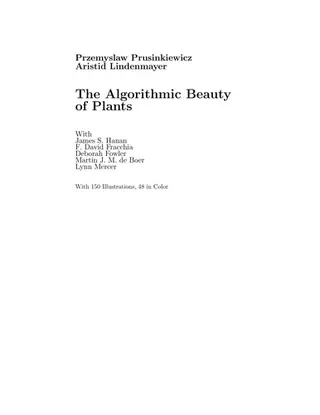
The algorithmic beauty of plants
Przemyslaw Prusinkiewicz, Aristid Lindenmayer
Recommended by 18 · mentioned by 2518 recommend · 25 mention18 recommend · 2518 recommend
 2012–2026
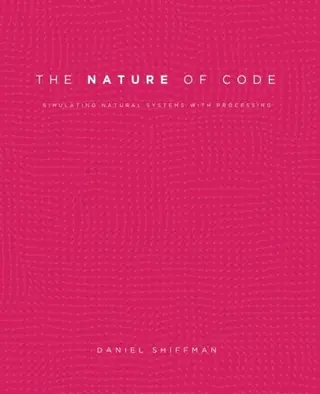
The Nature of Code
Daniel Shiffman
Recommended by 73 · mentioned by 8273 recommend · 82 mention73 recommend · 8273 recommend
 2007–2026
Artificial life
Steven Levy
Recommended by 13 · mentioned by 1413 recommend · 14 mention13 recommend · 1413 recommend
…revolutionary idea, that "complex behavior can arise from simple rules", wasn't his and, even if the news still hasn't yet reached many people, hadn't been revolutionary for decades. Gary William Flake's "The Computational Beauty of Nature" is an accessible alternative with interesting ideas, pretty pictures, and no hyperbole: https://mitpress.mit.edu/sites/default/files/titles/content/...
on “A New Kind of Science: A 15-Year View” ↗For something in a similar vein, but perhaps more approachable, check out The Computational Beauty of Nature (http://www.amazon.com/The-Computational-Beauty-Nature-Explor...).
on “The Algorithmic Beauty of Plants (1990)” ↗…there’s no such thing as a chair divorced from reality, there’s nobly instantiations of these abstract concepts we consider close enough to be concrete”. That totally blew my mind. Together with reading The Computational Beauty Of Nature” when it first came out nine years ago those were the two key experiences that drove me towards choosing to get a degree in mathematics.
on “What Even Is a Number?” ↗I recommend one of my favourite books, Gary William Flake’s 1998 The Computational Beauty of Nature to anybody interested in boids or other computational models of social, chemical, and physical phenomena. Therein the author covers boids extensively and in detail. If I am not mistaken it is in section…
on “Boids” ↗While not just about this, The Computational Beauty of Nature [1] is worth checking out. [1] https://www.amazon.com/Computational-Beauty-Nature-Explorati...
on “Ask HN: Looking for a Book on Cellular Automata” ↗Let me drop in a plug for my favourite book, William Gary Flake’s The Computational Beauty of Nature (1997), by far the best exploration of these kinds of concepts I have ever encountered. It’s rich in discussion, beautiful diagrams, formulae & equations, and even compilable code—kind of like Stephen…
on ““The Edge of Chaos” (2017)” ↗…advocating trying to form a company as described above!) A few books for those who want to research further into this fascinating area: http://www.amazon.com/Computational-Beauty-Nature-Exploratio... - The Computational Beauty of Nature - Computer Explorations of Fractals, Chaos, Complex Systems, and Adaptation http://www.amazon.com/Turtles-Termites-Traffic-Jams-Explorat... - Turtles, Termites, and Traffic Jams: Explorations in Massively…
on “God and Design Patterns” ↗…Revealed Cooking for Geeks The Bread Baker's Apprentice The Brewmaster's Table --- MISC --- Robot Building for Beginners Mountaineering - The Freedom of the Hills A First Course in Coding Theory The Computational Beauty of Nature Total Control The Ashley Book of Knots Make: Electronics
on “Ask HN: Good books?” ↗It looks like a more practical, interactive version of Gary Flake's wonderful "Computational Beauty of Nature." That's not a bad thing at all.
on “Daniel Shiffman launches "The Nature of Code" online for free” ↗The Computational Beauty of Nature by Gary William flake (1997) https://books.google.it/books/about/The_Computational_Beauty... A totally astounding introduction to how computing fits into the broader scale of understanding other phenomena…
on “Ask HN: What is the most mind blowing book you've ever read?” ↗There are some good theoretical computer science (sciency) books out there. I would recommend two of my favourites: Gary William Flake: Computational Beauty of Nature Douglas Hofstadter: Godel Escher Bach They won't make you a programmer ready for a job at Facebook; but they will entertain the part of your head that makes you a good programmer. The two books are…
on “Ask HN: Learning to code, without a computer?” ↗The Computational Beauty of Nature (1997) by William Flake is the book that cemented my fascination with computation, computability, and computer science as having something fundamental to say about the physical universe in which we live.It…
on “Ask HN: Most influential books you read growing up” ↗I'm an INTJ and I... ...have been excited by computational thinking ever since I read The Computational Beauty Of Nature whilst in High School in 1998 ...am an avid Mathematica user ...found Wolfram's arguments pretty trite and obvious, couched in self-aggrandising hand-waving ...found the book's prose style to be absolutely…
on “A New Kind of Science: A 15-Year View” ↗The Computational Beauty of Nature (as I have remarked ad nauseam elsewhere) is my all-time favourite book and reading it proved to be a pivotal watershed event in my life (back in 1998 when I was in high school). I'm glad I'm not the…
on “A New Kind of Science: A 15-Year View” ↗I suggest The Computational Beauty Of Nature by Gary William Flake, and then Cellular Automata by Andrew Ilachinski.
on “A Game of Life on Penrose Tilings” ↗