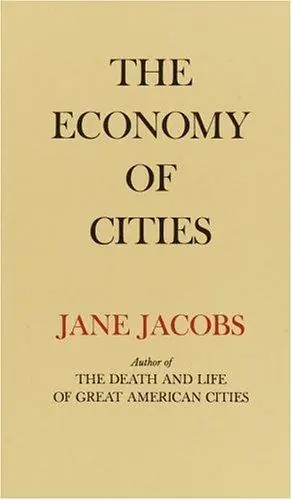
The economy of cities
by Jane Jacobs · first published 1969
57% recommend43% neutral
Why HN recommends it
Argues that cities, not nations or firms, drive economic growth by generating new work from old work; readers value it for reshaping how they think about economics, growth, and trade.
Summarised by Claude from recommending comments
The thesis of Jane Jacobsʹ The Economy of Cities remains remarkably fresh and provocative three decades later. Cities, she asserts, are not the result of processes most scientists and economists have assumed they were: Cities do not develop because a pre-existing rural economic base develops and eventually becomes strong enough to support an essentially parasitic urban growth. Instead, Jacobs argues, cities are the prerequisite for any kind of rural economy. Where there are no cities, there are no sustainable rural economies, and the rural economy depends on the city rather than the other way
Affiliate links. As an Amazon Associate I earn from qualifying purchases.
Mentions per year
What Hacker News says
Related books
 2008–2026
Cities and the wealth of nations
Jane Jacobs
Recommended by 10 · mentioned by 1410 recommend · 14 mention10 recommend · 1410 recommend
 2008–2026
The Death and Life of Great American Cities
Jane Jacobs
Recommended by 61 · mentioned by 8761 recommend · 87 mention61 recommend · 8761 recommend
 2007–2026
Freakonomics
Steven D. Levitt, Stephen J. Dubner
Recommended by 27 · mentioned by 6627 recommend · 66 mention27 recommend · 6627 recommend
 2007–2026
Hackers & painters
Graham, Paul
Recommended by 109 · mentioned by 245109 recommend · 245 mention109 recommend · 245109 recommend
 2007–2026
Gödel, Escher, Bach
Douglas R. Hofstadter
Recommended by 505 · mentioned by 1,055505 recommend · 1,055 mention505 recommend · 1,055505 recommend
If anybody is interested in delving deeper into this, I would recommend that they read two of Jane Jacobs's books: The Economy of Cities and Cities and the Wealth of Nations.
on “Hacking Economies - What makes places rich?” ↗Adventures of a Bystander by Peter Drucker. Jane Jacobs's three city books: The Death and Life of Great American Cities, The Economy of Cities, and Cities and the Wealth of Nations.
on “Ask HN: What is the greatest book you've ever read?” ↗…American Cities was a watershed for me (and I can still remember the marginalia in my uni's copy at one of her common-sense observations: "God bless you, Jane"). Cities and the Wealth of Nations and The Economy of Cities changed many of my perceptions of what economics was about and where its real centers lay (it's rarely nations or states, cities and metropolitan areas, yes). Wright's interesting. But he's no authority…
on “How Frank Lloyd Wright Tried to Solve the City” ↗…Amazon uk, starting at about 15 pounds) - from Powell's. If you found pg's cities essays interesting or clueless, read Jane Jacobs's trilogy on cities: The Death and Life of Great American Cities The Economy of Cities Cities and the Wealth of Nations The quality of the writing, and the thought, more than fully justify the hubris of the last title.
on “Ask YC (and PG): What books do you have on your bookshelf? ” ↗A few books I've found extremely helpful for thinking about these things. Jane Jacobs on cities as the economic entities that really matter: The Death and Life of Great American Cities, The Economy of Cities, and Cities and the Wealth of Nations. Peter Drucker: Entrepreneurship and Innovation. and the classic textbook: Paul Samuelson: Economics
on “Ask HN: Getting a grip on economics” ↗…seems good in the short term, but local growth comes from (a) increasing exports, and (b) substituting imports, both of which get hosed by too strong a currency. (at least according to Jane Jacobs, "The Economy of Cities". Most of her books are good, and "Systems of Survival" might even be relevant to the current US administration) Germany used the post-Plaza strong DM for reunification. Even after adding NIIP to accumulated…
on “Liquid Cities: Japanese architecture and science fiction” ↗…their suburbs and rural hinterlands; for the US context see https://en.wikipedia.org/wiki/Combined_statistical_area but note that countries are ephemeral with regard to cities) see also Jane Jacobs, The Economy of Cities (1969)
on “A City Is Not a Computer (2017)” ↗Its not size of Firm, its new work from old work. See Jane Jacobs, The Economy of Cities and her other book Cities and the Wealth of Nations.
on “The missing middle: firms in developing countries” ↗I'm reading The Economy of Cities by Jane Jacobs right now. One of the main theses of the book is that small "inefficient" enterprises are actually the engines of economic grown. Large efficient organizations often lead to stagnation.…
on “Terence Tao: The role of small organizations in society has shrunk significantly” ↗…suggesting that the solutions to power-law type problems, which usually require focussing on small parts of the problem rather than making sweeping changes, are unpalatable to government. Jane Jacobs, in the Economy of Cities, suggests the same thing. However, she suggests it's due to the desire of government people to want to cause change rapidly: sweeping changes provide this promise in a way that spot changes might not.
on “Million-Dollar Murray: Homelessness may be easier to solve than to manage” ↗I was going to post her name. Jane Jacobs wrote, among other books: - Cities and the Wealth of Nations - The Death and Life of Great American Cities - The Economy of Cities Her last book, in 2004, was ominously titled "Dark Age Ahead". Incidentally, I worked down the street from where she lived at the time of her death (the Annex, in Toronto). Her ideas were a recurring…
on “Megacities, not nations, are the world’s dominant, enduring social structures” ↗…actual reason, other than our sociable nature, for us to live in those 'Great Cities of the West' No actual reason, other than almost all of human progress since Çatalhöyük, Ur, etc.? see Jacobs, The Economy of Cities (1969) In the US, rural families would have to be ~5 times as large as urban for them to have a majority of births.
on “Welcome to the 'Great City of the West' – mankind's dead end” ↗see also Jacobs, The Economy of Cities (1969) It's not as obvious (but is still visible) in the US, but cities stay in the same place (and organise mostly similar hinterlands) over time, while national and super-national boundaries vary on…
on “Triumph of the City” ↗…of its loss); oddly enough the showrunner agrees with the vice admiral: https://news.ycombinator.com/item?id=41144977 (each on the hook for the education of the next is also a pattern in Jacobs' The Economy of Cities: when a city has added enough new export Know-how[0] to replace some of its old Know-how with imports, that is not only good for the city itself, but also provides the chance for some other, less developed[1],…
on “The Eleven Laws of Showrunning [pdf]” ↗cf Jacobs, The Economy of Cities
on “The Pull of Cities” ↗