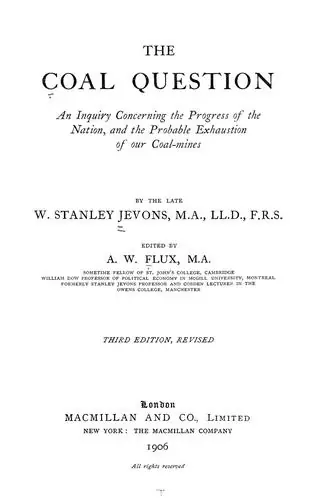
The coal question
by William Stanley Jevons, Alfred William Flux · first published 1865
12mentions
1recommended by
5HN commenters
2013–2026first – last mentioned
20% recommend80% neutral
Affiliate links. As an Amazon Associate I earn from qualifying purchases.
…An activity which already by the late 1700s was recognised as unsustainable (John Williams, A Natural History of the Mineral Kingdom, 1789). Discussed at greater length in William Stanley Jevons' The Coal Question: https://archive.org/stream/coalquestioninqu00jevo#page/14/mo...
on “King Tut's dagger blade made from meteorite, study confirms” ↗…on Earth. It's also hardly a "green" or "liberal" viewpoint: the finite nature of fossil fuels was realized quite early in the Industrial Revolution. William Stanley Jevons is often mentioned ("The Coal Question", 1865), but he was beat by 76 years by John Williams, "The Limited Quantity of Coal in Britain", 1789. More recently, M. King Hubbert (petroleum engineer), Hyman Rickover (US Navy admiral), and Colin…
on “Our Newfound Fear of Risk” ↗…of energy, though it's not particularly storeable. This has been suggested and explored by numerous economists and others since the early Industrial Revolution, notably: William Stanley Jevons (The Coal Question (1865)), US Navy Rear Admiral Hyman G. Rickover, Kenneth Boulding, Nicholas Georgescu-Roegen, Charles Odum, Charles A.F. Hall, and others. Generally, "thermoeconomics", "biophysical economics", or "ecological…
on “Investors must recognize what ‘this time it’s different’ really means” ↗…will lower resource consumption, ignoring the possibility of the paradox arising.[3] […] > The Jevons paradox was first described by the English economist William Stanley Jevons in his 1865 book The Coal Question. Jevons observed that England's consumption of coal soared after James Watt introduced the Watt steam engine, which greatly improved the efficiency of the coal-fired steam engine from Thomas Newcomen's…
on “How many radioactive bananas would you need to power a house?” ↗…Stanley Jevons, no raving left-wing radical himself (he's a father of the "marginal revolution" of economics on which much of neoclassical economics is based) wrote of this in 1865 in a book called The Coal Question, asking what would happen when Britain exhausted its admittedly considerable stores of coal. It begins: DAY by day it becomes more evident that the Coal we happily possess in excellent quality and abundance…
on “You should be amazed” ↗…been aware of ... for a fairly long time ... is that the very things which have given us an advanced industrial civilization cannot continue unabated forever. William Stanley Jevons wrote of this in The Coal Question in 1865, and referenced works back to 1789 (John Williams, "The Limited Quantity of Coal in Britain"). The alarm's been pulled repeatedly since (CO2 induced global warming: 1932, peak oil: 1945, 1956,…
on “The Ocean is Broken (2013)” ↗Somewhat more substantively, so were William Stanley Jevons, in The Coal Question (1857),[1] and earlier by John Williams, a mineral surveyor, in Natural History of the Mineral Kingdom (1789).[2] Thing is that since the time of Jevons, the only energy sources added to our knowledge…
on ““Energy in the Future”: a time capsule of energy concerns from 1953” ↗…1865, is similar to the 20th century worry of Peak Oil. > Are we wise in allowing the commerce of this country to rise beyond the point at which we can long maintain it? Jevons, William Stanley. The Coal Question: An Inquiry Concerning the Progress of the Nation, and the Probable Exhaustion of Our Coal Mines. Macmillan and Co., 1865.
on “FAA Authorizes Zipline to Deliver Commercial Packages Using Drones” ↗I assume the reference was to the Jevons paradox, as described in Jevons' 1865 book, "The Coal Question". Watt's steam engine massively increased the efficiency of coal in steam engines, which increased the use of coal fired steam engines, which increased coal consumption.
on “AI Companies Are Trying to Hide a Staggering Amount of Debt” ↗…increase prices and decrease efficiency. The fact that increased efficiency increases overall production has long been noted, William Stanley Jevons is credited with describing his eponymous paradox in The Coal Question, 1865. Oil's price is another problem. Carbon taxes address externalities on the consumption side, but in extraction, I'm coming to the conclusion that typical market forces tend to ignore, to their…
on “America’s Never-Ending Oil Consumption” ↗…https://en.wikipedia.org/wiki/Jevons_paradox I have questions. So then why did paper usage eventually plummet? Given long enough time frame, is Jevons Paradox a phase? 150 years after Jevons book The Coal Question, coal consumption is finally tanking. Decades after the start of data processing and office automation, paper usage finally tanked. Is this generalizable? Clearly software bloat (and by extension web…
on “HTTP/3 Is Fast” ↗…first question would be what examples of falling input prices not subject to the Jevons Paradox are. Several of the more notorious ones involve energy, and that was Jevons's principle topic of study (The Coal Question most notably). I've got my own theory of how technological mechanisms function, with an ontology of nine elements. Fuels are one of those, information is another. See prior comments: <https://hn.algolia.com/?dateRange=all&page=0&prefix=false&qu...>…
on “Nvidia’s $589B DeepSeek rout” ↗