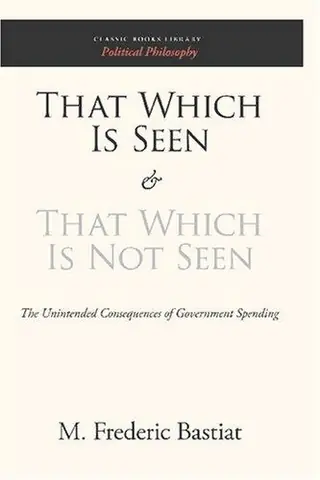
That Which Is Seen and That Which Is Not Seen
by Frédéric Bastiat · first published 2006
64% recommend36% neutral
Why HN recommends it
Short essay on hidden costs and unintended consequences: the broken window fallacy, opportunity cost, taxes, war, and automation. Suits anyone who wants to think through second-order effects like an economist.
Summarised by Claude from recommending comments
Affiliate links. As an Amazon Associate I earn from qualifying purchases.
Mentions per year
What Hacker News says
Related books
 2010–2026
The Problems of Philosophy
Bertrand Russell
Recommended by 17 · mentioned by 2617 recommend · 26 mention17 recommend · 2617 recommend
 2008–2025
The Law
Frédéric Bastiat
Recommended by 17 · mentioned by 2417 recommend · 24 mention17 recommend · 2417 recommend
 2016–2026
Rise and Fall of American Growth
Robert J. Gordon
Recommended by 24 · mentioned by 3724 recommend · 37 mention24 recommend · 3724 recommend
 2008–2026
The Jungle
Upton Sinclair
Recommended by 32 · mentioned by 13632 recommend · 136 mention32 recommend · 13632 recommend
 2010–2026
Thinking in systems
Donella H. Meadows, Diana Wright
Recommended by 124 · mentioned by 163124 recommend · 163 mention124 recommend · 163124 recommend
 2007–2026
Economics in One Lesson
Henry Hazlitt
Recommended by 107 · mentioned by 147107 recommend · 147 mention107 recommend · 147107 recommend
 2007–2026
Das Kapital
Karl Marx
Recommended by 40 · mentioned by 19140 recommend · 191 mention40 recommend · 19140 recommend
 2007–2026
Dune
Frank Herbert
Recommended by 193 · mentioned by 512193 recommend · 512 mention193 recommend · 512193 recommend
…Never. I'd like to see a clear argument why the internet, the mobile revolution and the ongoing automation going around us is going to kill more jobs than it creates. I urge people to read Bastiat's "That Which is Seen, and That Which is Not Seen". You'll understand that the implications are never THAT simple not predictable. http://bastiat.org/en/twisatwins.html ---> about your second point: The article may not say that directly, but the…
on “How Computers Are Creating a Second Economy Without Workers” ↗Please don't. Taxing is evil and has unintended consequences. Just charge for road use instead. * For reference on unintended consequences of taxation I recommend Frédéric Bastiat's "That Which Is Seen, and That Which Is Not Seen" essay. Link: http://bastiat.org/en/twisatwins.html (you can just jump to 'Taxes' or - better - read the whole thing as it is very interesting and not that long). He's more recognized for the Broken…
on “Self-driving cars will "cruise" to avoid paying to park” ↗War is destruction. People who claim that war somehow creates wealth are profoundly idiotic, to say the least. Reference: "That Which is Seen, and That Which is Not Seen", by Frédéric Bastiat, in English [1] and the original in French [2] (Ce qu'on voit et ce qu'on ne voit pas) [1] http://bastiat.org/en/twisatwins.html [2] http://bastiat.org/fr/cqovecqonvp.html
on “The Lack of Major Wars May Be Hurting Economic Growth” ↗I vote for this collection of Claude Frédéric Bastiat: https://mises.org/library/bastiat-collection. In particular the leading essay, "That Which Is Seen, and That Which Is Not Seen." It may be the quintessential statement of how to think like an economist. The article includes a popularization of it as "Economics in One Easy Lesson" but here's the original source, free, clear and…
on “Books to Understand Economics” ↗Economics: - The Wealth of Nations, Adam Smith - Das Kapital, Karl Marx - That Which Is Seen, and That Which Is Not Seen, Frederic Bastiat Philosophy / Politics: - The Republic, Plato - Second Treatise on Government, John Locke - The Law, Frederic Bastiat - Leviathan, Thomas Hobbes - Meditations, Marcus Aurelius -…
on “Ask HN: What are your favorite books or essays written at least 100 years ago?” ↗…been used to produce other goods. If that's the case then a ban on incandescent light bulbs has a hidden cost. You shouldn't look only at the visible effects but also at those invisible. A great essay That Which is Seen, and That Which is Not Seen [1] by Frederic Bastiat comes to my mind. It explores this kind of situations. [1] http://bastiat.org/en/twisatwins.html
on “The Great Lightbulb Conspiracy” ↗This reminds me of Frédéric Bastiat and his essay "That Which is Seen, and That Which is Not Seen". Nicely formatted at http://bastiat.org/en/twisatwins.html The article notes that "It’s often easier to identify when people didn’t adequately consider the second and subsequent order impacts." That…
on “Second-Order Thinking: What Smart People Use to Outperform (2016)” ↗…economy, it needs to get money from the economy. No additional value is created; the cycle is only perpetuated. Frederic Bastiat, who developed the notion of opportunity cost, said it best in his essay That Which is Seen and That Which is Not Seen. It is easy to see the benefits of government spending when it arises (contracts going to construction workers, teachers, etc), but much harder to see the tradeoff of where that money is not being spent;…
on “Ask HN: Thoughts on private versus government spending (for growth)?” ↗You're committing one of the oldest and most common Economic fallacies, the "Broken Window Fallacy". Bastiat's "That which is seen and that which is not seen"[1] or Hazlitt's "Economics in One Lesson" would help clear up your confusion, or just a good treatment of the Broken Window Fallacy[2]. [1]http://bastiat.org/en/twisatwins.html [2]http://www.investopedia.com/ask/answers/08/broken-window-fal...
on “2010: Cyberpunk World” ↗Bastiat provides a nice counter point to all that. But I'm too lazy to copy and paste the whole thing here. I'll just suggest reading The Law and/or That Which is Seen, and That Which is Not Seen if you haven't, for another take on things. Note though that there's a lot of subtlety to this whole thing, and Bastiat appears to allow for some notion of lawful taxation, but it's pretty clear that…
on “Unnecessariat” ↗There might also be a net loss to society for any number of reasons, Bastiat's That Which is Seen, and That Which is Not Seen is of special interest here.
on “Heat loss from big corporate projects” ↗Interesting fact: Economics in One Lesson is an extended meditation on Frédéric Bastiat's classic essay "That Which is Seen, and That Which is Not Seen." Part of Hazlitt's goal was to make Bastiat's ideas more modern and accessible. However, enough time has passed that some of his examples are a bit dated. I actually prefer the original. Bastiat is a…
on “Ask HN: What books changed the way you think about almost everything?” ↗It’s a very good intro to economics. However, I generally recommend instead reading the work that it’s based on: That Which is Seen, and That Which is Not Seen by Frédéric Bastiat. [1] Bastiat’s work is timeless, whereas Hazlitt’s, written to be consciously modern at the time, is showing it’s age. [1] http://bastiat.org/en/twisatwins.html
on “Books to Understand Economics” ↗It's one of my favorite reads, That Which Is Seen, and That Which Is Not Seen [1]. Bastiat was stunningly brilliant. [1]http://bastiat.org/en/twisatwins.html
on “Parable of the Broken Window” ↗…wrestled over since humans figured out that houses are nicer than caves. Cities need both taxes and sewers to survive, but too much of either will stink enough to drive off anyone who can. Take a peek at That Which is Seen and That Which is Not Seen [1]. Bastiat had his head screwed on straight for a Frenchman, and had it figured out in 1850. [1] http://bastiat.org/en/twisatwins.html
on “‘America does so much more to subsidise affluence than alleviate poverty’” ↗