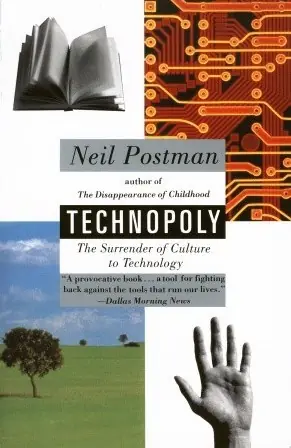
Technopoly
The Surrender of Culture to Technology
by Neil Postman · first published 1992
67% recommend29% neutral4% critical
Why HN recommends it
Examines how technology reshapes culture and values, and why societies adopt tools without weighing consequences. Suits readers wanting a more accessible critical lens on tech than Ellul, with questions to ask.
Summarised by Claude from recommending comments
With characteristic wit and candor, Neil Postman, our most astute and engaging cultural critic, launches a trenchant--and harrowing--warning against the tyranny of machines over man in the late twentieth century. We live in a time when physical well-being is determined by CAT scan results. Facts need the substantiation of statistical study. The human mind needs "deprogramming" while computers catch devastating "viruses." We live, then, in a Technopoly -- a self-justifying, self-perpetuating system wherein technology of every kind is cheerfully granted sovereignty over social institutions a
Affiliate links. As an Amazon Associate I earn from qualifying purchases.
Mentions per year
What Hacker News says
Related books
 2008–2026
Amusing Ourselves to Death
Neil Postman
Recommended by 174 · mentioned by 306174 recommend · 306 mention174 recommend · 306174 recommend
 2012–2026
Four arguments for the elimination of television
Jerry Mander
Recommended by 6 · mentioned by 86 recommend · 8 mention6 recommend · 86 recommend
 2018–2025
The myth of the machine
Lewis Mumford
Recommended by 5 · mentioned by 65 recommend · 6 mention5 recommend · 65 recommend
 2010–2025
The medium is the massage
Marshall McLuhan
Recommended by 10 · mentioned by 2610 recommend · 26 mention10 recommend · 2610 recommend
 2010–2026
Technics and civilization
Lewis Mumford
Recommended by 12 · mentioned by 2012 recommend · 20 mention12 recommend · 2012 recommend
 2010–2026
Propaganda
Jacques Ellul
Recommended by 10 · mentioned by 1610 recommend · 16 mention10 recommend · 1610 recommend
The medium is the message
Marshall McLuhan
Recommended by 5 · mentioned by 215 recommend · 21 mention5 recommend · 215 recommend
 2009–2026
The Technological Society
Jacques Ellul
Recommended by 36 · mentioned by 5236 recommend · 52 mention36 recommend · 5236 recommend
Technopoly by Neil Postman Industrial society and it's future by Theodore Kaczynski Both these books drastically changed my perception of technology. The role we think it has and the effects and consequences it…
on “Ask HN: Mind bending books to read and never be the same as before?” ↗Responsibility and limits are key. Be responsible for what you through into the Internet, and make sure you take time off. Also, read! Technopoly: the Surrender of Culture to Technology by Neil Postman And theorist Vilem Flusser was an amazing philosopher who forecasted the ways of the Internet before the Internet was mainstrem.
on “The Coming Anti-Tech Counterculture” ↗You might be interested in Neil Postman's Technopoly: http://www.amazon.com/Technopoly-Surrender-Technology-Neil-P... It reasons along a similar vein.
on “Humanist among machines” ↗…such rapid changes inevitably break down traditional values." I think this is roughly valid in the context of technology changes they way we live in unpredictable ways. A much better read of this is Technopoly by Neil Postman. I tend to agree that the society critique parts read like an angry rant against society, that a structured critique. It's unfortunate these subjects don't get discussed openly (the manifesto…
on ““Industrial Society and its Future”: the writings of the Unabomber” ↗If you haven't read it, Technopoly is really great. It outlines some of the unintended consequences of what you mention. Technology has an effect of changing how you see the world. In ancient times of oral history everything was a song.…
on “Neil Postman: Things We Need to Know About Technological Change (1998) [pdf]” ↗I think it's important to think about the effect technology has on culture (both positive and negative). To that end, I would recommend _Technopoly_ by Neil Postman. (And optionally _Amusing Ourselves to Death_ by the same author -- it's more accessible but slightly less applicable to the software industry.)
on “Ask HN: What books do you wish your manager would read?” ↗"Technopoly" by Neil Postman focusses on how technologies influence cultures. Postman taught at NYU for decades. He was not anti-technology - he said we need technology like we need food - but he was critical. He…
on “Ask HN: Good Books on the History of Technology?” ↗…worth it for the quotes from "David Noble['s] 1997 book The Religion of Technology." I'll have to check that out, because everything quoted there rings very true. Another good book in the same vein is Technopoly by Neil Postman: https://en.wikipedia.org/wiki/Technopoly. > There’s ample evidence that neither Andreessen, nor Musk, nor any of the rest of them will be able to realize the futures they promise. Those…
on “The Religion of Techno-Optimism” ↗Agreed about Huxley. Neil Postman covers many of the same themes in his non-fiction work. Technopoly in particular is a good read. Atlas Shrugged is _not_ a message I think our age is lacking however. I enjoyed it as a kid, but it's pretty clear capitalism and selfishness are enjoying the commanding…
on “Seattle School Board votes to keep 'Brave New World' on curriculum” ↗Do you have some recommended reading? I enjoyed reading Neil Postman’s Technopoly, but any contemporaries you find particularly insightful?
on “The Social Dilemma” ↗Everyone should read Neil Postman's Technopoly and Amusing Ourselves To Death. Postman's 6 questions about technology: 1. “What is the problem to which this technology is the solution?” 2. “Whose problem is it?” 3. “Which people and what institutions…
on “Doug Rushkoff Is Ready to Renounce the Digital Revolution” ↗Kelly's basic argument is that, yes, the Unabomber was fundamentally correct in his understanding of the tension involved in a technopoly (a society where technology is no longer a tool but actually driving the society--read Neil Postman's book of that name for a good read), but that he (Kelly) disagrees with what to do about it. Obviously,…
on “KK on Unabomber: pounce on [technology] when it is down and kill it before it rises again” ↗Please do yourselves a favour and look up Neil Postman. I can recommend "Amusing Ourselves to Death" and "Technopoly", in particular.
on “We’re creating a culture of distraction” ↗…who's too blinded by the shiny new thing... Technophile, as coined by Neil Postman. -- My early disappointment, disillusion with technology was largely validated and informed by Neil Postman's book Technopoly. http://en.wikipedia.org/wiki/Technopoly Computers et al were supposed to make everything better, right? Why are my users still struggling? Why after a decade and 100s millions of dollars are we still…
on “Alan Kay on Marshal McLuhan and the Personal Computer” ↗…Television, which is an ad-man's perspective on what is fatally flawed with his own industry. See also his later book, The Capitalism Papers. And of course, Neil Postman's Amusing Ourselves to Death and Technopoly. There've been a number of recent HN posts on how bloated websites are becoming, and how content is being watered down on the Web. Pretty much all of this can be traced to the current funding mechanism:…
on “Is Advertising Morally Justifiable? The Importance of Protecting Our Attention” ↗