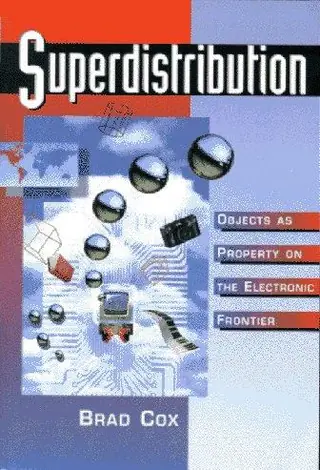
Superdistribution
by Brad J. Cox · first published 1995
17% recommend83% neutral
Affiliate links. As an Amazon Associate I earn from qualifying purchases.
Mentions per year
What Hacker News says
Related books
 2012–2026
Object-oriented programming
Brad J. Cox
Recommended by 4 · mentioned by 134 recommend · 13 mention4 recommend · 134 recommend
 2014–2026
Stoner
John Williams
Recommended by 19 · mentioned by 2419 recommend · 24 mention19 recommend · 2419 recommend
 2008–2026
Limits to Growth
Donella H. Meadows, Dennis Meadows, Jorgen Randers, Dennis L. Meadows
Recommended by 19 · mentioned by 7819 recommend · 78 mention19 recommend · 7819 recommend
 2007–2026
Blood Meridian
Cormac McCarthy
Recommended by 105 · mentioned by 192105 recommend · 192 mention105 recommend · 192105 recommend
 2008–2026
The Brothers Karamazov
Fiódor Dostoievski, Constance Garrett
Recommended by 86 · mentioned by 18786 recommend · 187 mention86 recommend · 18786 recommend
 2008–2026
The making of the atomic bomb
Richard Rhodes
Recommended by 117 · mentioned by 161117 recommend · 161 mention117 recommend · 161117 recommend
 2007–2026
Zen and the Art of Motorcycle Maintenance
Robert M. Pirsig
Recommended by 302 · mentioned by 508302 recommend · 508 mention302 recommend · 508302 recommend
 2007–2026
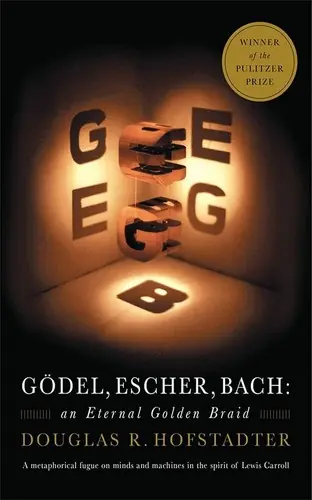
Gödel, Escher, Bach
Douglas R. Hofstadter
Recommended by 505 · mentioned by 1,055505 recommend · 1,055 mention505 recommend · 1,055505 recommend
Brad Cox's two books are worth reading: "Object-Oriented Programming: An Evolutionary Approach" ISBN-10: 0201548348 ISBN-13: 978-0201548341 "Superdistribution: Objects as Property on the Electronic Frontier" ISBN-10: 0201502089 ISBN-13: 978-0201502084 even after all these years, they still give some interesting insights
on “Java Was Strongly Influenced by Objective-C” ↗Not in 2014, but I think they are worth reading: Brad Cox: Superdistribution: Objects as Property on the Electronic Frontier Brad Cox: Object-Oriented Programming: An Evolutionary Approach Jason Brennan: Why Not Capitalism? Leo Brodie: Thinking Forth
on “Ask HN: What book changed your life in 2014?” ↗While you are looking, Brad Cox’s other book Superdistribution: Objects as Property on the Electronic Frontier is well worth a read to get a feel for where he wanted to go.
on “Bringing Objective-C to the Amiga” ↗Yeah, but I think Brad Cox deserves to be named. As a side note he has two really good (if a bit dated) books: "Object-oriented programming ; an evolutionary approach" and "Superdistribution: Objects as Property on the Electronic Frontier".
on “The Lisp Curse (2011)” ↗For more of Brad Cox's thinking see his book "Superdistribution: Objects as Property on the Electronic Frontier".
on “The origins of Objective-C at PPI/Stepstone and its evolution at NeXT” ↗…and has two very interesting books. Object-Oriented Programming: An Evolutionary Approach - this one covers an early version of Obj-C http://www.amazon.com/Object-Oriented-Programming-An-Evoluti... Superdistribution: Objects as Property on the Electronic Frontier - economics of software components - http://www.amazon.com/Superdistribution-Objects-Property-Ele...
on “In praise of Objective C” ↗More on another of Cox's signature ideas – about which he wrote a book[1] – 'Superdistribution': http://archive.wired.com/wired/archive/2.09/superdis_pr.html The gist is to stop charging for software (including subcomponents like shared libraries and reusable objects) per copy, or by copy-based-licensing.…
on “Interview with Brad Cox, the Man Behind Objective-C (2009)” ↗This book? https://www.amazon.com/Superdistribution-Objects-Property-El... Strong vibes of the dot-com era reading the description but there's probably one or two insights there worth revisiting. Ordered! :)
on “Launch HN: Lago (YC S21) – Open-source usage-based billing” ↗…"thinking forth", "Computer Lib" by Ted Nelson, etc. They are well known to some audiences but not others. ---- I also enjoy reading what people though the computing future would be like. I have "Superdistribution" by Brad Cox: https://news.ycombinator.com/item?id=21833331 And "Mirror Worlds" by Gelertner: https://www.amazon.com/Mirror-Worlds-Software-Universe-Shoeb... I'm pretty sure Gelertner claims that…
on “Ask HN: What are the best unknown books you have read?” ↗…to be somewhat clumsy, and there had always been a successful niche for languages like Snobol and now Perl. Brad Cox was a splendid conversationalist in many other areas as well. His talk focused on Superdistribution as the next evolution of the Software IC concept, and he very skillfully pitched this to a Swiss audience that a banking nation should be a natural superpower to take the lead in a micropayment world.…
on “Brad Cox has died” ↗…the fringes – where new capabilities emerge – there'd be openings for new entrants. (In fact, the implied functionality/market model reminds me a bit of two old dreams of the software future: • the 'Superdistribution' concept of Objective-C-creator Brad Cox • the composite-document approach of Apple's early-90s OpenDoc initiative Each saw future software being an assemblage of capabilities from many sources, enabling…
on “Google, Mozilla Team Up to Create a Smarter, Action-Based Web” ↗Brad Cox laid out a scheme similar to this in hopes of solving the software crisis, in his 1995 book Superdistribution. Now, it wasn't really technically feasible when software was local and native, but in the cloud era it makes a lot more sense. I've personally felt the pain of creating a bespoke multitiered billing…
on “Launch HN: Lago (YC S21) – Open-source usage-based billing” ↗