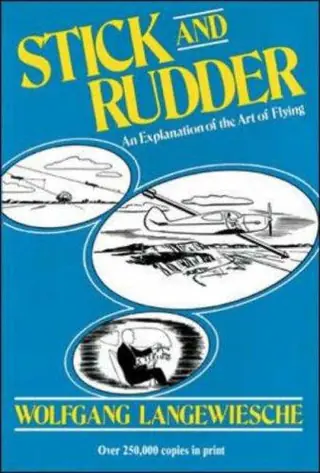
Stick and Rudder
by Wolfgang Langewiesche · first published 1972
28mentions
19recommended by
25HN commenters
2010–2025first – last mentioned
76% recommend24% neutral
Why HN recommends it
Explains how airplanes fly and why they respond to controls, building intuition for angle of attack, stability and control through vivid analogies rather than engineer-speak; suits student pilots and curious readers.
Summarised by Claude from recommending comments
Affiliate links. As an Amazon Associate I earn from qualifying purchases.
…dismissively. "Just step on the ball" she recited, referring to the turn-and-bank indicator. No thank you, I'd rather know what's keeping my plane stable, so I found the answer elsewhere: Langewiesche's awesome Stick and Rudder, still relevant 70 years after publication.
on “Reflecting on Haskell in 2015” ↗…surface of the Atlantic Ocean. But that is what happened. And I thought that name sounded familiar. William is the son of Wolfgang Langewiesche, author of one of the books that taught me how to fly: Stick and Rudder. https://en.wikipedia.org/wiki/Stick_and_Rudder
on “The Worst U.S. Maritime Disaster in Decades” ↗Exactly this. The Langewiesche legacy goes back to his father Wolfgang Langewiesche, who is also a terrific writer, incidentally about probably still the best book about flying fixed wings, Stick and Rudder (1936). But flying has moved on a lot since then. Although I also appreciate "The story of Mel", computing has moved on so far from moving some bits and bytes on a drum memory, that I absolutely prefer…
on “My Letter to the Editor of New York Times Magazine” ↗I have Wolfgang Langewiesche's _Stick and Rudder_, a classic book for pilots on how to fly airplanes, sitting on a shelf near me. According to Wikipedia, the author of this article is his son.
on “The Turn (1993)” ↗…died out for larger aircraft partly because the slanted cabin when on the ground was inconvenient. The DC-3 was the last successful tail-dragger airliner. Wolfgang Langewiesche, in his 1944 classic, "Stick and Rudder", writes that the tail-dragger arrangement is a poor landing gear, but a good takeoff gear for underpowered aircraft. It gives the effect of flaps on takeoff for planes that don't have flaps. Tail-draggers…
on “When the plane takes off, why doesn’t the tail hit the runway?” ↗This book is also available as a boxer set with Weather Flying Robert Buck and Instrument Flying by Taylor. The first of those is almost as good as Stick and Rudder.
on “Stick and Rudder: An Explanation of the Art of Flying (1944)” ↗A friend of mine wrote: "I don't know whether you recognized the name of the author. He is a well-known aviation writer and journalist, and the son of Wolfgang Langeweische, author of the book Stick and Rudder. Stick and Rudder has been the bible for pilots of how planes fly since its publication in the 1940s."
on “What Really Brought Down the Boeing 737 Max?” ↗…pilot, I would like to recommend to ANYone interested in anything involving air as a fluid, the absolutely amazingly written (the man has absolutely beautiful analogies at every paragraph of the book) 'Stick and Rudder' by Wolfgang Langewiesche just my 3.5 (inflated) cents
on “Launch HN: OutSail (YC W23) – Wingsails to reduce cargo ship fuel consumption” ↗…maps. I visited every airport within 500 miles of Meigs Field. I flew in all kinds of weather. I bought every extra option. I visited local pro shops and bought a dozen flying books. I highly recommend "Stick and Rudder by Wolfgang Langewiesche". Best book ever. I took private pilot flying lessons and knew exactly how to fly. I pre-paid for the new MS Flight Simulator. I bought pedals and a yoke. I bought a new, high-end…
on “Microsoft Flight Simulator 2024” ↗I was inspired by Stick & Rudder, which is a very easy book to recommend to most people in this community. I'm sure I'll keep coming back to make adjustments, but the end result is what I hoped to achieve. The Charter font was a particularly good find as part of the "transitional" system font stack. I'll definitely use it for other projects in the future.
on “Exploring the design space of binary search trees” ↗…much more sensory input available. Because of this, you are likely to teach yourself bad habits in the simulator that will be expensive to unlearn in a real airplane. If you insist on doing it, read "Stick And Rudder" first: https://books.google.com/books?vid=ISBN9780070362406 As other comments have observed, the most motivated students tend to be the ones who go to the extra trouble to use simulators: it is possible…
on “Can Microsoft Flight Simulator help me learn to fly or make me a better pilot?” ↗…but it is hard for me to figure out why. Maybe something is lost in the "pedagogy" of many modern textbooks. I'll read such books about pretty much any topic just for pleasure. An all-time favorite is "Stick and Rudder" by Wolfgang Langewiesche, although a very different topic, obviously.
on “Public domain technical books published before 1964” ↗As the article notes, besides his own extensive career as an author of aviation literature and analysis, he is he son of Wolfgang Langewiesche, whose book “Stick and Rudder” probably provides the most layperson accessible explanation of aircraft stability and control. https://www.docdroid.net/IevViY7/stick-and-rudder-an-explana...
on “William Langewiesche, the 'Steve McQueen of Journalism,' Dies at 70” ↗…if you're really into geology. William Langewiesche had a similar style. He died recently, and leaves behind some good writing on aviation. He was the son of Wolfgang Langewiesche, known for writing "Stick and Rudder", a very well written book for pilots on how airplanes really work.
on “The McPhee method for writing deeply reported nonfiction” ↗Stick and Rudder is the best read out there if you want an intuitive pilots understanding of what happened here. It unpacks angle of attack from a pilots perspective rather than using engineer speak. At that speed the…
on “The slowest SR-71 Blackbird fly-by” ↗