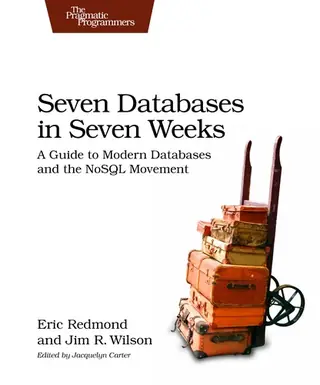
Seven Databases in Seven Weeks
by Eric Redmond · first published 2012
57% recommend43% neutral
Why HN recommends it
Brief, well-organized introduction to a range of modern databases and the NoSQL movement, giving a useful overview of how the different database types compare; suited to developers new to databases.
Summarised by Claude from recommending comments
Redis, Neo4J, Couch, Mongo, HBase, Riak, and Postgres: with each database, you'll tackle a real-world data problem that highlights the concepts and features that make it shine. You'll explore the five data models employed by these databases: relational, key/value, columnar, document, and graph. See which kinds of problems are best suited to each, and when to use them. You'll learn how MongoDB and CouchDB -- both document oriented datastores that harness the power of JavaScript -- are strikingly different. Learn about the Dynamo heritage at the heart of Riak and Cassandra. Understand MapReduce
Affiliate links. As an Amazon Associate I earn from qualifying purchases.
Mentions per year
What Hacker News says
Related books
 2012–2021
Blood Song
Anthony Ryan
Recommended by 4 · mentioned by 44 recommend · 4 mention4 recommend · 44 recommend
 2010–2026
Rising Up and Rising Down
William T. Vollmann
Recommended by 3 · mentioned by 43 recommend · 4 mention3 recommend · 43 recommend
 2010–2026
Database systems
Hector Garcia-Molina, Jeffrey D. Ullman, Jennifer D. Widom
Recommended by 11 · mentioned by 1611 recommend · 16 mention11 recommend · 1611 recommend
 2012–2026
The Signal and the Noise
Nate Silver
Recommended by 47 · mentioned by 7947 recommend · 79 mention47 recommend · 7947 recommend
 2012–2026
The Expanse
James S. A. Corey, Hallie Lambert, Georgia Lee
Recommended by 34 · mentioned by 4834 recommend · 48 mention34 recommend · 4834 recommend
 2010–2026
Racing the Beam
Nick Montfort, Ian Bogost
Recommended by 39 · mentioned by 4839 recommend · 48 mention39 recommend · 4839 recommend
 2008–2026
Count Zero
William Gibson
Recommended by 26 · mentioned by 8526 recommend · 85 mention26 recommend · 8526 recommend
 2010–2025
The Joy of Clojure
Michael Fogus, Chris Houser
Recommended by 72 · mentioned by 11772 recommend · 117 mention72 recommend · 11772 recommend
Seven Databases in Seven Weeks: A Guide to Modern Databases and the NoSQL Movement http://www.amazon.com/Seven-Databases-Weeks-Modern-Movement/... Not the kind of short cut book that it may lead you to think. The book is a brief introduction…
on “Ask HN: Best books you read in 2012” ↗I can't recommend enough the book Seven Databases in Seven Weeks by Eric Redmond & Jim Wilson. It covers the whole range of different types of databases, with just a little bit of theory (the CAP theorem).
on “Ask HN: How do I get a better understanding of NoSQL databases” ↗Seven Databases in Seven Weeks https://pragprog.com/book/rwdata/seven-databases-in-seven-we... Designing Data Intensive applications http://dataintensive.net/
on “Ask HN: Learning NoSQL, papers and books” ↗I strongly recommend the book "Seven Databases in Seven Weeks" if you want to understand a bit of "theory" around databases. The first chapter focuses on a relational database, PostgreSQL, but by learning about the other types (columnar, document-store, graph,…
on “Ask HN: Relational Databases and Concepts” ↗There are a number of textbooks on Database Implementation.I used one from 1999. You should probably read "Seven Databases in Seven Weeks" to learn about the different kinds of DBs. Basically, a DB is just some very large data structures with optimized access algorithms. There are a number of open source DBs, reading the code will be a…
on “Ask HN: How can I learn how to write my own DB system?” ↗The book "Seven Databases in Seven Weeks" may be a good start. It may not answer all of your questions, but it does a good job summarizing various types of databases. Honestly you can read through it in a day or two - I don't think there's much…
on “The Abandoned Facebook Tech That Now Helps Power Apple” ↗…language and you can use it for all kinds of other stuff too. If you don't know databases yet, I would think that PostgreSQL or MongoDB would make a good project for a few days. There's this book called "Seven Databases in Seven Weeks" which is outstanding, but I'm not sure you can use it offline because the book itself doesn't explain how to install or troubleshoot the databases. (There are other books in this series: "Seven Programming…
on “What new language/tool to teach myself in 1 week with no Internet connection?” ↗A very good book i've read on the subject is "seven databases in Seven Weeks" by E. Redmon and Jim Wilson. It doesn't cover everything because there is too much out there but it gives you the base and make you realize the importance between types of database.
on “Ask HN: Books on data modeling and how to select a database for a given problem” ↗If you enjoy this sort of exploration and comparison of databases and want more, I can't recommend the book Seven Databases in Seven Weeks enough. https://pragprog.com/book/rwdata/seven-databases-in-seven-we...
on “A Postgres Perspective on MongoDB” ↗You might try "Seven Databases in Seven Weeks". It's a few years old now but still solid.
on “The Infrastructure Behind Twitter: Scale” ↗…yet, or rephrased a deep enough analysis has so far always excluded nosql solutions and that Might indicate a positive analysis isn't deep enough. Hear hooves, think horses not zebras. I've bought the "seven databases in seven weeks" book and its an excellent introduction unfortunately its something like a guided introduction into smooshing up against the business requirements limits of each DB as much as a technical intro. Another…
on “Ask HN: What made SQL databases so popular?” ↗From reading Redmond & Wilson's book "Seven Databases in Seven Weeks", my impression is that the CAP Theorem is a big idea (essentially, you get two choose any two: consistency, availability, and partition-tolerance). Relational databases have to be "consistent", i.e.…
on “Why The Clock is Ticking for MongoDB” ↗"Good Math: A Geek's Guide to the Beauty of Numbers, Logic, and Computation" by Mark C. Chu-Carroll "Seven Databases in Seven Weeks: A Guide to Modern Databases and the NoSQL Movement" by Eric Redmond and Jim R. Wilson "The Joy of Clojure, Second Edition" by Michael Fogus and Chris Houser
on “Ask HN: What book are you reading right now?” ↗I'm currently reading Seven Databases in Seven Weeks [1] and finding it to be a really fun and interesting look at some tech I don't know much about. I'm wondering what other interesting books there are out there that focus less on teaching you all the…
on “Ask HN: Fun Tech Book Recommendations?” ↗…development against easily maintained longevity. I suspect I will move to something more relational but have also taken on the need to really understand the trade-offs I'm making. I've started reading Seven Databases in Seven Weeks to fill in some of my gaps.
on “Does everyone hate MongoDB?” ↗