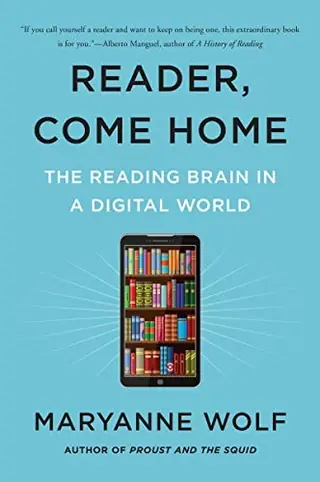
Reader, Come Home
The Reading Brain in a Digital World
by Maryanne Wolf · first published 2018
64% recommend36% neutral
Why HN recommends it
Explores how digital reading changes the way the brain processes text, drawing on research into deep reading and comprehension. Suits readers whose focus or ability to finish books has slipped and want to know why.
Summarised by Claude from recommending comments
Draws on the author's extensive research from "Proust and the Squid" to consider the future of the reading brain and its capacity for critical thinking, empathy, and reflection in today's highly digitized world. A decade ago, Wolf's Proust and the Squid revealed what we know about how the brain learns to read and how reading changes the way we think and feel. Now, in a series of letters, Wolf describes her concerns-- and hopes-- about how digital mediums may be changing our brains. Wolf herself has found that her ability to read deeply has been impacted as she becomes increasingly dependent
Affiliate links. As an Amazon Associate I earn from qualifying purchases.
Mentions per year
What Hacker News says
Related books
 2017–2024
The distracted mind
Adam Gazzaley
Recommended by 3 · mentioned by 33 recommend · 3 mention3 recommend · 33 recommend
 2008–2026
Uncle Tom's Cabin
Harriet Beecher Stowe
Recommended by 6 · mentioned by 646 recommend · 64 mention6 recommend · 646 recommend
 2009–2026
Fahrenheit 451
Ray Bradbury
Recommended by 63 · mentioned by 26563 recommend · 265 mention63 recommend · 26563 recommend
 2008–2026
Amusing Ourselves to Death
Neil Postman
Recommended by 174 · mentioned by 306174 recommend · 306 mention174 recommend · 306174 recommend
 2007–2026
The Wheel of Time
Robert Jordan
Recommended by 57 · mentioned by 20857 recommend · 208 mention57 recommend · 20857 recommend
 2014–2026
The Hard Thing About Hard Things
Ben Horowitz
Recommended by 124 · mentioned by 197124 recommend · 197 mention124 recommend · 197124 recommend
 2008–2026
How to Read a Book
Mortimer J. Adler, Charles Lincoln Van Doren
Recommended by 157 · mentioned by 234157 recommend · 234 mention157 recommend · 234157 recommend
 2012–2026
Antifragile
Nassim Nicholas Taleb, Genís Sánchez Barberán, Albino Santos Mosquera
Recommended by 135 · mentioned by 281135 recommend · 281 mention135 recommend · 281135 recommend
I'm not sure if this is necessarily true. The book Reader, Come Home by Maryanne Wolf actually discusses this. There are quantifiable differences between reading online and reading physically. So much so that even printing out the same journal article can change it. It…
on “Screen time: how much is too much?” ↗I forgot to add that if you're interested in how our reading is changing, Maryanne Wolf's research is great. Her book 'Reader, Come Home: The Reading Brain in a Digital World' gives a great overview of a diverse way of looking at reading. (I haven't read 'Proust and the Squid' yet, by the same author, but I think it touches on similar…
on “Reading in the Age of Constant Distraction” ↗"Reader, Come Home" by Maryanne Wolf is a good book on the topic of how new technology influences our reading habits. https://www.goodreads.com/book/show/35887237-reader-come-hom...
on “Humans who are not concentrating are not general intelligences” ↗I would suggest you read this before you pass a final judgement on books : https://www.amazon.com/Reader-Come-Home-Reading-Digital/dp/0...
on “Ask HN: Are books worth it?” ↗I recently read Reader, Come Home by Maryanne Wolf, which makes many similar arguments, and found myself agreeing with this. I've been finding it harder and harder to lose myself in a book, to finish books, to read as I used to read.…
on “In Praise of Print: Reading Is Essential in an Era of Epistemological Collapse” ↗Regarding the feeling of something missing by reading on electronic devices, expressed in a few comments: Some (not all) answers I was able to find in Maryanne Wolf's book "Reader, Come Home". Main concept there is what she calls deep-reading, a complex back and forth between different brain areas and the hemispheres, that needs time and is replaced by specific forms of skimming on the mentioned…
on “The New Bibliomaniacs” ↗Thank you. Wow, Reader, Come Home sounds very interesting! Now I am reading Reading in the Brain, a book that talks about how brain processes reading. Your suggestion it's a great match to follow it. I really like this topic! Thank!
on “Gin, Television, and Social Surplus (2008)” ↗>Provide some evidence for this claim. This is exactly what Reader, Come Home, by Maryanne Wolf (i.e., the book being reviewed here) does.
on “What we lose by reading 100,000 words every day” ↗In all likelihood the author was asked to write 1200 words to promote her book. Maryanne Wolf is the author of Reader, Come Home: The Reading Brain in a Digital World So I guess the article is supposed to pique your interest sufficiently to then go buy the book. I'm going to side with you here though, the majority of the book…
on “Skim reading is the new normal. The effect on society is profound” ↗…breath as I typed. Going through a couple of different ideas, I landed on typing out what I was reading, every word and every sentence. This leans on Maryanne Wolf's research on "the deep reading brain" (Reader, Come Home) and the cognitive disfluency literature on desirable difficulty (Alter & Oppenheimer 2009). One choice that I found helpful was making the user track their position in the text and scroll on their own…
on “Show HN: Typewryte – Type through classics to read more deeply” ↗- The Shallows - Amusing Ourselves to Death - Reader, Come Home: The Reading Brain in a Digital World
on “Gin, Television, and Social Surplus (2008)” ↗