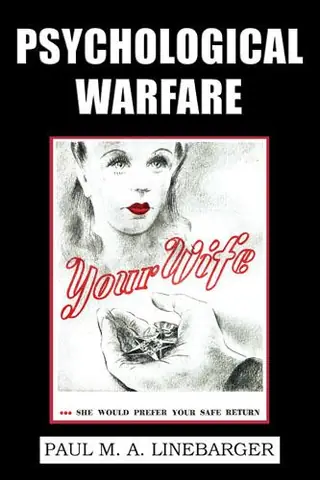
Psychological warfare
by Paul Myron Anthony Linebarger · first published 1948
29mentions
1recommended by
4HN commenters
2015–2026first – last mentioned
25% recommend75% neutral
A classic treatise on psychological warfare's history and operations.
Affiliate links. As an Amazon Associate I earn from qualifying purchases.
Mentions per year
What Hacker News says
Related books
 2023–2024
The best of Cordwainer Smith
Paul Myron Anthony Linebarger
Recommended by 1 · mentioned by 21 recommend · 2 mention1 recommend · 21 recommend
 2014–2026
Expert Political Judgment
Philip E. Tetlock
Recommended by 4 · mentioned by 164 recommend · 16 mention4 recommend · 164 recommend
 2007–2026
The Structure of Scientific Revolutions
Thomas S. Kuhn, Dennis Holland
Recommended by 96 · mentioned by 21596 recommend · 215 mention96 recommend · 21596 recommend
 2011–2026
Thinking, fast and slow
Daniel Kahneman
Recommended by 373 · mentioned by 879373 recommend · 879 mention373 recommend · 879373 recommend
I highly recommend Psychological Warfare (and its development from the 40's to the 50's). Read it, and apply its lessons to itself. I think you'll find that Linebarger has more to say, between the lines, and you'll probably also get a more nuanced…
on “Throngs of Himself: On Paul Linebarger, a.k.a. Cordwainer Smith (2018)” ↗…easier for german soldiers to surrender by giving them a "Surrender Form" to fill out and hand to Allied troops, with all the standard bureaucratic fields they were accustomed to in civilian life. (His Psychological Warfare is well worth reading; not only does he warn the reader up front that PSYWAR operators are not always to be taken at face value, but I believe both 1948 and 1954 versions can be easily be read between…
on “A science fiction obsession led me to psychological war” ↗Linebarger has a nice history with examples going back to biblical times, in his textbook on Psychological Warfare.
…supposed to lead to the recent discussion of the lack of a useful distinction between 2nd person singular and plural in (unlike AAVE) SAE? come to think of it, maybe my fascination with Linebarger's Psychological Warfare is because (delicately speaking of the indelicate*) he argues high-brow theories whose subject matter is convincing people via low-brow rhetoric? > "Ignorance is like a delicate exotic fruit; touch it…
on “The Rise of Post-Literate History” ↗…exploitation of local social graphs is in his description of the techniques used to sell US entry into the Great War/WWI) But there were other authors I consulted in the same timeframe, and Linebarger, in Psychological Warfare (1948) points out that propaganda/public relations men (they were all men, in those days) are less than completely reliable sources when it comes to testimony as to their methods and their efficacy. So…
on “Human behavior on social media is similar to collective behavior in nature” ↗Given that a large part of the subtext (Linebarger* does implore us to habitually analyse all communication as if it might be propaganda) in Psychological Warfare is that "hey, it might really be better if the US Army didn't practice apartheid" (finally ended in practice ca. the 6.25 전쟁), I'd bet the confederate train was supposed to evoke the US Civil War. (let's…
on “What's causing populism around the world? It's the Internet Stupid (Fukuyama)” ↗…the problem of potential totalitarianism: with the many, or with the few? I believe it very difficult with the former, and impossible[3] with the latter. How do you see it? [1] compare Linebarger's Psychological Warfare, in the context of hot war, not peaceful political process: "the defeated people may lose their sense of organization, fail to decide on leaders and methods, and give up because they can no longer fight…
The age of information (and knock-on misinformation) started around 1440. It's quantitatively easier these days, but the qualitative techniques remain recognisable. Remember the Maine! Linebarger's Psychological Warfare (1948) has a history of tradecraft that goes back to biblical episodes. http://www.gutenberg.org/files/48612/48612-h/48612-h.htm flame wars in the seventeenth: "The vocabulary of seventeenth-century…
on “How objectivity in journalism became a matter of opinion” ↗One of the lightly ironic points Linebarger (in his textbook, Psychological Warfare) makes is: never trust a psywar person as a reliable narrator, to accurately and straightforwardly report how effective they may have been. Their déformation professionelle is, after all, self-serving…
on “How the US Hacked ISIS” ↗Of those who repeat the Kremlin line, I am reminded of Linebarger's Psychological Warfare opening chapter, in which he remarks: > In the Chinese San Kuo novel, which has probably been read by more human beings than any other work of fiction, there is preserved the alleged text of the proclamation…
on “Do rural Russians think the war is going well?” ↗…mind of Western civilised man are essentially alike.’ That this was a novel conclusion shocks me, less than a century later! Linebarger makes similar points to what the British discovered here in his Psychological Warfare book I've cited in another thread; reading between the lines he makes a strong, if implicit case, for desegregating the US Army in the 1940s edition (something they would eventually do ~Korea — but still…
on “Dreams Change Under Authoritarianism (2019)” ↗As one of the people "who lost China", Linebarger had some pointed post-mortems in the 1954 Edition of his Psychological Warfare. His reaction to "how could anyone go communist?" was not to say "brainwashing" (an area in which he presumably had professional expertise), but to say "because our counter-offer needs to be better":…
on “The True Story of Brainwashing and How It Shaped America” ↗In Linebarger's book Psychological Warfare, he points out that asking propaganda men (in his defense, they probably were almost all men ca. 1947, and I suspect he may even have referred to specific men, eg Edward Bernays) about their work is highly…
on “Was Modern Art a CIA Psy-Op?” ↗That's also in Linebarger's Psychological Warfare book: they had a great deal of trouble in the mopping up because although Hitler had already realised in Feb 1943 how bad his situation was and the officer corps was certainly aware by Apr 1945 what was…
on “Hymn for Walpurgisnacht” ↗In Psychological Warfare (1948), Linebarger apologises that he (having been subject to army approval for publication) only gives examples of enemy propaganda, but reassures the reader that the Allied departments in which he worked…
on “The Powers of Soviet Puppetry” ↗