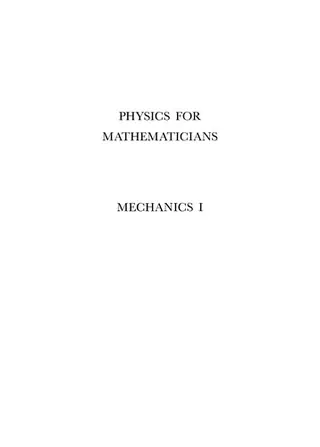
Physics for mathematicians
by Michael Spivak · first published 2010
73% recommend27% neutral
Why HN recommends it
Careful, rigorous build-up of classical mechanics from first principles, with arguments explaining why the mathematics takes the form it does; well suited to mathematicians who want to learn physics.
Summarised by Claude from recommending comments
Affiliate links. As an Amazon Associate I earn from qualifying purchases.
Mentions per year
What Hacker News says
Related books
 2012–2024
College algebra
James Stewart
Recommended by 2 · mentioned by 42 recommend · 4 mention2 recommend · 42 recommend
 2010–2024
Real Mathematical Analysis
Charles Chapman Pugh
Recommended by 8 · mentioned by 98 recommend · 9 mention8 recommend · 98 recommend
 2013–2026
Algebra
Paolo Aluffi
Recommended by 11 · mentioned by 1211 recommend · 12 mention11 recommend · 1211 recommend
 2012–2026
Precalculus mathematics in a nutshell
George Finlay Simmons
Recommended by 10 · mentioned by 1110 recommend · 11 mention10 recommend · 1110 recommend
 2009–2025
Naive Set Theory
Paul R. Halmos
Recommended by 29 · mentioned by 3529 recommend · 35 mention29 recommend · 3529 recommend
 2014–2024
Quantum Mechanics
Leonard Susskind, Art Friedman
Recommended by 9 · mentioned by 139 recommend · 13 mention9 recommend · 139 recommend
 2010–2026
Topology
James R. Munkres
Recommended by 11 · mentioned by 1911 recommend · 19 mention11 recommend · 1911 recommend
 2008–2025
Mathematics for the million
Lancelot Thomas Hogben
Recommended by 19 · mentioned by 2219 recommend · 22 mention19 recommend · 2219 recommend
On the other side of the spectrum, I would recommend Spivak's Physics for Mathematicians [1] strongly. I don't think anything else could come close for a mathematician who wants to learn physics. [] https://www.amazon.com/Physics-Mathematicians-Mechanics-Mich...
on “Mathematics for Physics (2009) [pdf]” ↗…listening or watching instructive material, shouldn't be missed. Feynman's sheer enthusiasm for the material is hard to get across in print. In the spirit of SICP, I also like Spivak's less conventional Physics for Mathematicians [2], but, as the title suggests, this assumes more, or at least different, mathematical prerequisites than most introductory mechanics texts. "Strong undergraduate maths background — at least one course…
on “Ask HN: What Is the SICP of Physics?” ↗Physics for Mathematicians by Spivak is basically the Principia updated to modern prose and rigor.
on “Ask HN: Math books that made you significantly better at math?” ↗Spivak (of differential geometry fame) wrote a book with this precise title: https://archive.org/details/physics-for-mathematicians-mecha... It's a very interesting take on classical mechanics.
on “Physics for Mathematicians – Introduction” ↗Michael Spivak's Physics for Mathematicians has a lot of arguments like the one in the top answer here, answering questions about why the math of classical mechanics is the way it is.
on “Why does kinetic energy increase quadratically, not linearly, with speed? (2011)” ↗Spivaks Physics for Mathematicians is a blessing - even for physicists. and Quantum Field Theory for the gifted amateur is a surprisingly fun read.
on “Ask HN: What, in your opinion, are the greatest and most useful textbooks?” ↗I own a copy of that book, and I also highly recommend it! (The full title is "Physics for Mathematicians: Mechanics I", but sadly we're now never going to get a "Mechanics II".) It has a different goal than my notes --- he's more interested in building up classical mechanics very, very carefully from first…
on “Physics for Mathematicians – Introduction” ↗…despite the medium, thus the submission here. It does essentially require you understand https://en.wikipedia.org/wiki/Einstein_notation and/or basis-independent abstract index notation, however. The "Physics for Mathematicians" work discussed on HN recently at <https://news.ycombinator.com/item?id=39305931> has an excellent crash course at <https://nicf.net/articles/general-relativity/#abstract-index...>. It's important to…
on “Tethered Accelerating Rockets in Special Relativity [Thread]” ↗…"better" at teaching stats in some objective sense, but many of them (not all) have a certain turn of mind which looks like "clarity" through my subjective lens. It is probably like Michael Spivak writing _Physics for Mathematicians_, because he didn't understand physics books written by physics people. PDF where he explains his troubles with elementary physics: (http://www.math.uga.edu/~shifrin/Spivak_physics.pdf)
on “Lisp Hackers: Peter Seibel” ↗There is a book "Physics for Mathematicians, Mechanics I", by Spivak, who wrote well-regarded books on differential geometry. Physicist Gerard 't Hooft has a list of books by subfield of physics for self-study at https://webspace.science.uu.nl/~gadda001/goodtheorist/index....…
on “Ask HN: Good resources for studying physics from the “ground up”?” ↗…introductory book on mechanics (and is in the process of writing a sequel on the subject of E&M), but with an emphasis and style unlike any mechanics book written for physicists. The book is called "Physics for Mathematicians: Mechanics". It looks deceptively simple in terms of the amount of formula used; however, it will really only be appreciated by mathematicians who have studied some amount of differential geometry (I…
on “Ask HN: How or where to begin learning mathematics from first principles?” ↗