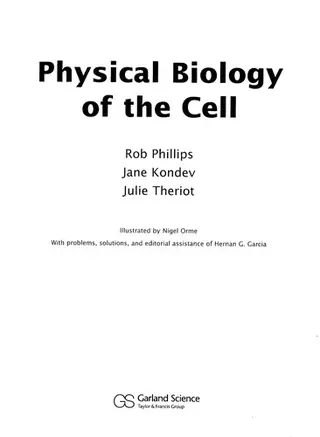
Physical Biology of the Cell
by Rob Phillips · first published 2008
63% recommend38% neutral
Why HN recommends it
Quantitative, physics-based look at how cells work, with a lot of worked material; suits people with a math or physics background who want biology framed through models and numbers.
Summarised by Claude from recommending comments
"Physical Biology of the Cell is a biophysics textbook that explores how the basic tools and insights of physics and mathematics can illuminate the study of molecular and cell biology. Drawing on key examples and seminal experiments from cell biology, the book teaches physical model building through a practical, case-study approach, demonstrating how quantitative models derived from basic physical principles can be used to build a more profound, intuitive understanding of cell biology."--Jacket.
Affiliate links. As an Amazon Associate I earn from qualifying purchases.
Mentions per year
What Hacker News says
Related books
 2009–2026
An introduction to systems biology
Uri Alon
Recommended by 9 · mentioned by 109 recommend · 10 mention9 recommend · 109 recommend
 2009–2021
Molecular Cell Biology
Harvey Lodish, Arnold Berk, Chris A. Kaiser, Monty Krieger
Recommended by 4 · mentioned by 64 recommend · 6 mention4 recommend · 64 recommend
Molecular biology of the gene
James D. Watson, Nancy H. Hopkins, Jeffrey W. Roberts, Joan Argetsinger Steitz
Recommended by 4 · mentioned by 64 recommend · 6 mention4 recommend · 64 recommend
 2008–2026
Molecular Biology of the Cell
Bruce Alberts, Alexander Johnson, Julian Lewis, David O Morgan
Recommended by 49 · mentioned by 7749 recommend · 77 mention49 recommend · 7749 recommend
 2013–2026
The machinery of life - 2. ed.
David S. Goodsell
Recommended by 35 · mentioned by 3835 recommend · 38 mention35 recommend · 3835 recommend
 2008–2024
Principles of neural science
Eric R. Kandel, James H. Schwartz, Thomas M. Jessell, J.H. Schwartz
Recommended by 13 · mentioned by 2513 recommend · 25 mention13 recommend · 2513 recommend
 2007–2026
Calculus on manifolds
Michael Spivak
Recommended by 22 · mentioned by 4822 recommend · 48 mention22 recommend · 4822 recommend
 2015–2026
The vital question
Nick Lane
Recommended by 66 · mentioned by 8466 recommend · 84 mention66 recommend · 8466 recommend
For the HN audience, Physical Biology of the Cell may also be another useful perspective/introduction. http://www.amazon.com/Physical-Biology-Cell-Rob-Phillips/dp/...
on “This Biology Book Blew Me Away” ↗…good: 1. Biological Sequence Analysis by Durbin et al. How to model DNA, RNA and proteins as probabilistic languages / generative models. There is also a companion book with all exercises solved. 2. Physical Biology of the Cell by Phillips et al. A massive amount of quantitative cell biology models that use simple undergrad physics. Originated from a Caltech course. After reading this book, all other intro to biology books…
on “I should have loved biology” ↗Statistical mechanics/Biophysics: Introduction to Modern Statistical Mechanics - David Chandler Physical Biology of the Cell - Phillips, Kondev, Theriot, & Garcia
on “Ask HN: What are the best textbooks in your field of expertise?” ↗Computational Cell Biology by Fall et al. and Physical Biology of the Cell by Phillips et al. are superb.
on “BioModels” ↗…towards evolution and populations. That's all in the standard two-semester introductory course, hence my book recommendation. If that's wrong and OP wants a math-first approach, here are a few gems: Physical Biology of the Cell, Phillips, et. al An Introduction to Systems Biology, Alon Evolutionary Dynamics, Nowack
on “Biology is a Burrito: A text- and visual-based journey through a living cell” ↗…particularly in inference, without being either as turgid as most stats texts for people without a maths background or as dry as more 'pure' books (no measure theory required). For biology I'd recommend 'Physical Biology of the Cell' (http://microsite.garlandscience.com/pboc2/) if you like to think quantitatively. About evolution specifically I find Schrodinger's 'What is Life?' thought-provoking if you already know the basics.
on “Structure and Interpretation of Classical Mechanics” ↗It's a fantastic and atypical program. It's not surprising faculty there wrote and teach from this masterpiece: https://www.routledge.com/Physical-Biology-of-the-Cell/Phill...
on “Biological Circuit Design” ↗…James Watson. I asked the professor of the class about further reading, and he suggested "2 texts: (1) An Introduction to Systems Biology: Design Principles of Biological Circuits (Alon, U.), and (2) Physical Biology of the Cell (Rob Phillips et al.)." Hope that helped. You can email me for more info, email is in my profile.
on “Ask HN: What Kind of Biology Study Did You Have in Higher Education?” ↗If you've got a physics background, you might also enjoy Physical Biology of the Cell [0]. I haven't read it personally, so I can't vouch for it, but I've seen it recommended as one of the go-to texts for those interested in the biophysics of cells. [0] http://www.amazon.com/Physical-Biology-Cell-Rob-Phillips/dp/...
on “A Eukaryote Without a Mitochondrial Organelle” ↗…heating food to jiggle apart their protein origami string machines of life. With video like https://www.youtube.com/watch?v=k4qVs9cNF24 . > Compartmentalizing I've been told the upcoming new edition of "Physical Biology of the Cell" will have better coverage of compartmentalization. So there's at least some hope for near-term increasing emphasis in introductory content.
on “Ask HN: What scientific phenomenon do you wish someone would explain better?” ↗