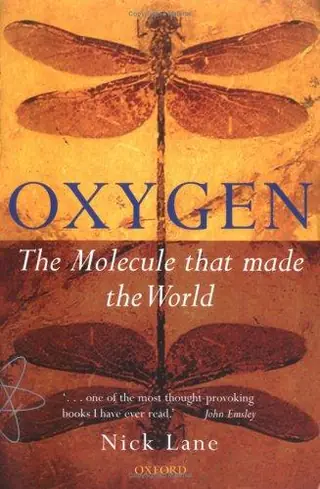
Oxygen
by Nick Lane · first published 2003
47% recommend53% neutral
Why HN recommends it
Readable popular-science account of how oxygen shaped life's history and biochemistry, covering eras when oxygen was far lower and higher than today. Suits general readers curious about evolution and mitochondria.
Summarised by Claude from recommending comments
Explores the impact oxygen has had on earth - history of life, origin of two sexes, evolution of aging and death (why we age and what we can do about it).
Affiliate links. As an Amazon Associate I earn from qualifying purchases.
Mentions per year
What Hacker News says
Related books
 2020–2024
The story of Earth
Robert M. Hazen
Recommended by 2 · mentioned by 42 recommend · 4 mention2 recommend · 42 recommend
 2010–2026
Power, Sex, Suicide
Nick Lane
Recommended by 18 · mentioned by 2318 recommend · 23 mention18 recommend · 2318 recommend
 2015–2026
The vital question
Nick Lane
Recommended by 66 · mentioned by 8466 recommend · 84 mention66 recommend · 8466 recommend
 2007–2026
The Structure of Scientific Revolutions
Thomas S. Kuhn, Dennis Holland
Recommended by 96 · mentioned by 21596 recommend · 215 mention96 recommend · 21596 recommend
Oxygen[0] by Nick Lane makes a pretty compelling argument why this will not happen. With perfect health you can at best achieve ~120 years age. I think this paper A unifying view of ageing and disease:the double-agent…
on “If you're alive in 30 years you might be in 1000 years too” ↗…less mobile when they were made by older individual. It's possible that this loss of mobility is caused by damage that mitochondria sustained during male lifetime. I can recommend https://www.amazon.com/Oxygen-Molecule-World-Popular-Science... It's bit speculative towards the end but makes many very interesting points. Written by Nick Lane, Professor of Evolutionary Biochemistry in the Department of Genetics,…
on “A new study finds that mice with genes from three parents live longer” ↗…https://arxiv.org/abs/2008.06608 doi.org/10.48550/arXiv.2008.06608 If you are interested in this topic, I cannot praise Nick Lane's nonfiction trilogy of books on mitochondria and evolution highly enough: • "Oxygen: The Molecule that Made the World" (2002) https://www.amazon.com/Oxygen-Molecule-that-Made-World/dp/0198508034 • "Sex, Power, Suicide: Mitochondria and the Meaning of Life" (2005) https://www.amazon.com/Power-Sex-Suicide-Mitochondria-Meaning/dp/0192804812…
on “Ancient Genes for Symbiosis Hint at Mitochondria’s Origins” ↗No mention yet of Nick Lane and his (wonderful) books: - Oxygen - Power, Sex, Suicide If you want a fascinating, very readable, well laid out argument against the entire notion of antioxidant supplementation (as well as a fascinating, technical but not too technical,…
on “The Vitamin Myth: Why We Think We Need Supplements” ↗…effort to recall, but enjoyed the Baroque Cycle by Neil Stephenson, almost anything by Gore Vidal. On the nonfiction side, I will always recommend books by Nick Lane, especially the first one I read: Oxygen - it made me wish that I had continued my Biochemistry studies into university.
on “Ask HN: What is the best thing you read in 2022?” ↗On this topic, I would highly recommend Nick Lane's Oxygen: The Molecule that Made the World. Interesting learning about how life worked different when oxygen was much lower, and much higher than today.
on “Microbes are 'active engineers' in Earth's rock-to-life cycle” ↗Don’t forget Oxygen. Amazing book and my intro to Nick Lane.
on “Ask HN: Mind bending books to read and never be the same as before?” ↗Thank you for this. Well told story. Nick Lane’s book “Oxygen“ is a favorite.
on “Rise of collagen-eating microbes may help explain gaps in the fossil record” ↗The reason water exists on earth, and not on mars, may be that life on earth saved the water by discovering photosynthesis. The discovery of photosynthesis caused the "great oxygenation event" which pumped oxygen into the atmosphere. Oxygen reacts with atmospheric hydrogen to form water. Without the oxygen, the very light hydrogen molecules would float to the top of the atmosphere…
on “A newly discovered moon tunnel” ↗In "Oxygen: the molecule that made the world"[1], Nick Lane also mentions the theory that these cyanobacteria are the reason we have liquid water on earth, while mars (for example) doesn't. It goes like this: early…
on “Great Oxidation Event” ↗One thing arguing against this is that there was little free atmospheric oxygen, and thus little ozone. According to Nick Lane in his book, "Oxygen", UV light at the surface of the earth was 30 times greater then than now. Life has had a lot of time to build up mechanisms to protect…
on “Scientists discover chemistry that may help explain the origins of cellular life” ↗I recently read the book "Oxygen, The molecule that made the world" by Nick Lane. Roughly the first half talks about the geologic aspects of oxygen in world history. The second half talks about biological processes relating to oxygen.…
on “Cricket Juice Healthier Than Orange Juice? Many Insects Loaded with Antioxidants” ↗…but impossible. It discusses a misconception that has been propogated lately. > The Amazon is a vast, ineffable, vital, living wonder. It does not, however, supply the planet with 20 percent of its oxygen. > As the biochemist Nick Lane wrote in his 2003 book Oxygen, “Even the most foolhardy destruction of world forests could hardly dint our oxygen supply, though in other respects such short-sighted idiocy…
on “The Amazon Is Not the Earth’s Lungs” ↗In Nick Lane's Oxygen: The Molecule that Made the World, he talks about the importance of both methane and carbon dioxide and how they exist at the extremes of a complex metabolic oxidation-reduction cycle. Methane stores…
on “Webb Discovers Methane, Carbon Dioxide in Atmosphere of K2-18B” ↗Birds are also long-lived, compared to mammals of similar size. One of Nick Lane's books discussed this and something about their adaptations against damage from respiration -- either Oxygen or Power, Sex, Suicide, I forget which.
on “Did learning to fly give bats super-immunity?” ↗