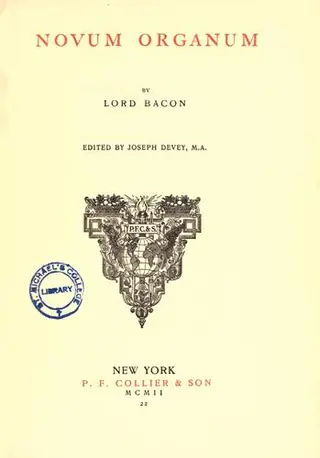
Novum organum
by Francis Bacon · first published 1620
27% recommend73% neutral
"When The New Organon appeared in 1620, as part of a six-part programme of scientific inquiry entitled 'The Great Renewal of Learning', Francis Bacon was at the high point of his political career, and his ambitious work was groundbreaking in its attempt to give formal philosophical shape to a new and rapidly emerging experimentally based science. Bacon combines theoretical scientific epistemology with examples from applied science, examining phenomena as various as magnetism, gravity and the ebb and flow of the tides, and anticipating later experimental work by Robert Boyle and others. His wor
Affiliate links. As an Amazon Associate I earn from qualifying purchases.
Mentions per year
What Hacker News says
Related books
 2008–2026
The Demon-Haunted World
Carl Sagan
Recommended by 93 · mentioned by 16293 recommend · 162 mention93 recommend · 16293 recommend
 2007–2026
Zen and the Art of Motorcycle Maintenance
Robert M. Pirsig
Recommended by 302 · mentioned by 508302 recommend · 508 mention302 recommend · 508302 recommend
 2007–2026
Cryptonomicon
Neal Stephenson
Recommended by 324 · mentioned by 628324 recommend · 628 mention324 recommend · 628324 recommend
 2007–2026
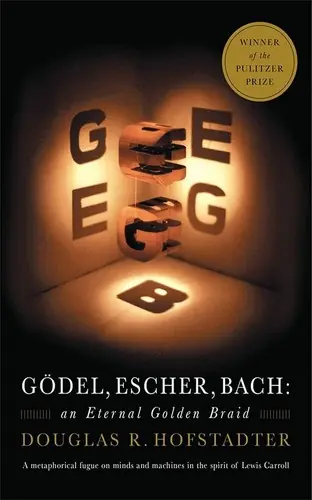
Gödel, Escher, Bach
Douglas R. Hofstadter
Recommended by 505 · mentioned by 1,055505 recommend · 1,055 mention505 recommend · 1,055505 recommend
Take a look at Francis Bacon's Novum Organum written in 1620, specifically the sections on the four idols of the human mind that sometimes prevent one from reaching truthful conclusions. To my mind, this is philosophy of science before any practices…
on “The Problem of Induction (1967)” ↗"The Road to Serfdom" by Friedrich Hayek [1] "Novum Organum" by Francis Bacon [2] [1] https://en.wikipedia.org/wiki/The_Road_to_Serfdom [2] https://en.wikipedia.org/wiki/Novum_Organum
on “Ask HN: What is the most mind blowing book you've ever read?” ↗…have an interactive session where I can shower you with critical thinking resources from Alan Kay, Marvin Minksy and a few others. Book references: Human Blindspots and “Bad Brains”: Francis Bacon, “Novum Organum Scientia” Daniel Kanneman, “Thinking: Fast and Slow” Robert Meyer, Howard Kunreuthner, “The Ostrich Paradox” https://en.wikipedia.org/wiki/List_of_cognitive_biases Alfred Korzybski, “Science and Sanity”…
on “Ask HN: How to start developing critical thinking?” ↗…central human failing. In one translation: “Heedfulness is the state free of death; heedlessness is the state of death. The heedful do not die, while the heedless are like the dead.” [7] Francis Bacon, Novum Organum, “Idols of the Mind” — 1620. https://history.hanover.edu/texts/bacon/novorg.html. Bacon argues that the “Idols of the Tribe” are rooted in human nature itself, and that human understanding distorts reality…
on “Leave Me Behind” ↗"What I cannot create, I do not understand." —Feynman Francis Bacon established the same idea as the foundation of the scientific method in "Novum Organum."
on “I was tricked into thinking I had “grit”” ↗Google says: "While elements of the scientific method existed in ancient times, the modern scientific method is generally attributed to Sir Francis Bacon who outlined it in his 1620 treatise "Novum Organum," placing the invention of the scientific method during the early 17th century during the Scientific Revolution;" which sounds about right. It was much more prevalent in free market countries. Authoritarian…
on “Windshield pitting incidents in Washington reach fever pitch on April 15, 1954 (2003)” ↗> "While elements of the scientific method existed in ancient times, the modern scientific method is generally attributed to Sir Francis Bacon who outlined it in his 1620 treatise "Novum Organum," Which specific aspect of that work was responsible for humans being better able to solve complex problems after its development which could not have been solved before it, if the same access to materials…
on “Windshield pitting incidents in Washington reach fever pitch on April 15, 1954 (2003)” ↗…With the Enlightenment and the scientific revolution, everything changed: empiricism and rationalism (despite the disputes between the two), came to shape European intelligentsia. Cue Francis Bacon's Novum Organum and deliberate experimentation. Taken together, it changed the direction of western civilization. Anyhow, my belabored point is this: "science" is intrinsically tied to a fundamental change in human…
on “People have no idea which sciences are robust” ↗…glaring errors of reason or fact can at least move you to more interesting areas of disagreement. - Much of philosophy provides tools for thinking through questions. Aristotle's Organon (and Bacon's Novum Organum) literally means (new) tool. - The history of philosophy says much about how we ended up thinking and/or knowing what we do, and where we (very frequently) got mislead along the way. Even the false…
on “Philosophy of Computer Science [pdf]” ↗…machines, textiles, agriculture, medicine, metalurgy and mining, and ancient chemistry and alchemy. What changed starting, arguably, at some point between roughly 1620 (publication year of Francis Bacon's Novum Organum) and about 1800 (patent expiry on James Watt's enhancements to the Newcomen steam engine) was a change in attitudes to both science and technology (or the practical arts, as they were then called), due…
on “Tony Brooker, creator of Mark 1 Autocode, has died” ↗…author has pinned down some aspect of reality that would be impossible to capture in any other way. EDIT: I think it's worth pointing out as a bit of evidence for my worldview here the Francis Bacon's "Novum Organum," which could be said to be the foundation of scientific thinking, is itself a work of philosophy.
on “How to Think: The Skill You’ve Never Been Taught” ↗…orbits by Gauss, how in the 1940's inverting a 14x14 matrix (for Leontief's input-output analysis in economics[4]) was a big data problem, and so on. I personally believe data science began with Bacon's Novum Organum[5], which describes an inductive method[6] starting from tables of facts and simplifying them until you reason general truths that may be treated as axioms for the purposes of deductive reasoning. This…
on “The origin story of data science” ↗