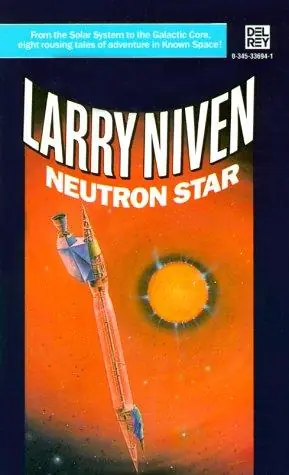
Neutron Star
by Larry Niven · first published 1968
47% recommend47% neutral7% critical
Why HN recommends it
Short story collection of hard science fiction set in Known Space, built on inventive ideas about extreme physics and exotic environments. A fun, classic Niven read for SF fans.
Summarised by Claude from recommending comments
Affiliate links. As an Amazon Associate I earn from qualifying purchases.
Mentions per year
What Hacker News says
Related books
 2009–2026
House of Suns
Alastair Reynolds, John Lee
Recommended by 26 · mentioned by 3526 recommend · 35 mention26 recommend · 3526 recommend
 2008–2026
Blood Music
Greg Bear
Recommended by 31 · mentioned by 5131 recommend · 51 mention31 recommend · 5131 recommend
 2012–2026
The Expanse
James S. A. Corey, Hallie Lambert, Georgia Lee
Recommended by 34 · mentioned by 4834 recommend · 48 mention34 recommend · 4834 recommend
 2013–2026
Existence
David Brin
Recommended by 13 · mentioned by 1713 recommend · 17 mention13 recommend · 1713 recommend
 2021–2026
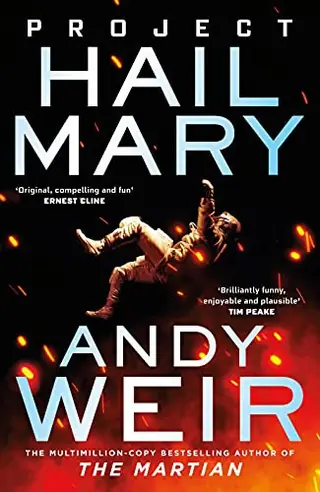
Project Hail Mary
Andy Weir
Recommended by 131 · mentioned by 221131 recommend · 221 mention131 recommend · 221131 recommend
 2011–2026
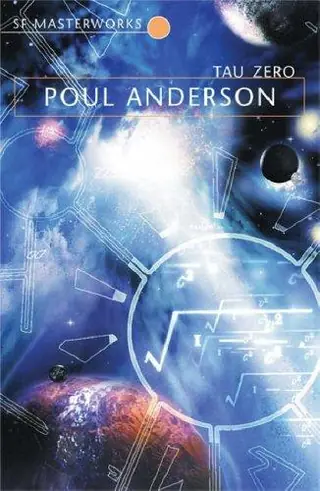
Tau Zero
Poul Anderson
Recommended by 34 · mentioned by 4934 recommend · 49 mention34 recommend · 4934 recommend
 2017–2026
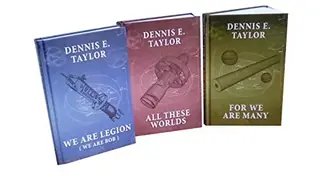
The Bobiverse
Dennis E. Taylor
Recommended by 36 · mentioned by 4036 recommend · 40 mention36 recommend · 4036 recommend
…Crisis - Donald Kingsbury (assuming you have already read Asimov's Foundation series) A Fire Upon the Deep - Vernor Vinge Chung Kuo, the Middle Kingdom - David Wingrove Ancillary Justice - Ann Leckie Neutron Star - Larry Niven Existence - David Brin The Dosadi Experiment - Frank Herbert The Space Merchants - Pohl and Kornbluth Sun of Suns - Karl Schroeder All the Traps of Earth - Clifford Simak Test of Fire…
on “Ask HN: What's your favorite sci-fi book?” ↗…the Known Space books but something happened to him after 1970 that was worse than what happened to Heinlein around then. I don't think the books he wrote w/ Pournelle where anywhere near as good as Neutron Star, World of Ptavvs, etc. His great disaster short story Inconstant Moon dates from that period.
on “J.G. Ballard: My Favorite Books” ↗I still think Neutron Star is one of the best sci-fi books of all time as it is a short story collection that reads like a novel. I liked Ringworld when I was a kid but fell out of love with it slowly over decades, particularly…
on “Nobody Wants to Buy the Future: Why Science Fiction Literature Is Vanishing” ↗…hard sci-fi, although I'm assuming anything tackling this sort of thing would automatically filter into that genre) regarding exotic elements, extreme conditions in space, or those sorts of things? Like Neutron Star or Cannonball Express by Larry Niven. That sort of thing.
on “Heaviest element yet detected in an exoplanet atmosphere” ↗> additional speed for spacecraft Extreme rip-your-craft-to-bits tidal effects [0] would make life exciting. Also, see 'Neutron Star' by Larry Niven for a description of such a manoeuvre, albeit a less dangerous one than than sling-shoting a black Hole because of the larger size of the neutron star. [0] https://en.wikipedia.org/wiki/Tidal_force
on “What if Planet 9 is a Primordial Black Hole? (2019)” ↗…Probably "Goodnight Mr. James" by Clifford Simak. Honorable mentions to: "Microcosmic God" and "If all men were brothers would you let one marry your sister?" by Ted Sturgeon "Bordered in Black" and "Neutron Star" by Larry Niven "Blood Music" by Greg Bear "Special Delivery" by George O. Smith "The Gold at the Starbow's End" by Fredrick Pohl
on “Ask HN: Whats your favorite Sci-Fi short story?” ↗…less of them these days is because of the lack of popular serial format magazines. Some favorites that come to mind at the moment: "Goodnight Mr. James" in 'All the traps of Earth' by Clifford Simak "Neutron Star" and "What good is a glass dagger?" by Larry Niven "Tales from the Vulgar Unicorn" by various authors The Fafhrd and Grey Mouser series by Fritz Leiber (successive short stories) "If all men were brothers,…
on “Ask HN: Favorite Short Fiction?” ↗Larry Niven. His older stuff: Ringworld. and all his short-story collections, especially Neutron Star. He also did a scifi take on magic, in The Magic Goes Away. I see Vinor Vinge's AFUTD and ADITS as the closest thing to Niven.
on “The Realism of Our Times: Kim Stanley Robinson on how science fiction works” ↗…won't take much force at all to destroy it. If it's 10 m long (dramatically reducing the tidal effect) and made of solid diamond then it can fly much closer. Not that there would be anything to see. Read Neutron Star by Larry Niven (1966) for a dramatic description of a close flyby of a compact stellar mass object.
on “A Sun-like star orbiting a boson star” ↗Thanks for the Niven reference. Neutron Star was a fun read. I'm currently working through a collection of 80s SF shorts[0]. It's an entertaining lens into the narratives mores of the time, and or own in contrast. [0]:https://ci.nii.ac.jp/ncid/BB07948947
on “Show HN: What if the speed of light was 5 km/h?” ↗…certainly a reason to have failsafe timers and dead-man switches when testing new things. While I did read The Expanse, when I think of that class of dangers, what pops to my mind is an old short story Neutron Star (1966) [0]. A financially desperate pilot is hired to discover what killed some researchers while leaving the indestructible starship hull intact... and the thrusters off. [0] https://en.wikipedia.org/wiki/Neutron_Star_(short_story)
on “Show HN: What if the speed of light was 5 km/h?” ↗…You'd calibrate them when you first use them. Of course, the black-spot can be made a little overlarge, for margin of error. Larry Niven (surely not the only one) mentioned this idea in Grendel (in the Neutron Star collection), a 1968 shortstory, which included [MINOR SPOILER] an update on the old fighter-pilot tactic of attacking out of the sun - which with these sunglasses, is hidden by the black-spot.
on “Sunglasses that block out glare with lcd spot” ↗Looks like someone has been reading Niven. That picture shows a ship built off a General Products #2 hull, and is come straight off the book "Neutron Star": http://ca.pbsstatic.com/l/41/6941/9780345336941.jpg With that hull you could fly past a neutron star and live, if you could survive the tidal forces.
on “What would a teaspoonful of neutron star do to you?” ↗That's a very classical approach to scifi, like those Larry Niven stories (Neutron Star etc) where a lone hero man with no friends, but a spaceship, defeats a high school physics class problem. It turns out reading only books about lone men with no friends doesn't prepare you for real life.
on “Mercury found to be tectonically active” ↗[Spoiler] Another usage: Larry Niven used this for blackmail information, Neutron Star.
on “To Remember, the Brain Must Actively Forget” ↗