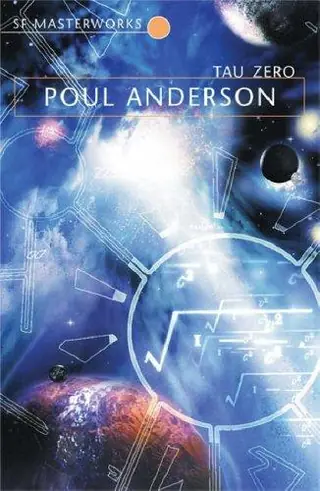
Tau Zero
by Poul Anderson · first published 1970
69% recommend29% neutral2% critical
Why HN recommends it
Hard sci-fi about a Bussard ramjet ship that cannot stop accelerating, so relativity and time dilation play out on a vast scale. Valued for its consistent premise and sense of awe; suits hard-SF fans.
Summarised by Claude from recommending comments
Poul Anderson's Tau Zero is an outstanding work of science fiction, in part because it combines two qualities that are often at odds in this genre: an interest in the emotional lives of its characters and a fascination with all things technological and scientific. In Tau Zero these components are not merely fused; they work together with a remarkable synergy that makes the novel much more than just a deep space adventure story.The novel centers on a ten-year interstellar voyage aboard the spaceship Leonora Christine, and it opens with members of the crew preparing for their departure from ear
Affiliate links. As an Amazon Associate I earn from qualifying purchases.
Mentions per year
What Hacker News says
Related books
 2011–2024
Indistinguishable From Magic
Robert L. Forward
Recommended by 1 · mentioned by 21 recommend · 2 mention1 recommend · 21 recommend
 2011–2026
Pushing Ice
Alastair Reynolds
Recommended by 18 · mentioned by 2518 recommend · 25 mention18 recommend · 2518 recommend
 2010–2026
Gateway
Frederik Pohl
Recommended by 22 · mentioned by 3422 recommend · 34 mention22 recommend · 3422 recommend
 2012–2026
Redshift Rendezvous
John E. Stith
Recommended by 3 · mentioned by 53 recommend · 5 mention3 recommend · 53 recommend
 2012–2025
Dream Park
Larry Niven, Steven Barnes, Grover Gardner narrator
Recommended by 5 · mentioned by 65 recommend · 6 mention5 recommend · 65 recommend
 2019–2025
Evolution
Stephen Baxter
Recommended by 5 · mentioned by 85 recommend · 8 mention5 recommend · 85 recommend
 2009–2026
Revelation Space
Alastair Reynolds, John Lee
Recommended by 78 · mentioned by 12378 recommend · 123 mention78 recommend · 12378 recommend
 2009–2026
Mission of gravity
Hal Clement
Recommended by 9 · mentioned by 109 recommend · 10 mention9 recommend · 109 recommend
…sci-fi at the moment for anything flying above a 250 km earth orbit because atmospheric density decreases dramatically fast with altitude. One of my favorite takes on this concept was Poul Anderson's Tau Zero [1], which used a Bussard ramjet [2]. Apparently, in the 70s, in was thought that there was enough hydrogen surrounding our solar system to support interstellar travel. [1] https://en.wikipedia.org/wiki/Tau_Zero…
on “First firing of air-breathing electric thruster” ↗Disagree. Asimov has enormous resonance today despite never writing a convincing human character. Tau Zero puts barely any paragraphs into people's society or relationships, but is still breathtaking. Having a world that behaves consistently and plausibly is what gives a fictional work heft; we can care about…
on “Science Fiction’s Wonderful Mistakes” ↗There are very few sci-fi movies or books where relativity is important and they treat it seriously. Tau Zero is one, I'm not sure about Time for the Stars, but Forever War does have FTL. I created a list of all these works I could find a few years ago. Here is one link: https://tvtropes.org/pmwiki/discussion.php?id=l6q90mvssgscsj...…
on “How far could a spaceship go if we never ran out of thrust? (2020)” ↗…pulsar for example, or measure the orbits of binary star systems, etc. It would be quite apparent to them that there is a time dilation effect for them with respect to most of the rest of the universe. See Tau Zero, by Poul Anderson. It has a few mistakes, but it's still a great read.
on “Eldar Black Holes” ↗"...me understand time slowing down as speed increases in Anvil of Stars." For me it was Tau Zero by Poul Anderson
on “Greg Bear has died” ↗…it a long time ago as part of Gollancz's space opera series. The whole series features awesome cover designs by Sanda Zahirovic http://bookcoverarchive.com/sanda_zahirovic I highly recommend reading Tau Zero by Poul Anderson and Stone by Adam Roberts.
on “The Best Science Fiction Books (According to Reddit)” ↗You're thinking of Poul Anderson's "Tau Zero". It won a Hugo award in 1971. There are a few others that have worked the same concept, but none so famous or well-written.
on “Gamma-ray bursts are a threat to life” ↗Anyone who enjoys this story will likely also enjoy _Tau Zero_ by Poul Anderson.
on “The Melancholy of Infinite Space (1996)” ↗Tau Zero by Poul Anderson is an interesting little novel that touches on some of this stuff.
on “Was There a Civilization on Earth Before Humans?” ↗…(where I first heard about space elevators), but it looks like this isn't aimed at technological ideas, more straight science. Though "telescopes" is one of the categories. Glad to see Poul Anderson's "Tau Zero" on the list - that made a big impression on me when I read it back in the 70s. Fun that Ted Chiang's "Exhalation" shows up in 3 different categories. Stunning story. I would have included his "Tower…
on “Science Fiction Stories with Good Astronomy and Physics: A Topical Index” ↗For a hard science fictional version of this, check out Poul Anderson’s “Tau Zero”, from 1970, according to Wikipedia. I read it a few years after that, and it’s stuck with me since. A ship with a Bussard ramjet runs into troubles and has to keep accelerating, into the far future.
on “How far could a spaceship go if we never ran out of thrust? (2020)” ↗You are thinking of Tau Zero by Poul Anderson. It's well worth reading even though the cosmology is dated.
on “How far could a spaceship go if we never ran out of thrust? (2020)” ↗Check out Pohl Anderson's "Tau Zero" which examines precisely this scenario. A starship using bussard ramjet needs to find an "empty" section of space free of interstellar hydrogen so they can fix their engines and decelerate without getting…
on “Why can’t I go faster than the speed of light?” ↗…well known as some others here. * Last and First Men, by Olaf Stapledon * Way Station, by Clifford D. Simak * The Gap (series), by Stephen Donaldson * The Golden Apples of the Sun, by Ray Bradbury * Tau Zero, by Poul Anderson
on “Ask HN: What is your favorite fiction book?” ↗Chronologically starting with children's: Swallows and Amazon series. Stranger in a Strange Land, The Man In The Maze, Tau Zero, Asimovs Foundation series. All Jane Austen's work: Pride and Prejudice, Sense and Sensibility, Persuasion, Mansfield Park, Emma, and Northhanger Abbey.
on “Ask HN: What is your favorite fiction book?” ↗