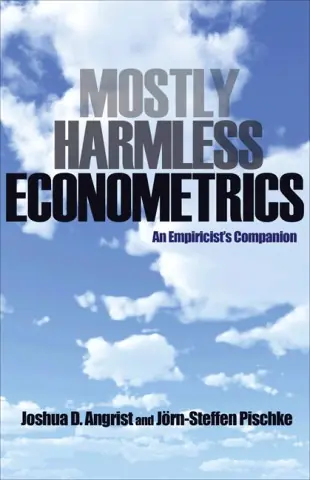
Mostly harmless econometrics
an empiricist's companion
by Joshua David Angrist, Jörn-Steffen Pischke, Joshua D. Angrist · first published 2008
56% recommend44% neutral
Why HN recommends it
A practical, readable guide to applied econometrics for empirical social scientists, covering causal inference methods like regression and instrumental variables. A more accessible follow-up to intro textbooks.
Summarised by Claude from recommending comments
In addition to econometric essentials, this book covers important new extensions as well as how to get standard errors right. The authors explain why fancier econometric techniques are typically unnecessary and even dangerous.
Affiliate links. As an Amazon Associate I earn from qualifying purchases.
Mentions per year
What Hacker News says
Related books
 2014–2018
Hedge fund market wizards
Jack D. Schwager
Recommended by 6 · mentioned by 66 recommend · 6 mention6 recommend · 66 recommend
 2010–2018
The new market wizards
Jack D. Schwager
Recommended by 6 · mentioned by 76 recommend · 7 mention6 recommend · 76 recommend
 2009–2026
Options, futures, & other derivatives
John C. Hull
Recommended by 25 · mentioned by 3525 recommend · 35 mention25 recommend · 3525 recommend
 2008–2025
The art of software security assessment
Mark Dowd, John McDonald, Justin Schuh
Recommended by 21 · mentioned by 3121 recommend · 31 mention21 recommend · 3121 recommend
 2009–2023
The web application hacker's handbook
Dafydd Stuttard, Marcus Pinto
Recommended by 31 · mentioned by 4831 recommend · 48 mention31 recommend · 4831 recommend
 2008–2025
Trading and Exchanges
Larry Harris
Recommended by 50 · mentioned by 5950 recommend · 59 mention50 recommend · 5950 recommend
 2012–2026
Clean Architecture
Robert C. Martin
Recommended by 47 · mentioned by 10447 recommend · 104 mention47 recommend · 10447 recommend
I'd recommend textbooks or corsera rather than pop econ books. Mostly Harmless Econometrics - Angrist and Krueger Principles of microeconomics - Mankiw (beginner) Intermediate microeconomics - Varian (intermediate) You also want to cover finance and time series - I don't know what would be…
on “Ask HN: What are the must-read books about economics/finance?” ↗…interested in. Works by Keynes, Smith, Marx, Robinson, Hayek, and Ricardo do a fantastic job laying the groundwork for modern economic theory. If you're looking for the quantitative side of economics, Mostly Harmless Econometrics, Freakonomics, and (on the very theoretical side) Recursive Methods in Economic Dynamics are must reads. Capital by Picketty is currently being debated, as the underlying evidence towards his theories…
on “Ask HN: What are the must-read books about economics/finance?” ↗In econometrics / empirical social science: - Mostly Harmless Econometrics by Joshua Angrist and Jorn Steffan Piscke - Causal Inference for Statistics, Social, and Biomedical Sciences by Guido Imbens and Donald Rubin - Data Analysis using Regression and Multilevel Models by…
on “Ask HN: What are the best textbooks in your field of expertise?” ↗…econometrics - since it is those tools that allow us to (try to) see which theories may be right and which may be wrong. The books by Pischke & Angrist are good: "Mastering Metrics", and at a higher level, "Mostly Harmless Econometrics". The Journal of Economic Perspectives [1] is a great resource to learn more about a topic in economics. As it says: > The Journal of Economic Perspectives (JEP) fills the gap between the general interest…
on “Ask HN: Books you plan to read in 2019?” ↗+1 Mostly Harmless Econometrics - Angrist and Krueger
on “Ask HN: What are the must-read books about economics/finance?” ↗…counterfactual employment rates in New Jersey in the absence of a minimum wage change.” See [2]. [1] https://davidcard.berkeley.edu/papers/reanal-ff-nj.pdf [2] Joshua Angrist and Jörn-Steffen Pischke, Mostly Harmless Econometrics, page 293, https://press.princeton.edu/books/paperback/9780691120355/mo...
on “Why is U.S. labor supply so low?” ↗First thing: all claims to have proved a causal relationship are relative to a set of assumptions which may or may not be satisfied (even in experimental sciences). Taking the experiment as an ideal we cannot reach, there are many settings where there is useful variation in the data which can approximate the random assignment to treatment which is the essence of experiments. Some canonical rese
on “A field fixes itself: the applied turn in economics” ↗Regression with measurement error is usually treated in much higher level statistics/econometrics classes. If you're interested in this you can read more in Mostly Harmless Econometrics [1] about adressing this with IV methods [1] http://www.development.wne.uw.edu.pl/uploads/Main/recrut_eco...
on “Linear regression by hand” ↗…kind of wild to look back on! Are you curious about anything in particular? Or if you're just wondering what kind of books I'm talking about, highlights include CLRS, Probabilistic Graphical Models, Mostly Harmless Econometrics, and Characters & Viewpoint. Next up on my list are more creative writing books and a couple theoretical stats books (I'm working towards a book on semiparametrics, but first need a better foundation…
on “How to Learn Stuff Quickly” ↗