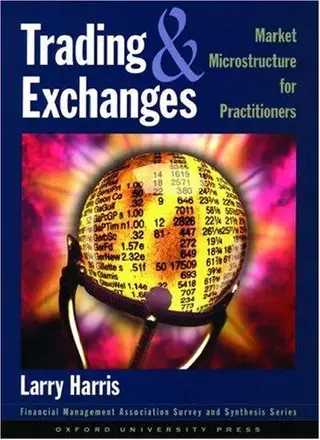
Trading and Exchanges
by Larry Harris · first published 2002
85% recommend14% neutral2% critical
Why HN recommends it
Accessible overview of market microstructure: how exchanges work and the roles of traders and dealers. Suits anyone who wants to understand real markets rather than get-rich strategies, including aspiring quants.
Summarised by Claude from recommending comments
Affiliate links. As an Amazon Associate I earn from qualifying purchases.
Mentions per year
What Hacker News says
Related books
 2011–2024
Algorithmic trading & DMA
Barry Johnson
Recommended by 8 · mentioned by 118 recommend · 11 mention8 recommend · 118 recommend
 2009–2021
The complete guide to capital markets for quantitative professionals
Alex Kuznetsov
Recommended by 7 · mentioned by 87 recommend · 8 mention7 recommend · 87 recommend
 2010–2020
How to read the financial pages
Peter Passell
Recommended by 2 · mentioned by 22 recommend · 2 mention2 recommend · 22 recommend
 2010–2020
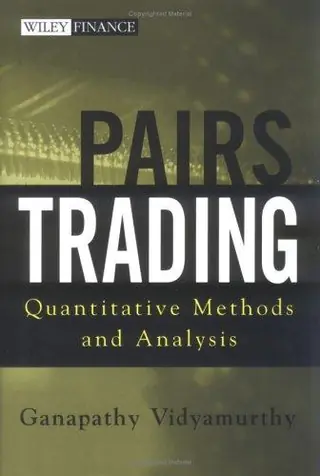
Pairs Trading
Ganapathy Vidyamurthy
Recommended by 3 · mentioned by 43 recommend · 4 mention3 recommend · 43 recommend
 2012–2024
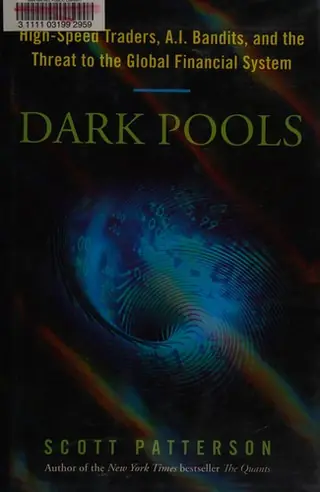
Dark Pools
Scott Patterson
Recommended by 27 · mentioned by 4827 recommend · 48 mention27 recommend · 4827 recommend
 2016–2020
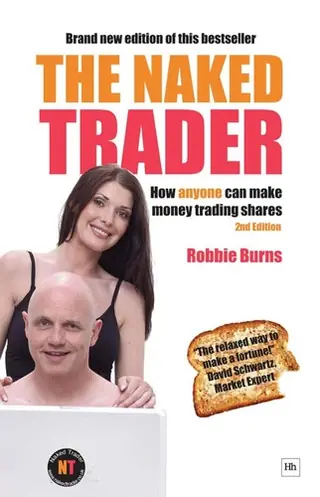
The naked trader
Robbie Burns
Recommended by 2 · mentioned by 22 recommend · 2 mention2 recommend · 22 recommend
 2010–2011
Arbitrage theory in continuous time
Björk, Tomas.
Recommended by 1 · mentioned by 21 recommend · 2 mention1 recommend · 21 recommend
…Bertsekas) - Convex Optimization (by Boyd & Vandenberghe) - Nonlinear Control Systems (by Isidori) - Visual Complex Analysis (by Needham) - Lasers (by Siegman) - Game Theory (by Fudenberg & Tirole) - Trading and Exchanges (by Harris) Plus a bunch of books on Classical Mechanics, Relativity, Quantum Mechanics, Differential Geometry, Real Analysis, Algebra, Theoretical CS, Chemistry, Biochemistry, Cellular Biology, Evolution,…
on “Reading list for those who love to learn” ↗For the love of all that is holy go to Amazon right now and buy a copy of Trading and Exchanges: Market Microstructure for Practioners by Larry Harris. I'm not a trader, or an exchange, but I've been forced to get very, very intimate with the technological plumbing of both, and I've interviewed…
on “Ask HN: Good resources for learning+getting into Finance / Trading?” ↗…buzzword (e.g. HFT) books are rubbish (think about it: if you have a profitable operation, why would you write a book? Unless, like me, you have a screw loose :P ) If you want some practical discussions, "Trading and Exchanges" by Larry Harris is a bit dated, but nothing comes close. Most of the descriptions are still valid today (even if some of the mechanics have changed) If you want something more along the lines of what…
on “Good books for hackers interested in quant finance?” ↗In a non-commodity market, price is determined by value, not cost. Cost is irrelevant. There are e-books worth $100. Harris' _Trading and Exchanges_ is a great example (although it's stupidly priced at roughly half that). It is clearly worth more in Kindle format than it is in giant-ass hardcover format. And yet it costs them $0 marginal dollars…
on “EBook Pricing Goes Outright Insane” ↗I always recommend "Trading and Exchanges" by Larry Harris. If you want a slower mathematical introduction, I recommend the Stochastic Calculus for Finance books by Steven Shreve.
on “Quantitative Finance Reading List” ↗…hiring process and find myself profoundly worried when no code gets discussed in tech interviews. I also really enjoyed stockfighter challenges. Between those six and my university's copy of Harris' Trading and Exchanges, I learned quite a bit. I bailed out on the AVR challenges though. From a purely selfish viewpoint, I also want to work at places where the hiring process isn't really just whiteboard or gotcha questions,…
on “I’m Joining Stripe to Work on Atlas” ↗…entries but I assume they did. But the physical certificates still needed to be retained.[2] If you're interested in this sort of market structure/market participant discussion, I'd recommend the textbook Trading and Exchanges: Market Microstructure for Practitioners, by Larry Harris. 0. https://en.wikipedia.org/wiki/Depository_Trust_%26_Clearing_... 1. https://www.bloomberg.com/view/articles/2015-07-14/banks-for... 2. http://www.dtcc.com/annuals/2013/superstorm-sandy-recovery/i...
on “A Simple Explanation of How Shares Move Around the Securities Settlement System” ↗Related, Trading and Exchanges: Market Microstructure for Practitioners by Larry Harris is also excellent. https://www.amazon.com/Trading-Exchanges-Market-Microstructu... These aren't really textbooks, but regardless, the Market…
on “Ask HN: What are the best textbooks in your field of expertise?” ↗Trading and Exchanges: Market Microstructure for Practitioners, An introduction to quantitative finance by Blyth. Avoid pop finance books that is light on numbers. If you want to understand the qualitative aspects/culture/history,…
on “Ask HN: Introductory Books on the Stock Market?” ↗I liked Trading and Exchanges by Larry Harris
on “Ask HN: Book recommendations for understanding financial systems?” ↗Short answer: No, don't do it. Long answer: For anyone interested in this stuff I highly recommend the book Trading & Exchanges by Larry Harris. The book is about market microstructure, and the knowledge applies to any market whether it's equities or options or online gambling like intrade.com. It's a textbook, so not riveting reading, but great information. As other posters have pointed out,
on “Ask HN: Why be an option/futures/day trader when it is zero-sum?” ↗I'm halfway through Harris _Trading and Exchanges_, recommended at the top of this article, and it's just a phenomenally awesome book. I brought it up to the lake for summer reading, it's been that fun to read so far.
on “A bestiary of algorithmic trading strategies” ↗Trading and Exchanges: Market Microstructure for Practitioners. http://www.amazon.com/Trading-Exchanges-Market-Microstructur... I'm finding this a more interesting and detailed read than _Capital Markets for Quantitative…
on “Good books for hackers interested in quant finance?” ↗…cents in the best case but getting out at 10 cents in the worst. I came to my understanding of this topic in a weird way (see downthread) but one resource I found extremely helpful was Larry Harris' _Trading And Exchanges: Market Microstructure For Practitioners_. It is the TCP/IP Illustrated of markets. Very well written, and well written in a way easily appreciated by programmers. Highly recommended. When I first started…
on “A High Frequency Trader's Apologia, Part 1” ↗If you're looking for good talks on the security or technical implications of trading markets, look for microstructure details. Any talk that has a diagram of "orders" going to a "trading engine" is addressing itself at a higher level than you're interested in. Just the order entry side of a real firm OMS is too complicated to get one bubble in a diagram. Again: strongly recommend _Trading & Exch
on “A High Frequency Trader's Apology, Pt 2” ↗