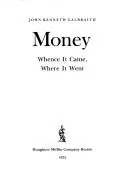
Money, whence it came, where it went
by John Kenneth Galbraith · first published 1975
50% recommend50% neutral
Why HN recommends it
A readable history of how money and banking developed, rich in detail and wit. It serves as an introduction to money and national economies and provides useful background for later financial reading.
Summarised by Claude from recommending comments
The history of the creations, uses & mis-uses of money
Affiliate links. As an Amazon Associate I earn from qualifying purchases.
Mentions per year
What Hacker News says
Related books
 2009–2023
Naked Economics
Charles J. Wheelan
Recommended by 15 · mentioned by 1715 recommend · 17 mention15 recommend · 1715 recommend
 2008–2024
The worldly philosophers
Robert L. Heilbroner
Recommended by 17 · mentioned by 1817 recommend · 18 mention17 recommend · 1817 recommend
 2009–2024
The affluent society
John Kenneth Galbraith
Recommended by 11 · mentioned by 2311 recommend · 23 mention11 recommend · 2311 recommend
 2010–2026
Lords of finance
Liaquat Ahamed
Recommended by 14 · mentioned by 2114 recommend · 21 mention14 recommend · 2114 recommend
The use of knowledge in society
Friedrich A. von Hayek
Recommended by 16 · mentioned by 3116 recommend · 31 mention16 recommend · 3116 recommend
 2007–2026
Economics in One Lesson
Henry Hazlitt
Recommended by 107 · mentioned by 147107 recommend · 147 mention107 recommend · 147107 recommend
 2010–2026
The big short
Michael Lewis, Francisco José Ramos Mena
Recommended by 99 · mentioned by 20299 recommend · 202 mention99 recommend · 20299 recommend
 2007–2026
The Wealth of Nations
Adam Smith
Recommended by 92 · mentioned by 40592 recommend · 405 mention92 recommend · 40592 recommend
I learned a heck of a lot from reading John Kenneth Galbraith's books. In particular, The Affluent Society, The New Industrial State, and Money: Whence it Came, Where it Went
on “Ask HN: Best book(s) to learn about the basics of economics?” ↗I think the best way to understand it all is to understand the history of how it came to be. I would start with something like: Money: Whence it Came, Where it Went by John Kenneth Galbraith The Ascent of Money: A Financial History of the World by Niall Ferguson
on “Ask HN: Book recommendations for understanding financial systems?” ↗Along these lines, there is an excellent book by John Kenneth Galbraith - Money: Whence It Came, Where It Went (1975) that covers the whole history of money, with much details & wit
on “Bitcoin Is Time” ↗I'd recommend the books by Galbraith -- Money: Whence It Came, Where It Went, The Great Crash 1929, and A Short History of Financial Euphoria. That is some pretty timeless background.
on “America’s banks are missing hundreds of billions of dollars” ↗…this book by Galbraith many years ago. I don't say you have to agree with him politically or economically, but as a basic introduction to the idea of money, and national economies, it's a great read. Money: Whence It Came, Where It Went. John Kenneth Galbraith. (1975) He had a very interesting life.
on “El Salvador abandons Bitcoin as legal tender” ↗"The study of money, above all other fields in economics, is the one in which complexity is used to disguise truth or to evade truth, not to reveal it." -Money: Whence it Came, Where it Went, John Kenneth Galbraith >Why don't the people at the top want to share? Ideology and power >What are we even sharing? Money >How does sharing happen? >By what means does sharing occur? Computer…
on “Technology Change Not the Culprit in Wages Falling Behind US Productivity Gains” ↗…teaches us that nothing, not even inflation, is permanent. We learn also that the fear of inflation which inflation leaves in its wake can be as damaging as the inflation itself. J.K. Galbraith 1975 Money Whence it came, where it went
on “Central bankers rethink their devotion to slaying inflation” ↗"The study of money, above all other fields in economics, is the one in which complexity is used to disguise truth or to evade truth, not to reveal it." John Kenneth Galbraith, Money: Whence It Came, Where It Went (1975), p. 5
on “Why is finance so complex? (2011)” ↗>The study of money, above all other fields in economics, is the one in which complexity is used to disguise truth or to evade truth, not to reveal it. -John Kenneth Galbraith, Money: Whence it came, where it went
on “Decline in the labor share of income in the U.S.” ↗>The study of money, above all other fields in economics, is the one in which complexity is used to disguise truth or to evade truth, not to reveal it. -John Kenneth Galbraith, Money: Whence it Came, Where it Went
on “UK government urged to use Bitcoin-style digital ledgers” ↗>The study of money, above all other fields in economics, is one in which complexity is used to disguise truth or to evade truth, not to reveal it. -John Kenneth Galbraith, Money: Whence it came, where it went (1975)
on “People Aren’t Dumb, the World Is Hard” ↗