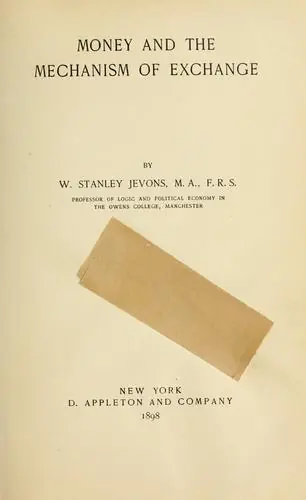
Money and the mechanism of exchange
by William Stanley Jevons · first published 1875
10mentions
2recommended by
4HN commenters
2013–2023first – last mentioned
50% recommend50% neutral
Affiliate links. As an Amazon Associate I earn from qualifying purchases.
…if they lose faith in it. But this assumes that the _sellers_ will accept the currency. A loss of _seller_ acceptance will in fact torpedo the currency. I strongly recommend William Stanley Jevons, _Money and the Mechanism of Exchange_, which still serves as the foundation of much thinking on money (~1880). 7. How is this not a Ponzi scheme? https://en.wikipedia.org/wiki/MMM_%28Ponzi_scheme_company%29 (Questions also posted to G+.)
on “Apply HN: Gresham Dollar – Viral Currency for Basic Income” ↗…faster if they lose faith in it. But this assumes that the _sellers_ will accept the currency. A loss of _seller_ acceptance will in fact torpedo the currency. I strongly recommend William Stanley Jevons, _Money and the Mechanism of Exchange_, which still serves as the foundation of much thinking on money (~1880). The plan is to maintain a growing number of contracted merchant partners. If our merchant partners spontaneously stopped accepting…
on “Apply HN: Gresham Dollar – Viral Currency for Basic Income” ↗I'd suggest William Stanley Jevons, Money and the Mechanism of Exchange for a clear foundational explanation of money, that still underlies much present discussion. Chapter V in particular, on the qualities of the material of money, provides a vital set of properties which…
on “The Economy” ↗…asset. Function 4 is debt. Note that debt also needs to have some sense of value, and that effective debt-management systems tend to rely on a stable metric of value. William Stanley Jevons writing in Money and the Mechanism of Exchange (1875)[2] gives seven qualities of the material of money: utility/value, portability, indestructibility, homogeneity, divisibility, stability, and cognizability. By utility, he holds that money must…
on “Hyperinflation and Trust in Ancient Rome” ↗…are confused and poorly written. If anyone reading this ever wants to write an article on a new digital currency, please consider beginning your analysis based on Jevon's four properties of money. >In Money and the Mechanism of Exchange (1875), William Stanley Jevons famously analyzed money in terms of four functions: a medium of exchange, a common measure of value (or unit of account), a standard of value (or standard of deferred payment),…
on “China Trials Its Own ‘Bitcoin’ but Here’s Why It Will Probably Suck” ↗…the characteristics which are desireable of financial vehicles and assets: utility/value, portability, indestructibility, homogeneity, divisibility, stability, cognixability. (William Stanley Jevons, Money and the Mechanism of Exchange https://archive.org/stream/moneyexchange00jevorich#page/n7/m...) And whilst land may not be particularly portable, land ownership is. Other productive assets: metals, grain, productive plant, etc.,…
on “Bank of Canada increases overnight rate target to 1 per cent” ↗…identified a properties of money as: 1. utility and value 2. portability 3. indestructability 4. homogeneity 5. divisibility 6. stability of value, and 7. cognisability William Stanley Jevons, Money and the Mechanism of Exchange Chapter 5: <https://archive.org/details/cu31924013816172> Points 1, 2, & 3 afford low cost of storage. Of those, I differ with him on utility and value, as we have fiat currencies and accounts notations…
on “Digression 3: Corrosion – Rust Never Sleeps” ↗…control and usury through local fiscal monopoly. To let the imagination flow: we potentially stand on the threshold of global society's yet greatest rennaissance. [1] Jevons, William Stanley. (1875) Money and the Mechanism of Exchange [2] Milnes, Alfred (1919). The economic foundations of reconstruction. Macdonald and Evans. p. 55. [3] Graeber, David Debt: The First 5000 Years (2011) [4] http://ifex-project.org/ [5] http://www.ifex-project.org/our-proposals/x-iso4217-a3 [6]…
on “Why You Should Care About Bitcoin” ↗…dollar as their own national currency: <https://www.investopedia.com/articles/forex/040915/countries...>. William Stanley Jevons defined what to him were the vital set of properties required of money in Money and the Mechanism of Exchange (1877): utility/value, portability, indestructibility, homogeneity, divisibility, stability, cognixability. <https://archive.org/details/moneyexchange00jevorich/page/30/...> I disagree with him on…
on “Bank of England, 1914 war bonds cover-up” ↗…utility and value are the inverse of trust in the money-issuing authority. "Seignorage" in specie is then a measure of trust, and fiat currency effectively has infinite trust. William Stanley Jevons, Money and the Mechanism of Exchange Chapter 5: <https://archive.org/details/cu31924013816172> In your Apple example: what Apple produces is a future stream of profits, and systems which provide utility to purchasers of those systems.…
on “Tidal Energy Is Not Renewable” ↗