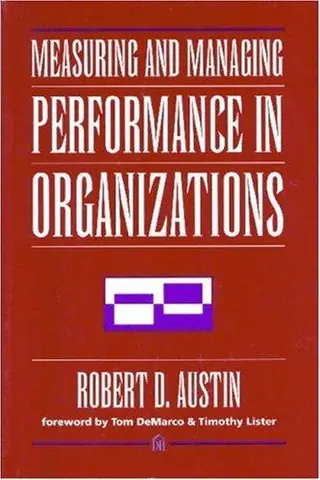
Measuring and managing performance in organizations
by Robert D. Austin · first published 1996
82% recommend18% neutral
Why HN recommends it
Examines how performance measurement distorts behavior, including the gaming of metrics and the limits of measuring hard-to-quantify work. Useful for managers and engineers setting KPIs.
Summarised by Claude from recommending comments
Affiliate links. As an Amazon Associate I earn from qualifying purchases.
Mentions per year
What Hacker News says
Related books
 2010–2026
Sein und Zeit
Martin Heidegger
Recommended by 2 · mentioned by 92 recommend · 9 mention2 recommend · 92 recommend
 2010–2022
Awareness
Anthony De Mello
Recommended by 8 · mentioned by 98 recommend · 9 mention8 recommend · 98 recommend
 2010–2026
A treatise of human nature
David Hume
Recommended by 12 · mentioned by 2512 recommend · 25 mention12 recommend · 2512 recommend
 2007–2024
The Fabric of the Cosmos
Brian Greene
Recommended by 23 · mentioned by 3123 recommend · 31 mention23 recommend · 3123 recommend
 2008–2025
The Law
Frédéric Bastiat
Recommended by 17 · mentioned by 2417 recommend · 24 mention17 recommend · 2417 recommend
 2008–2025
Emotional Intelligence
Daniel Goleman
Recommended by 22 · mentioned by 3622 recommend · 36 mention22 recommend · 3622 recommend
 2015–2024
The Master Algorithm
Pedro Domingos
Recommended by 23 · mentioned by 4023 recommend · 40 mention23 recommend · 4023 recommend
 2009–2026
The Red Queen
Matt Ridley
Recommended by 28 · mentioned by 3228 recommend · 32 mention28 recommend · 3228 recommend
It's time again for me to recommend Measuring and Managing Performance in Organizations by Austin[0]. Don't let the underwhelming title fool you: it's largely a book on why it can't be done. Austin takes classical principal-agent models and extends it to add a third participant: the client.…
on “Against metrics: how measuring performance by numbers backfires” ↗…it. Furthermore, it's completely untrue. Many things that must be managed are incompletely measurable, and almost everything in knowledge work falls into that category. See Robert Austin's excellent "Measuring and Managing Performance in Organizations" for a scientific exploration of the topic. (It's a more accessible version of his Ph.D. thesis.) His insights are applicable to more than just performance measurement.
on “Andrew Mason's statement about being fired as Groupon CEO” ↗Read Robert D. Austin's book Measuring and Managing Performance in Organizations (http://www.dorsethouse.com/books/mmpo.html) for an absolutely devastating analysis of this problem.
on “Joel Spolsky: Thanks or No Thanks” ↗…complexity, number of emails sent) as your measurement. But then all that happens is that the proxies are optimised for. People will write peculiar software and treat email like twitter. The book to read is Measuring and Managing Performance in Organizations by Robert D. Austin. His 3-party model of performance tracking neatly demonstrates why, under most conditions, an "objective" system is impossible. Not hard. Impossible.
on “Why are Amazon, Facebook and Yahoo copying Microsoft's stack ranking system?” ↗If you want something more academic I recommend Measuring and Managing Performance in Organizations by Robert Austin [1]. There is a sample that is a pretty good introduction as well [2]. This was the only book worth reading when I was researching metrics for our team at work. TL;DR: Don't use performance…
on “How Completely Messed Up Practices Become Normal” ↗…rare for me to read a technical book cover to cover. I recently read IPv6 FUNDAMENTALS by Graziani (Cisco), but that was more an act of desperation. The best CS-related book I've ever read was probably MEASURING AND MANAGING PERFORMANCE IN ORGANIZATIONS by Robert Austin. It completely changed the way I see the world, both professional and personally. Austin uses agency theory, an application of game theory, to show how incentives in an information economy…
on “Ask HN: What's the best computer science book you've read recently?” ↗MEASURING AND MANAGING PERFORMANCE IN ORGANIZATIONS by Robert D. Austin Austin, who is now on the faculty of Harvard Business School, wrote this seminal book on measurement dysfunction and how incentives in the information age drive misbehavior while…
on “Ask HN: What books fundamentally changed the way you think about the world?” ↗If the blog post seems anecdotal, there's a great, underused book, 'Measuring and Managing Performance in Organizations' by Robert Austin that covers his CMU PhD work, which came to the same conclusion as the quote attributed to Harford: "If a job is complex, multifaceted and involves subtle trade-offs, the best approach…
on “Every attempt to manage academia makes it worse” ↗"Measuring and Managing Performance in Organizations" by Robert D. Austin, Dorset House, 1996. Changed my entire world view. The basic idea - which Austin arrives at using an offshoot of game theory - is that all incentive systems will be gamed by the people…
on “Ask HN: What books changed the way you think about almost everything?” ↗…mortgages, wing flaps aren't thinking about their next promotion. The best discussion I've read about the problems of using measurements and targets to control (in the engineering sense) skilled workers is Measuring and Managing Performance in Organizations by Robert D. Austin. He elegantly demonstrates that the less directly-observable the work, the more destructive attempts to externally control it are. Which fits with my updated understanding of what…
on “Intellectual Control [pdf]” ↗In many years I haven't seen a better study of the issues in measuring anyone's performance than 'Measuring and Managing Performance in Organizations', Robert Austin. One key difference is between informational metrics (e.g. using a scale to guide your own planning about diet and exercise) and motivational metrics (e.g. reporting your weight and being…
on “A Human-Centered Approach to Developer Productivity” ↗…Too many senior managers shirk the responsibility of growing a cadre of good managers by connecting it all to numbers that encourage destructive behaviour. It's the lazy and gutless way to lead. See Measuring and Managing Performance in Organizations for a full enumeration of why having people compete for a tech leadership job would easily destroy any small company.
on “VP of Engineering - "best of the best" = no more than 12 years experience?” ↗I have a good book on the subject: Measuring and Managing Performance in Organizations. The TL;DR version is that any job worth doing has some hard to measure components, so the best you will get using measures as incentives is to lag in the hard to measure parts. So the recommendation…
on “To Stop Cheating, Nuclear Officers Ditch the Grades” ↗I recommend Measuring and Managing Performance in Organizations[0] to anyone who decides to start tinkering with bonus schemes. It's a short, sharp, quite readable explanation of why tying reward & punishment to metrics of difficult-to-observe work tends to quickly…
on “Advice for First Time Founders” ↗Required reading "Measuring and Managing Performance in Organizations" Has a lot of information about how people react and adapt to setting KPIs, aka "gaming the system".
on “Against metrics: how measuring performance by numbers backfires” ↗