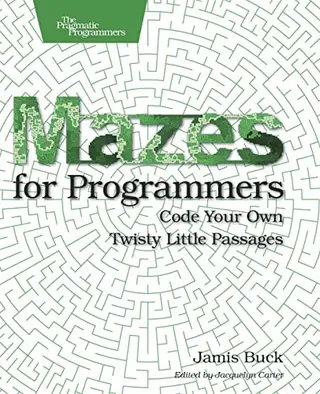
Mazes for programmers
by Jamis Buck · first published 2015
86% recommend14% neutral
Why HN recommends it
Clearly explained tour of maze generation algorithms with plenty of code; descriptions are detailed enough to reimplement in any language. Suits programmers who want hands-on practice projects, including game developers.
Summarised by Claude from recommending comments
Affiliate links. As an Amazon Associate I earn from qualifying purchases.
Mentions per year
What Hacker News says
Related books
 2019–2026
Ray Tracer Challenge
Jamis Buck
Recommended by 21 · mentioned by 2321 recommend · 23 mention21 recommend · 2321 recommend
 2014–2023
If Hemingway Wrote JavaScript
Angus Croll
Recommended by 9 · mentioned by 109 recommend · 10 mention9 recommend · 109 recommend
 2016–2026
Writing A Compiler In Go
Thorsten Ball
Recommended by 33 · mentioned by 3933 recommend · 39 mention33 recommend · 3933 recommend
 2016–2026
Writing An Interpreter In Go
Thorsten Ball
Recommended by 73 · mentioned by 9073 recommend · 90 mention73 recommend · 9073 recommend
 2007–2026
Turtle geometry
Harold Abelson, Andrea diSessa
Recommended by 15 · mentioned by 2715 recommend · 27 mention15 recommend · 2715 recommend
Beautiful Racket
Matthew Butterick
Recommended by 44 · mentioned by 4744 recommend · 47 mention44 recommend · 4744 recommend
 2010–2026
Physically Based Rendering
Matt Pharr, Greg Humphreys, Wenzel Jakob
Recommended by 92 · mentioned by 10992 recommend · 109 mention92 recommend · 10992 recommend
 2008–2026
The Elements of Computing Systems
Noam Nisan, Shimon Schocken
Recommended by 204 · mentioned by 268204 recommend · 268 mention204 recommend · 268204 recommend
…focus my teaching efforts, that every textbook should kind of have the appendix coffee-table section, I’d even like to carve out a new name for it and call it an “abridgement” or so, at the end. The book Mazes for Programmers has an appendix like this of “let me summarize all of these maze generation algorithms and their essential properties and their essential approaches” that I really loved, it makes it an absolute joy to…
on “Immersive Linear Algebra (2016)” ↗…F#, Elixir, or Racket) instead of whatever the book suggests, if it does suggest one (usually Python or some OOP language). But sometimes the language used in the book is fun, like Logo or Prolog. * Mazes for Programmers (by the same author of The Ray Tracer Challenge but is not as language agnostic) * The Elements of Computing Systems: Building a Modern Computer from First Principles * Programming Machine Learning:…
on “Ask HN: Books like “Crafting interpreters” or “The ray tracer challenge”?” ↗Mazes for Programmers http://www.mazesforprogrammers.com/
on “Ask HN: Fun Tech Book Recommendations?” ↗Ruby Under the Microscope: http://patshaughnessy.net/ruby-under-a-microscope The CS Detective: https://nostarch.com/csdetective Mazes for Programmers: http://www.mazesforprogrammers.com/ A Curious Moon: https://bigmachine.io/products/a-curious-moon/ xchg rax,rax: https://www.xorpd.net/pages/xchg_rax/snip_00.html
on “Ask HN: Most interesting, mildly impractical, well-written books on software?” ↗I would second the recommendation of Mazes for Programmers. The author used Ruby, but I used Python and that was actually good, because it forced me to really understand the algorithms, rather than just giving up and copying the Ruby code.
on “Ask HN: Books like “Crafting interpreters” or “The ray tracer challenge”?” ↗On topic, a great programming book other HN readers might like is Mazes for Programmers by Jamis Buck (http://www.mazesforprogrammers.com/ .) It's brilliant: very clearly explained, you can recreate source by reading the description in text which I find is the rarest of rare items in books…
on “Generating Mazes with Inductive Graphs” ↗This is by Jamis Buck! He wrote Mazes for Programmers, one of the best programming books I've ever read. It is clear and well-explained; you could write the code from the text description without seeing the code samples, which is incredibly rare. I had…
on “Lines of bare C++: raytracing made simple” ↗Jamis Buck's Mazes for Programmers is a really fun book to work through. Helped me break out of some doldrums when web development really got me down.
on “Eller’s Algorithm (2012)” ↗…follow the organic path you might follow doing things incrementally, rather than presenting everything full-blown. How to Make an RPG - Build a retro-style JRPG from scratch https://howtomakeanrpg.com/ Mazes for Programmers: Code Your Own Twisty Little Passages by Jamis Buck - covers a whole gamut of different maze generation algorithms. This author also has a great book on doing a raytracer step by step. https://www.amazon.com/Mazes-Programmers-Twisty-Little-Passa...…
on “Ask HN: What are some books where the reader learns by building projects?” ↗There's also a whole book dedicated to maze generating and solving: Jamis Buck's "Mazes for Programmers" https://pragprog.com/titles/jbmaze/mazes-for-programmers/
on “Mazette” ↗From the book "Mazes for Programmers" by Jamis Buck, 2015, The Pragmatic Programmers (a must-read for any maze/programming enthusiast!): > Aren't mazes supposed to have starting points and end points? […] honestly, […] it's entirely up…
on “Generating Mazes with Inductive Graphs (2017)” ↗For anyone interested in this, Jamis Buck's book 'Mazes for Programmers' is a masterpiece of the genre. My personal favorite distinction is between the Recursive Backtracker (which creates long, winding corridors with few dead ends which is great for tower defense games)…
on “Maze Algorithms (2017)” ↗Some interesting stuff I wasn't familiar with, thanks. I really like the book Mazes for Programmers by Jamis Buck [1]. Also, my open source Dungeon generator is a (slightly-misnamed) maze generator [2]. It produces 2D maps, and also 3D files (OBJ and MTL) for use in Blender etc. I like to think it…
on “Maze Algorithms” ↗“Mazes for Programmers” and “The Ray Tracer Challenge” by Jamis Buck.
on “Ask HN: What are some books where the reader learns by building projects?” ↗Procedural Generation in Game Design - provides a good overview, but is a bit light on implementation details. https://www.amazon.com/Procedural-Generation-Design-Tanya-Sh... Mazes for Programmers - only covers procedural mazes, but contains a lot of code and different types of mazes. https://www.amazon.com/Mazes-Programmers-Twisty-Little-Passa... Great channel with Unity tutorials on terrain…
on “Procedural content generation: creating a universe (2015)” ↗