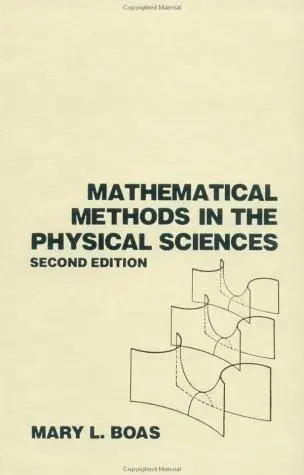
Mathematical Methods in the Physical Sciences
by Mary L. Boas, Mary Layne Boas · first published 1966
100% recommend
Why HN recommends it
Broad, succinct overview of the math techniques used across undergraduate physics, covering many areas without diving too deep into any one; a practical reference and cookbook for students and working physicists.
Summarised by Claude from recommending comments
Updates the original, comprehensive introduction to the areas of mathematical physics encountered in advanced courses in the physical sciences. Intuition and computational abilities are stressed. Original material on DE and multiple integrals has been expanded.
Affiliate links. As an Amazon Associate I earn from qualifying purchases.
Mentions per year
What Hacker News says
Related books
 2015–2024
Conceptual physics
Paul G. Hewitt
Recommended by 4 · mentioned by 54 recommend · 5 mention4 recommend · 54 recommend
 2016–2022
A first course in general relativity
Bernard F. Schutz
Recommended by 5 · mentioned by 75 recommend · 7 mention5 recommend · 75 recommend
 2008–2026
Calculus, An Intuitive and Physical Approach
Morris Kline
Recommended by 5 · mentioned by 55 recommend · 5 mention5 recommend · 55 recommend
 2008–2026
Calculus for the practical man
James Edgar Thompson
Recommended by 8 · mentioned by 228 recommend · 22 mention8 recommend · 228 recommend
 2011–2025
Introduction to graph theory
Richard J. Trudeau
Recommended by 10 · mentioned by 1810 recommend · 18 mention10 recommend · 1810 recommend
 2010–2025
Who is Fourier?
Transnational College of Lex
Recommended by 15 · mentioned by 1615 recommend · 16 mention15 recommend · 1615 recommend
 2008–2025
Mathematics
Andrei Nikolaevich Kolmogorov, M. A. Lavrentʹev, A.D Alexsandrov
Recommended by 12 · mentioned by 1512 recommend · 15 mention12 recommend · 1512 recommend
 2014–2026
Methods of mathematics applied to calculus, probability, and statistics
Richard Hamming
Recommended by 6 · mentioned by 96 recommend · 9 mention6 recommend · 96 recommend
Mary L Boas "Mathematical Methods in the Physical Sciences" [1] has absolutely been my favorite and most-used maths text in the 9 years since graduating uni. It's like a reference manual of just about all the non-CS (i.e. continuous/non-discrete) mathematical…
on “A Software Engineer’s Adventures in Learning Mathematics” ↗Mary Boas' "Mathematical Methods in the Physical Sciences" is also excellent, I'm using it for a course I'm teaching. At a level where a student is comfortable with calculus it presents an overview of the many areas needed to make graduate physics courses accessible.…
on “Theoretical Physics, In Your Own Time” ↗Good list! I'd also add Mary Boas' Mathematical Methods in the Physical Sciences. A standard textbook for incoming students across disciplines and very accessible
on “Ask HN: Are there books for mathematics like Feynman's lectures on physics?” ↗I would like to add one of my favorite mathematical "cookbooks" -- "Mathematical Methods in the Physical Sciences" by Mary Boas. Bad Integrals? Tensor Analysis? Fancy functions and special polynomials? PDE tricks? Boas has solutions! Methods are practically explained and succinct. It's my favorite book to brush…
on “Ask HN: How to self-study physics?” ↗…tricky, because you will usually need more development in math in concert with the physics. The omnibus "engineering mathematics" type books will cover a lot of it but I don't really like them. Boas's Mathematical Methods in the Physical Sciences would be something I would look at. For more detailed looks at electromagnetism and quantum mechanics, I (and many others I know) really liked David Griffiths's textbooks. The Feynman lectures make an…
on “Feynman Lectures on Physics now free online” ↗…counting numbers to partial differential equations. It's also a delight to read. I would start that as a survey of mathematical concepts, and then move on to a good math engineering/physics textbook, like Mathematical Methods in the Physical Sciences by Mary L. Boas
on “Ask HN: How or where to begin learning mathematics from first principles?” ↗On a related note, Mary Boas's text, Mathematical Methods in the Physical Sciences does a great job of giving you the necessary bag of tricks to learn all of undergraduate level physics (and probably much more) without diving too deep into any single topic. It should be sufficient to…
on “Physical Intuition, Not Mathematics (2011)” ↗…intergals, Maxwells Equations are actually really intuitive and quit beautiful. I was lucky that the maths course I was on covered those a few weeks before we started electrodynamics. Plus I had Mary Boas Mathematical Methods in the Physical Sciences which teaches this material (and Greens theorem etc) very well.
on “Why is Maxwell's theory so hard to understand? (2007) [pdf]” ↗…student do with all these books? I did my U/G & Masters in Physics in Exeter UK. We used only 1 actual textbook (University Physics by Young and Freedman, about 45USD new). I bought 1 more by choice (Mathematical Methods in the Physical Sciences by Mary Boas) because I needed some help there and the lecturer was weak. But all the actual information I needed was covered in lectures, tutorials etc. Assignments were class specific and produced…
on “High Prices Make Textbook ‘Piracy’ Acceptable to Most Students” ↗…of mathematicians! From the list, I have only read What is Mathematics? by Courant, which is a well-known and excellent book. I’d add Princeton Companion to Mathematics as a more advanced version, and Mathematical Methods in the Physical Sciences by Mary Boas as a more detailed alternative to What is Mathematics, to the list. Other titles on the list, such as those on probability or linear algebra, are perhaps less well-known.
on “Math Books” ↗Was a physics student. IMO the best book you can drill questions from is Boas' Mathematical Methods in the Physical Sciences. It offers fairly succinct yet comprehensive overviews of various fields of math. I still have my copy sitting at home. It is considered an essential textbook for any physics student. https://en.wikipedia.org/wiki/Mathematical_Methods_in_the_Ph...
on “Ask HN: How do I learn math/physics in my thirties?” ↗…stuff. Before going back to college to do Maths and Physics I went out to the local university to get advice as to how to study the subjects. I was told to get Feynman's Lectures ((in)famous) and Boas' Mathematical Methods in the Physical Sciences (extremely terse but excellent). I did, tried my best, and in retrospect still think they were taking the piss. And yet, when I went back to university a year later, there were so many ideas and intuitions…
on “How to Study Effectively” ↗