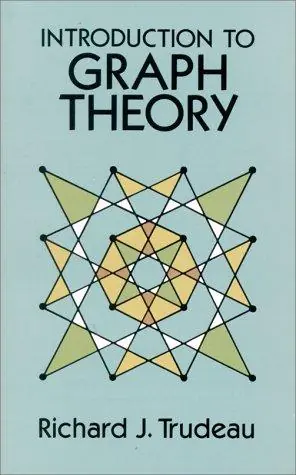
Introduction to graph theory
by Richard J. Trudeau · first published 1993
56% recommend44% neutral
Why HN recommends it
Gentle, proof-friendly introduction to graph theory that uses simple puzzles like two-colorable doodles to build intuition; suits readers with little math background, including those who found earlier math intimidating.
Summarised by Claude from recommending comments
Affiliate links. As an Amazon Associate I earn from qualifying purchases.
Mentions per year
What Hacker News says
Related books
 2009–2019
Prelude to mathematics
W. W. Sawyer
Recommended by 3 · mentioned by 33 recommend · 3 mention3 recommend · 33 recommend
 2016–2021
Advanced data structures
Peter Brass
Recommended by 3 · mentioned by 33 recommend · 3 mention3 recommend · 33 recommend
 2010–2025
Mathematical Methods in the Physical Sciences
Mary L. Boas, Mary Layne Boas
Recommended by 11 · mentioned by 1111 recommend · 11 mention11 recommend · 1111 recommend
 2012–2025
How to Think About Algorithms
Jeff Edmonds
Recommended by 4 · mentioned by 44 recommend · 4 mention4 recommend · 44 recommend
 2011–2022
A History of π
Petr Beckmann
Recommended by 3 · mentioned by 43 recommend · 4 mention3 recommend · 43 recommend
 2008–2026
Calculus, An Intuitive and Physical Approach
Morris Kline
Recommended by 5 · mentioned by 55 recommend · 5 mention5 recommend · 55 recommend
E, The Story of a Number
Eli Maor
Recommended by 8 · mentioned by 88 recommend · 8 mention8 recommend · 88 recommend
 2010–2023
A transition to advanced mathematics
Smith, Douglas
Recommended by 15 · mentioned by 1715 recommend · 17 mention15 recommend · 1715 recommend
…who's interested in this stuff enough background to figure out where to start digging deeper. For a little bit more on the technical side, a couple of good resources at: Introductory Graph Theory[8] Introduction to Graph Theory[9] Algorithms in Java: Part 5 - Graph Algorithms[10] [1]: http://en.wikipedia.org/wiki/Network_theory [2]: http://www.amazon.com/Network-Science-Applications-Ted-Lewis... [3]: http://www.amazon.com/Linked-Everything-Connected-Else-Means...…
on “An Introduction to Graph Theory and Network Science” ↗…1990s: http://www.springer.com/gp/book/9780387973821 But one I particularly enjoyed early on was written for liberal-arts level students of maths (who might've been traumatized by maths in the past): Introduction to Graph Theory: https://www.amazon.com/Introduction-Graph-Theory-Dover-Mathe... It will actually get you into writing proofs in set theory within the first couple of chapters.
on “Ask HN: Resources on how to improve abstract thinking skills?” ↗I really liked Introduction to Graph Theory by Trudeau. No upper level math required, but it got rigorous and fun at times. Mostly spatial reasoning. David Foster Wallace wrote Everything and More which included a lot of math history, while driving…
on “Classic Mathematics Books for Lifelong Learners” ↗…problems, but I don't think you need to know fancy math. A knowledge of functions, sets, tuples, logic, summations, etc, will get most of what you need. I highly recommend that book I linked in the article: "Introduction to Graph Theory" By: Trudeau
on “Think in Math, Write in Code” ↗…non-euclidian geometry, linear algebra, projective geometry and group theory. Again, for someone with an understanding of algebra. I enjoyed it and think it's in the spirit of what you're looking for. Edit: Introduction to Graph Theory by Trudeau is another that I really liked. Very little was applicable to graphs as programmers think of them. Pure math that is easy to grasp and enjoy.
on “Ask HN: Are there books for mathematics like Feynman's lectures on physics?” ↗I came to add add Introduction to Graph Theory and found it here. I second it! A nice book and I appreciate it's funny introduction as a book designed for liberal arts majors injured by the pedagogy of institutional mathematics (paraphrasing). If…
on “Ask HN: Are there books for mathematics like Feynman's lectures on physics?” ↗…Cryptography by Christof Paar Database Systems: Fundamentals of Design, Implementations and Management by by Peter Rob Principles of Concurrent and Distributed Programming: Algorithms and Models by M. Ben-Ari Introduction to Graph Theory by Richard Trudeau Advanced Data Structures by Peter Brass Ones and Zeros: Understanding Boolean Algebra, Digital Circuits, and the Logic of Sets by John Gregg An Introduction to Algebraic Structures…
on “Ask HN: What is a must read for a developer without a computer science degree?” ↗Read some books, practice exercises, and find an area of interest. Start with some liberal-arts introduction to a particular topic of interest and delve in. I often find myself recommending Introduction to Graph Theory [0]. It is primarily aimed at liberal arts people who are math curious but may have been damaged or put off by the typical pedagogy of western mathematics. It will start you off by introducing some basic…
on “Ask HN: How do I learn math/physics in my thirties?” ↗…think abstractly and make your own arguments is much more satisfying. There's a great book that doesn't require too much more than HS level math to understand which starts to make this connection called, Introduction To Graph Theory [0] and it's one of my all-time favorites. [0] https://www.amazon.com/Introduction-Graph-Theory-Dover-Mathe...
on “Ask HN: CS, still a good career in 3-5 years?” ↗Introduction to Graph Theory - Richard J. Trudeau A History of Pi - Petr Beckmann Journey through Genius: The Great Theorems of Mathematics - William Dunham How to Bake Pi - Eugenia Chang These are all sort of 'pop-math' books…
on “Ask HN: I suck at math, where to start?” ↗If you're interested in this, I highly recommend the book Networks, Crowds, and Markets [1]. It's an awesome (undergrad-level) introduction to graph theory, and has a ton of practical information on how it applies to modelling networks of people, as well as economic things like auctions and (game-theory) games. Since it's a textbook, it also has full exercises…
on “Graph and Network Analysis: Tutorial, datasets and code” ↗The freely available [1] is a nice supplement to some of the material in Concrete Mathematics, and this [2] is an approachable introduction to graph theory with side notes on both proof techniques and algorithms. More generally, if you're not already comfortable with linear algebra (a couple college semesters "or equivalent experience"), I'd recommend both…
on “Ask HN: Learn Math the Hard Way” ↗…talking about graph theory. Why should it be that a doodle is always two-colorable? It's a question a child could ask, but it leads to the whole area of graph theory. Personally, I find it a much better introduction to Graph Theory than the usual question about the Bridges of Königsberg: https://en.wikipedia.org/wiki/Seven_Bridges_of_Königsberg But there is a progression. * A doodle is two-colorable * A doodle is a planar, connected,…
on “An Unusual Proof of the Doodle Theorem” ↗…its just a myth or we can say a phobia that you need to know each and every piece of mathematics. And I think graph is a data structure that you should be work upon. For this you can refer this book Introduction to Graph Theory Subsequent Edition by Douglas Brent West. This book you can just read and practice while solving problems on above coding problem platforms. So, I recommend you first do code-forces DIV3, DIV2 problems,…
on “Ask HN: Looking for a book on algorithms and data structures” ↗…and therefore is well recommended. It is also where the subfield of graph theory (mostly) lies which makes it more readily accessible to programmers with an algorithms background. I can recommend West's Introduction to Graph Theory, but only with the caveat that it is incredibly dry and boring---you will get out of it what you put into practicing the proofs and nothing more. 3. Topology. This is the study of what it means for one…
on “Ask HN: How or where to begin learning mathematics from first principles?” ↗