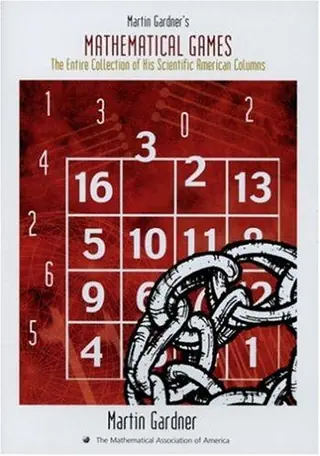
Martin Gardner's Mathematical Games
by Martin Gardner · first published 2005
11mentions
4recommended by
9HN commenters
2013–2026first – last mentioned
44% recommend56% neutral
Affiliate links. As an Amazon Associate I earn from qualifying purchases.
> Practice, and read about similar puzzles/problems. Track down reprints/scans of Martin Gardner's Mathematical Games and similar publications. The entire set of the 15 books that collected his "Mathematical Games" columns from Scientific American are available in PDF form on a CD-ROM: http://www.amazon.com/Martin-Gardners-Mathematical-Games-Gar...
on “The Parallel Climbers Puzzle” ↗…Scientific American and it completely hooked me. This was 1963 and SA was then a great magazine. I read every current issue and then read the bound volumes of past issues. My favorite monthly columns were Martin Gardner's Mathematical Games and the Amateur Scientist. I read every one of those two columns ever published. The schools I attended were not very good, but I learned a lot of math and science during those years at the library.…
on “Communicating Advanced Mathematics to Kids” ↗Practice, and read about similar puzzles/problems. Track down reprints/scans of Martin Gardner's Mathematical Games and similar publications. In general, for identifying if something is a graph problem: 1) Through some mapping, (almost?) everything can be transformed into a graph problem of some sort. Now, that's…
on “The Parallel Climbers Puzzle” ↗Maybe this won't be a popular opinion, but there are some non-CS-specific works that really helped cement some underlying principles. Namely, the fun stuff like "Martin Gardner's Mathematical Games" articles, "Gödel, Escher, Bach" by Hofstadter, and "The Cyberiad" by Stanislaw Lem. These require a bit of thoughtfulness applied to relate to CS. And it was specifically worthwhile to actually work…
on “Ask HN: I'm looking for a good book on the fundamentals of CS” ↗Thank you for sharing your story! I am going to google Martin Gardner's Mathematical Games later this afternoon!
on “Communicating Advanced Mathematics to Kids” ↗Martin Gardner's "Mathematical Games" column that popularized this game also included a description of a variant: Brussels Sprouts (http://en.wikipedia.org/wiki/Sprouts_(game)#Brussels_Sprouts), played with small crosses instead of dots.…
on “Sprouts Explained” ↗I was introduced to Nim by Martin Gardner's Mathematical Games column in Scientific American, Feb. 1958. It was there I learned the binary parity strategy that allows one to play perfect strategy easily. (Touched on in the Wikipedia article on Nim.) I got a lot…
on “Nim Game” ↗There were also Italian translations of Russian books, which were very popular slightly before my time as a student. On the other hand one of my most prized possessions is a hardcover version of Martin Gardner's Mathematical Games in Russian that I bought at a flea market for less than $2.
on “Mir Books” ↗What is this CD? I like old compilations. Edit: found it, it's called "Martin Gardner s Mathematical Games: The Entire Collection of His Scientific American Columns"
on “Math and puzzle fans find magic in Martin Gardner's legacy” ↗> John Baez's This Week's Finds posts I'm an aspiring amateur of recreational mathematics, and it gives me great joy to find this recommendation and start reading the series. It reminds me of Martin Gardner's "Mathematical Games" column, and its successor, Douglas Hofstadter's "Metamagical Themas". For a while now I've been chewing on Baez's paper, "Physics, Topology, Logic and Computation: A Rosetta Stone". I'm intrigued by…
on “AI in Mathematics Is Forcing Big Questions” ↗…numbers, and subtract or add the same constant to the century correction, without changing the final day. The month corrections and century corrections given in the article are old. I first saw them in Martin Gardner's "Mathematical Games" column in "Scientific American" around 50ish years ago. These are NOT the corrections most people use now. Instead of ADDING the numbers given: 1 4 4 0 2 5 0 3 6 1 4 6 with these century corrections…
on “How to Perform Calendar Calculations in Your Head” ↗