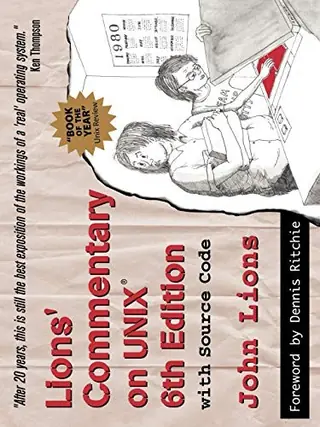
Lions' Commentary on UNIX 6th edition with source code
by John Lions · first published 1996
54% recommend46% neutral
Why HN recommends it
Annotated walkthrough of the complete 1976 Unix 6th Edition kernel source, prized for showing small, high-quality C code and how an early OS was structured; suits anyone wanting to study operating system design.
Summarised by Claude from recommending comments
Affiliate links. As an Amazon Associate I earn from qualifying purchases.
Mentions per year
What Hacker News says
Related books
 2009–2023
C, a reference manual
Samuel P. Harbison, Guy L. Steele Jr.
Recommended by 30 · mentioned by 4130 recommend · 41 mention30 recommend · 4130 recommend
 2008–2026
Modern Operating Systems
Andrew S. Tanenbaum, Herbert Bos
Recommended by 52 · mentioned by 8552 recommend · 85 mention52 recommend · 8552 recommend
 2008–2024
Structured Computer Organization
Andrew S. Tanenbaum
Recommended by 21 · mentioned by 2421 recommend · 24 mention21 recommend · 2421 recommend
 2008–2025
Design of the Unix Operating System
Maurice J. Bach
Recommended by 23 · mentioned by 3123 recommend · 31 mention23 recommend · 3123 recommend
 2008–2025
Advanced programming in the Unix environment
W. Richard Stevens, Stephen A. Rago
Recommended by 100 · mentioned by 136100 recommend · 136 mention100 recommend · 136100 recommend
 2007–2026
Operating Systems
Andrew S. Tanenbaum, Albert S. Woodhull
Recommended by 63 · mentioned by 10363 recommend · 103 mention63 recommend · 10363 recommend
 2008–2026
C interfaces and implementations
David R. Hanson
Recommended by 46 · mentioned by 6346 recommend · 63 mention46 recommend · 6346 recommend
 2008–2026
Expert C programming!
Peter Van der Linden
Recommended by 88 · mentioned by 11188 recommend · 111 mention88 recommend · 11188 recommend
My somewhat off-beat recommendation is "Lions' Commentary on UNIX 6th Edition with Source Code". The sources to a 1976 version of Unix written in an archaic dialect of C and targeting a long-dead CPU architecture are obviously not of immediate relevance to the modern world, and may well not be…
on “Ask HN: Recommended resources to learn the Linux kernel and OS theory?” ↗…programming. And kept reading and applying stuff; the key here is to never stop learning. Studying good software was probably the other major way. Back then, it was learning the UNIX V6 kernel with Lions' Commentary on UNIX 6th Edition, with Source Code plus reading the sources of all sorts of things and working on some of them. If you haven't read The Pragmatic Programmer, AntiPatterns: Refactoring Software, Architectures, and Projects in Crisis, something…
on “ASK HN: How are you becoming a better programmer?” ↗Indeed. I think I fit into that category, first used UNIX(TM) in 1978, first programmed in C in 1980-1 ... and I've never thought K&R was a good book. It was Lions' Commentary on UNIX 6th Edition, with Source Code (https://en.wikipedia.org/wiki/Lions%27_Commentary_on_UNIX_6t...) that was the key, and since its first edition, I've used C: A Reference Manual by Harbison and Steele (as in Guy Steele), initially written…
on “Admitting Defeat on K&R in LCTHW” ↗Back in 1980 K&R didn't really work well for me beyond the most basic things, the Lions' Commentary on UNIX 6th Edition, with Source Code did the trick, and it will teach you some basic operating system and UNIX things that are still quite useful. A classic, it's a copy of V6 UNIX with (the first really widely distributed one) including…
on “Ask HN: Best way to learn C” ↗…higher levels, in addition to the MIT Computer System Engineering courses mentioned by Mithrandir (http://news.ycombinator.com/item?id=1850311), especially 6.033, check out this classic from the '70s: Lions' Commentary on UNIX 6th Edition, with Source Code (http://en.wikipedia.org/wiki/Lions%27_Commentary_on_UNIX_6th...). Me and a lot of other people learned the basics from it, and while it's certainly dated, it has the advantage of being lucid and complete…
on “What are the best programming books around?” ↗…http://www.salon.com/technology/feature/2000/09/01/rich_stev... That article led me to this: http://www.salon.com/technology/feature/1999/11/30/lions/ind... which is another fantastic read. You can read about Lions' efforts here: Lions' Commentary on UNIX 6th Edition, with Source Code http://en.wikipedia.org/wiki/Lions_Commentary_on_UNIX_6th_Ed... http://tinyurl.com/2k9rwr (If the link above doesn't work) The commentary is available as a PDF file here: http://www.lemis.com/grog/Documentation/Lions/book.pdf
on “The Linux Programming Interface” ↗This course you build a small OS with the seL4 microkernel on a sabre lite board http://www.cse.unsw.edu.au/~cs9242/current/ Of course there's also Lions' Commentary on UNIX 6th Edition, with Source Code by John Lions and the plan9 operating system design specs you can go through to see why they did what they did. They're "old" resources but basics have stayed the same.
on “MenuetOS 1.0 – 1.5 MB OS written entirely in assembly [video]” ↗(1) Lions on Unix (PDF and source), http://www.lemis.com/grog/Documentation/Lions/index.php http://en.wikipedia.org/wiki/Lions%27_Commentary_on_UNIX_6th... "Lions' Commentary on UNIX 6th Edition, with Source Code by John Lions (1976) contains the complete source code of the 6th Edition Unix kernel plus a commentary. It is commonly referred to as the Lions book. Despite its age, it is still considered an excellent…
on “Ask HN: What are your recommended reads that are available for free?” ↗I have a positive opinion of Australian tech because I was one of many back in the day who learned a lot from Lions' Commentary on UNIX 6th Edition, with Source Code (https://en.wikipedia.org/wiki/Lions'_Commentary_on_UNIX_6th_...). This put the University of New South Wales on the map, and of course Australia as well. Since then, I've noticed you've got a research…
on “Why we kept our startup in Australia” ↗Certainly reading a lot of good C code is a part of this; for me, reading the predecessor Lions' Commentary on UNIX 6th Edition, with Source Code (https://en.wikipedia.org/wiki/Lions%27_Commentary_on_UNIX_6t...) was a key part of my learning serious C in the early '90s. Plus of course hacking on programs, most often various ersatz Emacs versions…
on “Ask HN: Books to learn advanced C programming” ↗I have not completely read yet but one of my favorite is : Lions' Commentary on UNIX 6th Edition, with Source Code[0] [0]. http://www.lemis.com/grog/Documentation/Lions/
on “Ask HN: Best book/document you've seen explaining a code base” ↗"Lions' Commentary on UNIX 6th Edition, with Source Code by John Lions (1976) ...Despite its age, it is still considered an excellent commentary on simple but high quality code. For many years, the Lions book was the only Unix kernel documentation available…
on “A Heavily-Commented Linux Kernel Source Code [pdf]” ↗…above and keep it somewhere close to 20,000 lines of assembly (excluding drivers). If you are looking for an education doing the above will probably do you just as good a job as trying from scratch. Lions' Commentary on UNIX 6th Edition, with Source Code http://en.wikipedia.org/wiki/Lions%27_Commentary_on_UNIX_6th... The Art of Computer Programming http://en.wikipedia.org/wiki/The_Art_of_Computer_Programming
on “BareMetal OS: A 64-bit Operating System in only 16KiB” ↗There's also the tried and true Lions' Commentary on UNIX 6th Edition with Source Code pdf floating around to understand what's going on in the workings of a timesharing OS. Nickolai Zeldovich a current MIT professor wrote HiStar OS from scratch and it's source is still available online…
on “Writing a simple operating system from scratch (2010) [pdf]” ↗"Lions' Commentary on UNIX 6th Edition, with Source Code" http://en.wikipedia.org/wiki/Lions%27_Commentary_on_UNIX_6th...
on “fork() can fail” ↗