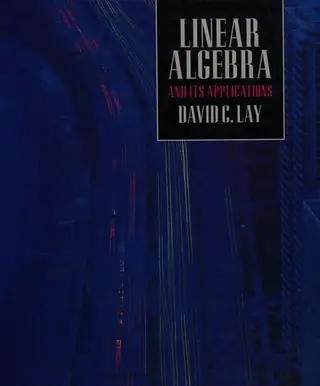
Linear algebra and its applications
by David C. Lay, Lay, Davic C. Lay, Steven R. Lay, Judi J. McDonald, Addison-Wesley Publishing Staff, Pearson Education Staff, David Lay, Judi McDonald, David C. Lay; Steven R. Lay; Judi J. McDonald, Judi McDonald David Lay, Steven Lay · first published 1994
73% recommend27% neutral
Why HN recommends it
Approachable intro to linear algebra with good diagrams and a geometric emphasis; concrete applications help build intuition. Sits between Strang and Axler in formality; suits self-learners and engineers.
Summarised by Claude from recommending comments
CD-ROM contains: Study guide -- Getting started with technology -- Download data -- New MATLAB projects -- PDF files.
Affiliate links. As an Amazon Associate I earn from qualifying purchases.
Mentions per year
What Hacker News says
Related books
 2008–2025
Linear algebra and its applications
Gilbert Strang
Recommended by 9 · mentioned by 139 recommend · 13 mention9 recommend · 139 recommend
 2011–2022
Linear Algebra for Everyone
Gilbert Strang
Recommended by 3 · mentioned by 33 recommend · 3 mention3 recommend · 33 recommend
 2011–2026
Matrix Analysis and Applied Linear Algebra
C. D. Meyer
Recommended by 6 · mentioned by 76 recommend · 7 mention6 recommend · 76 recommend
 2021–2023
Differential Equations and Dynamical Systems
Lawrence Perko
Recommended by 2 · mentioned by 22 recommend · 2 mention2 recommend · 22 recommend
 2007–2026
Introduction to linear algebra
Gilbert Strang
Recommended by 37 · mentioned by 5837 recommend · 58 mention37 recommend · 5837 recommend
 2008–2026
Linear Algebra Done Right
Sheldon Jay Axler
Recommended by 130 · mentioned by 179130 recommend · 179 mention130 recommend · 179130 recommend
 2018–2023
Math, Better Explained
Kalid Azad
Recommended by 2 · mentioned by 32 recommend · 3 mention2 recommend · 32 recommend
 2016–2023
Linear Algebra with Applications
Gareth Williams
Recommended by 2 · mentioned by 22 recommend · 2 mention2 recommend · 22 recommend
I enjoyed Linear Algebra Done Wrong [0], to be used in combination with a more traditional textbook, like Linear Algebra and its Applications [1] (which has some good diagrams). I've already seen it mentioned, but I'd like to add that 3b1b's Essence of Linear Algebra [2] videos are well made and make for a good supplementary resource early…
on “Ask HN: Best beginner friendly linear algebra book?” ↗My linear algebra was rusty so I bought "Linear Algebra and Its Applications" by David C. Lay. from a college student. The book is amazing, I highly recommend it.
on “Ask HN: What was the best book you read in 2016?” ↗…mathematician. - Linear Algebra, A Modern Intro, Poole https://www.amazon.com/Linear-Algebra-Introduction-Available... This is a solid text that has worked out most of its bugs over the editions. - Linear Algebra and its Applications, Lay https://www.amazon.com/Linear-Algebra-Applications-Updated-C... Like Poole, this is also a solid and long running text. The books by Klein and Strang also benefit from free videos of those courses…
on “The most mentioned books on Stack Overflow” ↗…first, to the point that you find many exercises in a text book straight forward. Watching 3blue1brown is a good start, but do move forward with deeper treatment. The book I find very usual is David Lay's Linear Algebra and Its Applications: https://www.amazon.com/Linear-Algebra-Its-Applications-5th/d.... Lay sets up a really intuitive geometric framework to explain the intuition of linear transformation with sufficient rigor.
on “An Intuitive Guide to Linear Algebra (2012)” ↗Personally I used David Lay's Linear Algebra and Its Applications as my first linear algebra book. It's more formal than Gilbert Strang's famous text book, but less formal than Linear Algebra Done Right. It's emphasis on geometric intuition really struck home, particularly…
on “Learning Math for Machine Learning” ↗I really liked Linear Algebra And Its Applications by David C Lay, although it seems that more people dislike it. I believe it's a pretty common book for college intro courses. It does illustrate everything pretty well if I remember correctly. Perhaps…
on “Ask HN: Best beginner friendly linear algebra book?” ↗I remember Linear Algebra and its Applications by David Lay was very approachable and had good visuals. It’s a small book that sticks to the main points.
on “Ask HN: Best beginner friendly linear algebra book?” ↗The three for me were: - Principles of Mathematical Analysis by Walter Rudin (aka “Little Rudin”) - Linear Algebra and its Applications by David Strang - Elementary Differential Equations and Boundary Value Problems by Boyce and Diprima
on “Ask HN: Math books that made you significantly better at math?” ↗I can second this, in my Engineering degree the Linear Algebra course (and the Calculus course) were both taught by the Math Faculty at my Uni. The textbook we used was "Linear Algebra: And its Applications" by David C Lay 20 years later I still keep this textbook with me at my desk and consult it a few times a year when I need to jog my memory on something. I consider it to be a very good textbook even…
on “Linear Algebra Done Right – 4th Edition” ↗"Linear Algebra and Its Applications" by David Lay is the best introductory linear algebra textbook, hands down. Love it.
on “Linear Algebra Done Right – Sheldon Axler” ↗…I will give you textbook suggestions: 1. Set Theory: Naive Set Theory, Halmos. 2. Calculus: Single Variable Calculus, Stewart; Multivariable Calculus, Stewart; Calculus, Spivak. 3. Linear Algebra: Linear Algebra and Its Applications, Strang; Linear Algebra Done Right, Axler; Linear Algebra, Hoffman & Kunz; Finite Dimensional Vector Spaces, Halmos. 4. Analysis: Analysis I, Tao; Analysis II, Tao; Understanding Analysis, Abbott; Principles…
on “Ask HN: How to self-learn math?” ↗Really good stuff from what I could tell from a glance at this! "Linear Algebra Done Right" is a terrific book, though personally I favor Lax's book: "Linear Algebra and its Applications". I have not studied Terence Tao's notes (which I obtained from AMS's link for "open math notes") https://www.ams.org/open-math-notes/omn-view-listing?listing.... Based on what I know of Tao's writing…
on “Linear Algebra Done Right Video Series” ↗…to more productive use. I feel like I've finally got my enemy in a corner. (The internet has never stopped me from working, but man has it stopped me from learning. But I digress.) As for what book: "Linear Algebra and its Applications" by Strang does sound like a good fit for hackers. I was convinced by this review: http://www.amazon.com/review/R289C7K1TN2RO2/ref=cm_cr_pr_per.... Some cheaper copies are available on Abebooks. There's…
on “Proposal: Linear Algebra Study Group” ↗Strang has another great book, Linear Algebra and its Applications: http://www.amazon.com/Linear-Algebra-Applications-Gilbert-St... Everything I know about linear algebra I learned from this book.
on “Surprises from numerical linear algebra (2010)” ↗…mathematics book. Formal theorem proving in vector spaces is the typical use case of a pure mathematician; this book is for them. If you're looking to do application, use an applied book. Gilbert Strang's "Linear Algebra and its Applications" is quite good.
on “Surprises from numerical linear algebra (2010)” ↗