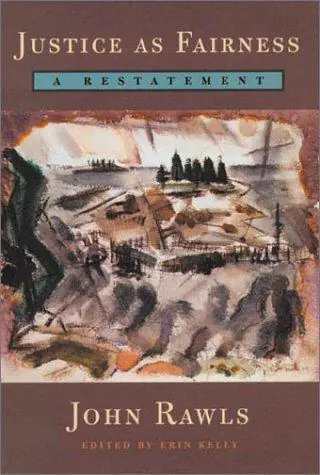
Justice as Fairness
by John Rawls · first published 1958
9mentions
3recommended by
7HN commenters
2011–2022first – last mentioned
43% recommend57% neutral
This book originated as lectures for a course on political philosophy that Rawls taught regularly at Harvard in the 1980s. In time the lectures became a restatement of his theory of justice as fairness, revised in light of his more recent papers and his treatise Political Liberalism (1993). Rawls offers a broad overview of his main lines of thought and also explores specific issues never before addressed in any of his writings. He is well aware that since the publication of A Theory of Justice in 1971, American society has moved farther away from the idea of justice as fairness. Yet his ideas
Affiliate links. As an Amazon Associate I earn from qualifying purchases.
…we may be closer to it than we were 200 years ago, but we're not there yet. In anycase, perfect egalitarianism is probably not possible. But for an excellent work on the subject, see John Rawls' work Justice as Fairness. As political philosophical texts go, it's fairly accessible to outsiders to the field, and it is comprehensive on the topic.
on “Personal income in the US shot up a record 10.5% in April” ↗If you still have a copy of A Theory of Justice, definitely pick it back up. If you'd like to work through his later-life work, then you'll want to grab Political Liberalism and Justice as Fairness: A Restatement, in which he revisits his original ideas, and brings together a full account of justice as fairness as he later understood it. Definitely recommend digging back into him.
on “Rich Kid, Poor Kid: For 30 Years, Baltimore Study Tracked Who Gets Ahead” ↗There's a great book on pretty much this topic in political philosophy, called Justice as Fairness by John Rawls. [0] In the vein of this conversation, he does not argue against inequality, and breaks out of the capitalism/communist spectrum. Instead he proposed the strictures under which inequality…
on “Hedge-fund billionaire Ray Dalio says capitalism is failing America” ↗Majority of the comments seem to be discussing the merits / morality of taxation, rather than Buffet's central points. Entertaining the discussion on the merits of taxation, I've found John Rawls' Justice as Fairness to be especially enlightening. (http://en.wikipedia.org/wiki/Justice_as_Fairness) Essentially, a just society is one in which decisions are made to benefit the worst-off in society. Given a majority…
on “Warren Buffett: Stop coddling the super rich” ↗…"justice" more "fairness" than anything else. There exist principles I would advocate from behind these veil that would be in most likelihood disfavorable against me. Indeed, Rawls write his principles as "Justice as Fairness" for a reason.
on “John Rawls: Visions of Justice” ↗…curious as to what are some alternate theories of how to do the most good besides a summing-like equation across individuals? See, as one of many alternatives, Rawls works (perhaps most particularly Justice as Fairness, but also the earlier A Theory of Justice) which present an approach which considers the position of different individuals and groups, but does not optimize a summing-like equation (unless you take "summing-like"…
on “The ‘effective altruists’” ↗I am reading Rawls’ followup book, “Justice as Fairness”, which he describes as a kind of restatement or correction to Theory of Justice. I am not sure if it would have been better to read the original first. The idea of the Veil of Ignorance for deriving…
on “Ask HN: Which books have made you a better thinker and problem solver?” ↗…preferences of the commons (see John Locke), not the individual. In practice have land owners pay the would be non-owners it’s full market value for the privilege of being called the owner (see Rawls, Justice as Fairness for this step). Call it a land value tax (see Henry George) or call it land rent. However, since it’s a payment to the commons, not the state, the only thing to do is to divide it fairly as a public dividend.…
on “Some excerpts from recent Alan Kay emails” ↗There's a certain irony in the coincidence of the defendant's name being "Rawls", who was a political philosopher [0] that sought to define what "justice" should be within political society... his work "Justice as Fairness" "describes a society of free citizens holding equal basic rights and cooperating within an egalitarian economic system." [0] https://plato.stanford.edu/entries/rawls/
on “Court rules that people can't be locked up indefinitely for refusing to decrypt” ↗