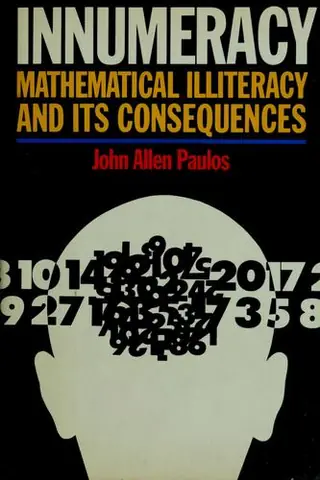
Innumeracy
Mathematical Illiteracy and Its Consequences
by John Allen Paulos · first published 1988
83% recommend17% neutral
Why HN recommends it
Accessible, fun look at everyday math illiteracy and its consequences, with real-world examples like percentages, estimation problems and a stock-market scam. Suits people who dislike math or want a friendlier view.
Summarised by Claude from recommending comments
Mathematical Illiteracy and its Consequences is a 1988 book by mathematician John Allen Paulos about innumeracy (deficiency of numeracy) as the mathematical equivalent of illiteracy: incompetence with numbers rather than words. Innumeracy is a problem with many otherwise educated and knowledgeable people.
Affiliate links. As an Amazon Associate I earn from qualifying purchases.
Mentions per year
What Hacker News says
Related books
Statistics, A Tool for Social Research
Joseph F. Healey
Recommended by 2 · mentioned by 22 recommend · 2 mention2 recommend · 22 recommend
 2007–2026
Super Crunchers
Ian Ayres
Recommended by 9 · mentioned by 219 recommend · 21 mention9 recommend · 219 recommend
 2012–2026
The Signal and the Noise
Nate Silver
Recommended by 47 · mentioned by 7947 recommend · 79 mention47 recommend · 7947 recommend
 2008–2026
The cartoon guide to statistics
Larry Gonick
Recommended by 17 · mentioned by 1717 recommend · 17 mention17 recommend · 1717 recommend
 2016–2026
Statistical Rethinking
Richard McElreath
Recommended by 81 · mentioned by 9281 recommend · 92 mention81 recommend · 9281 recommend
 2012–2025
Measurement
Paul Lockhart
Recommended by 23 · mentioned by 3023 recommend · 30 mention23 recommend · 3023 recommend
Chaos making a new science
james gleick
Recommended by 22 · mentioned by 3422 recommend · 34 mention22 recommend · 3422 recommend
 2007–2026
How to Lie with Statistics
Darrell Huff, Irving Geis
Recommended by 63 · mentioned by 12663 recommend · 126 mention63 recommend · 12663 recommend
…effectively is at least as important as learning how to think. This is also a book I recommend reading, re-reading, and then re-reading again for people of all ages. Edit: I'd also probably recommend Innumeracy[0] which is a fun book about dealing with numbers. It has some pretty great strategies for coming up with good back-of-napkin estimations which is a pretty useful skill. [0] http://www.amazon.com/Innumeracy-Mathematical-Illiteracy-Its...
on “What Would You Recommend to a Bright 14 Year Old?” ↗…double-check on slide rule calculations and exponent correction. But that is a useful skill, particularly in conjunction with a problem-solving attitude which they repeatedly emphasized us to do. And the book Innumeracy by Paulos gives examples of good problems to check with: "Is there a cubic mile of human blood in the world" and "How long would it take to move Mount Fuji" as a couple of examples. It doesn't sound…
on “My Nightmare Interviews With Google ” ↗…us. Four books come to mind. Physics: 1. Surely You're Joking, Mr. Feynman! (Adventures of a Curious Character) by Richard P. Feynman 2. The Universe in a Nutshell by Steven Hawking Mathematics: 1. Innumeracy: Mathematical Illiteracy and Its Consequences by J.A. Paulos 2. Gödel, Escher, Bach: An Eternal Golden Braid by D. Hofstadter These books brilliantly illuminate the beauty in these fields. They show…
on “Ask HN: Which book can attract anyone towards your field of study?” ↗…to have a programming job (that's a problem and they should be redirected to a more appropriate position). Another book I really like to recommend for people who hate maths or don't understand them is Innumeracy by John Allen Paulos. It really helps you get a more positive view on maths. The sequel, Beyond Numeracy, is less groundbreaking though.
on “How To Become A Better Programmer By Not Programming” ↗I think it was a comment about Mathematical Illiteracy. Many people have little idea what X% more / less actually means. http://www.amazon.com/Innumeracy-Mathematical-Illiteracy-Its...
on “New York City celebrates day without violent crime” ↗Really good book on the subject that deals with why/ramifications of a society that's okay with "I can't do math" as a reasonable thing for an otherwise educated person. Innumeracy: Mathematical Illiteracy and Its Consequences John Allen Paulos http://www.amazon.com/Innumeracy-Mathematical-Illiteracy-Its...
on “"I can't do math" (2001)” ↗Please read Paulos's classic book Innumeracy, on its 30th anniversary https://math.temple.edu/~paulos/oldsite/scam.html
on “Do Stocks Outperform Treasury Bills? (2018)” ↗…textbook used in the class, which I highly recommend] Catherine Marsh and Jane Elliott (2008) Exploring Data: An Introduction to Data Analysis for Social Scientists, second edition John Allen Paulos (1988) Innumeracy: Mathematical Illiteracy and Its Consequences Nate Silver (2012) The Signal and the Noise: Why So Many Predictions Fail, but Some Don't Nassim Nicholas Taleb (2005) Fooled by Randomness, second edition;…
on “More than half of adults in U.S. say they lack basic statistical understanding” ↗…Thinking by Numbers is the New Way to Be Smart. Joseph Healey (2020) Statistics: A Tool for Social Research [This is the textbook used in the class, which I highly recommend]. John Allen Paulos (1988) Innumeracy: Mathematical Illiteracy and Its Consequences. Nate Silver (2012) The Signal and the Noise: Why So Many Predictions Fail, but Some Don't. Nassim Nicholas Taleb (2005) Fooled by Randomness, second edition.…
on “Ask HN: Would you read a statistics textbook?” ↗…affects the low-tech systems that you use to handle them. For interesting/easy intros to why some math skills are important, look at Darrell Huff's "How to Lie With Statistics" or John Allen Paulos' "Innumeracy" (or "A Mathematician Reads the Newspaper"). I haven't read any of them, but I hear Petroski's books recommended. For a great short read that touches on architectural engineering, law, and ethics, look…
on “Ask HN: What are some good general technical books for teenagers?” ↗For a different take people might be interested in "A Mathematician Plays the Stockmarket", by John Allen Paulos (he also wrote the excellent "Innumeracy"). The book explains a bunch of mistakes he made when investing. http://www.amazon.com/Mathematician-Plays-The-Stock-Market/d...
on “Hard-won lessons about money and investing” ↗The first author that comes to mind is : https://en.wikipedia.org/wiki/John_Allen_Paulos His most famous book is Innumeracy: https://en.wikipedia.org/wiki/Innumeracy_(book) but all his books are nice. Maybe they are too simple/basic?
on “Ask HN: Do you know any fun science/maths books for a casual read?” ↗Maybe too re-known by the HN audience, to be "news", but in the classic "Innumeracy: Mathematical Illiteracy and Its Consequences" by John Allen Paulos there is a part, titled "A STOCK-MARKET SCAM" where the point is extremely well-made (the simplified scam described is a way to make…
on “Heads, I Win. Tails, You Forget We Had a Bet” ↗Might look to "Innumeracy" by John Allen Paulos. Though written a fairly long time ago, the subject fares better over time than many more qualitative ones.
on “John Urschel tackles his lifelong balance of math and football in new memoir” ↗…examples, including criticism of the limitations of statistical analysis, I would suggest these excellent studies: Lewis, Michael (2010) The Big Short: Inside the Doomsday Machine Paulos, John Allen (1988) Innumeracy: Mathematical Illiteracy and Its Consequences Silver, Nate (2012) The Signal and the Noise: Why So Many Predictions Fail, but Some Don't Taleb, Nassim Nicholas (2005/10) Fooled by Randomness, 2E; Black…
on “Ask HN: What is your favorite book for learning statistics?” ↗