Chaos making a new science
by james gleick · first published 1987
65% recommend32% neutral3% critical
Why HN recommends it
Accessible, readable introduction to chaos theory and complexity for lay readers, covering period-doubling, self-similarity and the scientists behind the field; pairs well with GEB and suits the curious non-specialist.
Summarised by Claude from recommending comments
The author describes how scientists studying the growth of complexity in nature are discovering order and pattern in chaos. He explains concepts such as nonlinearity, the Butterfly Effect, universal constants, fractals, and strange attractors, and examines the work of scientists such as Mitchell J. Feigenbaum, Edward Lorenz, and Benoit Mandelbrot.
Affiliate links. As an Amazon Associate I earn from qualifying purchases.
Mentions per year
What Hacker News says
Related books
 2015–2023
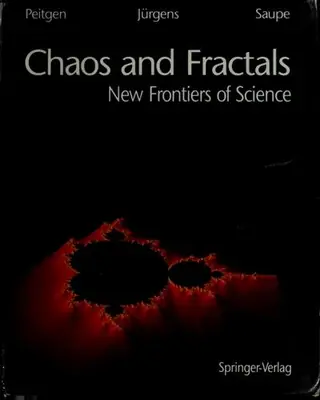
Chaos and fractals
Heinz-Otto Peitgen, Hartmut Jürgens, Dietmar Saupe
Recommended by 4 · mentioned by 54 recommend · 5 mention4 recommend · 54 recommend
 2015–2022
Algebra, the easy way
Douglas Downing
Recommended by 2 · mentioned by 32 recommend · 3 mention2 recommend · 32 recommend
 2008–2026
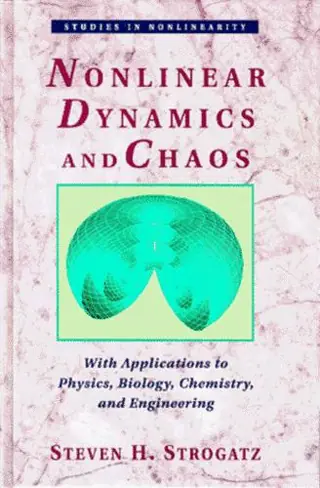
Nonlinear dynamics and Chaos
Steven H. Strogatz, Steven Strogatz
Recommended by 24 · mentioned by 2924 recommend · 29 mention24 recommend · 2924 recommend
 2009–2026
Calculus the easy way
Douglas Downing
Recommended by 6 · mentioned by 76 recommend · 7 mention6 recommend · 76 recommend
 2008–2026
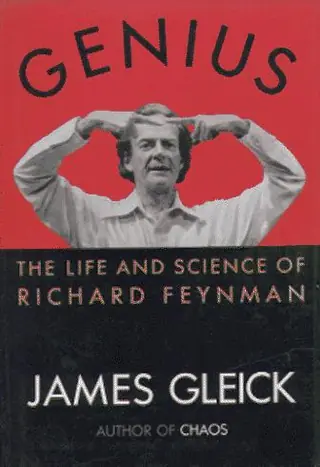
Genius
James Gleick
Recommended by 17 · mentioned by 2917 recommend · 29 mention17 recommend · 2917 recommend
 2009–2022
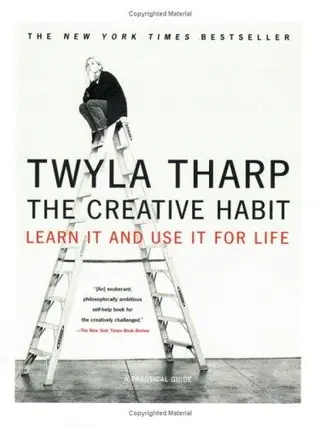
The Creative Habit
Twyla Tharp
Recommended by 10 · mentioned by 1410 recommend · 14 mention10 recommend · 1410 recommend
 2008–2026
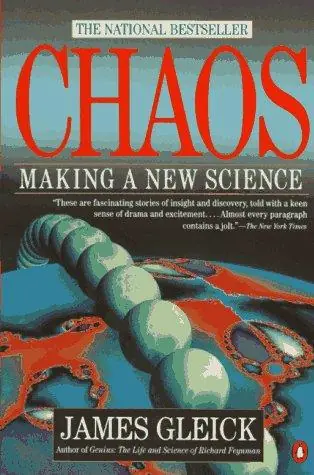
Chaos
James Gleick
Recommended by 45 · mentioned by 6345 recommend · 63 mention45 recommend · 6345 recommend
 2010–2026
Tai-Pan (Asian Saga
James Clavell
Recommended by 7 · mentioned by 97 recommend · 9 mention7 recommend · 97 recommend
It's sad to see that James Gleick did not make the list, but you must draw the line somewhere. For anyone who sees this, may I suggest Chaos: Making A New Science.
on “Steven Weinberg: Science books for the general reader” ↗I was unable to finish "Tipping Point" as it was, in my view, a failed kindergarten-level attempt to explain Chaos, which was done so superbly in 'Chaos: Making a New Science' by James Gleick. That plus his howler about "Igon Value." A good storyteller, yes, but that is the limit.
on “Michael Lewis' next book is about Sam Bankman-Fried” ↗…3/6, cca 7:10) Why are the still saying that? When I first read about deterministic chaos in the James Gleick book [1], I almost wept with joy and awe. It opened my eyes and made complete sense. [1] Chaos: Making a New Science (http://en.wikipedia.org/wiki/Chaos:_Making_a_New_Science)
on “The Secret Life of Chaos (BBC documentary)” ↗I remember being blown away by this book as a teen: James Gleick - Chaos: Making a New Science https://www.amazon.com/Chaos-Making-Science-James-Gleick/dp/...
on “Ask HN: Recommend a maths book for a teenager?” ↗…- Taiichii Ohno * Thinking in Systems - Donella Meadows * Fifth Discipline - Peter Senge Agile: * Extreme Programming, Explained (2nd ed.) - Kent Beck (the annotated bibliography is a goldmine) * Chaos: Making a New Science - James Gleick Programming: * Implementation Patterns - Kent Beck * Test-Driven Development, By Example - Kent Beck * Refactoring (both editions) - Martin Fowler * Refactoring to Patterns - Joshua…
on “Theory-building and why employee churn is lethal to software companies” ↗James Gleick's "Chaos: Making a new science" will answer your questions and is a fun read!
on “Symmetry in Chaos” ↗"Streetlights and Shadows: Searching for the Keys to Adaptive Decision Making", Gary Klein "Normal Accidents: Living with High-Risk Technologies", Charles Perrow "Chaos: Making a New Science", James Gleick "Filters Against Folly", Garrett James Hardin "Judgment in Managerial Decision Making", Max Bazerman "Deep Simplicity: Bringing Order to Chaos and Complexity", John Gribben
on “Ask HN: What books to read on developing mental models and increasing cognition?” ↗Many of the scientists involved in the genesis of chaos theory were active in multiple disciplines, notably meteorology. It's a central theme in James Gleick's Chaos: Making a New Science[1]. It's a fascinating book, and would be a great read if you were tickled by the article. [1] http://www.amazon.co.uk/Chaos-Making-Science-James-Gleick/dp...
on “The father of fractals: Benoit Mandelbrot's unusual multidisciplinary approach” ↗Chaos: Making A New Science -- James Gleick I can't recommend this book enough. Go get it right now. It's worth it.
on “Ask HN: Good resources to learn Chaos Theory” ↗Chaos : Making a New Science by James Gleick https://www.amazon.com/dp/B003YL4KOO/ contextualizes the period-doubling thing and talks about some of the other related stuff. Good book.
on “Mitchell Feigenbaum (1944–2019), 4.66920160910299067185320382…” ↗One more related recommendation would be James Gleick's Chaos book: https://en.wikipedia.org/wiki/Chaos:_Making_a_New_Science It is a good introduction to Chaos Theory and complexity science and a nice read alongside GEB.
on “Gödel's Completeness Theorem” ↗- Sapiens - The Lord of the Rings - Siddhartha - Chaos: Making a New Science - The Death Gate cycle books - Neuromancer - Head First Design Patterns - Valis - Dune - The name of the rose I'm sure there are more, but these are the ones off the top of my head.
on “Ask HN: Which books have you read more than once?” ↗I liked 'Chaos: Making a New Science' by James Gleick but that was a long time ago. 'Turbulent Mirror: An Illustrated Guide to Chaos Theory' is also excellent.
on “Ask HN: What's your favorite book about chaos theory?” ↗…https://www.youtube.com/watch?v=g1eUIK9CihA James Gleick, Doyne Farmer, Jim Crutchfield, Ken Wilson, or Leo Kadanoff maybe? https://petterhol.me/2022/08/11/the-golden-age-of-complexity... >J Gleick, 1987. Chaos: Making a New Science. Viking Penguin, New York. The name aside, Gleick’s Chaos is the quintessential complex systems book, providing a prototype for the golden age. It does an excellent job of capturing the frenzied mid-80s…
on “The Fundamentals of Control Theory” ↗…statistical ensemble predictions. We can never know the initial state of a system to infinite precision, as is needed to predict its trajectory. [0] [0] Light-ish reading on nonlinear dynamics: James Gleick - Chaos: Making a New Science
on “What You (Want to)* Want” ↗