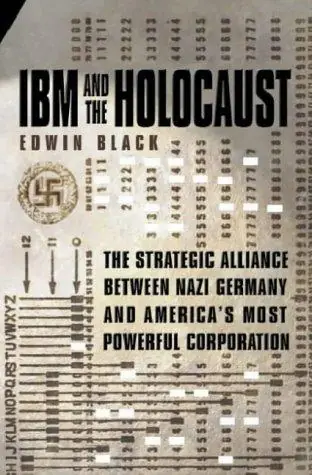
IBM and the Holocaust
The Strategic Alliance Between Nazi Germany and America's Most Powerful Corporation
by Edwin Black · first published 2001
19% recommend80% neutral1% critical
Why HN recommends it
Meticulously documented account of IBM's punch-card and tabulation support for Nazi Germany, read for how data processing enabled persecution and what it says about corporate ethics; suits technologists.
Summarised by Claude from recommending comments
IBM and the Holocaust is the stunning story of IBM's strategic alliance with Nazi Germany -- beginning in 1933 in the first weeks that Hitler came to power and continuing throughout World War II. As the Third Reich embarked upon its plan of conquest and genocide, IBM and its subsidiaries helped create enabling technologies, step-by-step, from the identification and cataloging programs of the 1930s to the selections of the 1940s. Only after Jews were identified -- a massive and complex task that Hitler wanted done immediately -- could they be targeted for efficient asset confiscation, ghettoiz
Affiliate links. As an Amazon Associate I earn from qualifying purchases.
Mentions per year
What Hacker News says
Related books
 2010–2025
The printing press as an agent of change
Elizabeth L. Eisenstein
Recommended by 5 · mentioned by 75 recommend · 7 mention5 recommend · 75 recommend
 2009–2026
The Technological Society
Jacques Ellul
Recommended by 36 · mentioned by 5236 recommend · 52 mention36 recommend · 5236 recommend
 2013–2023
COMING OF THE THIRD REICH
Richard J Evans
Recommended by 8 · mentioned by 138 recommend · 13 mention8 recommend · 138 recommend
 2009–2025
Collected Fictions
Jorge Luis Borges
Recommended by 13 · mentioned by 1613 recommend · 16 mention13 recommend · 1613 recommend
 2007–2026
Anthem
Ayn Rand, classics jifara, Spectrum Spectrum Classics
Recommended by 12 · mentioned by 2612 recommend · 26 mention12 recommend · 2612 recommend
 2015–2026
The Gutenberg Galaxy
Marshall McLuhan
Recommended by 8 · mentioned by 188 recommend · 18 mention8 recommend · 188 recommend
 2010–2026
The Rise and Fall of the Third Reich
William L. Shirer
Recommended by 37 · mentioned by 6737 recommend · 67 mention37 recommend · 6737 recommend
 2009–2026
Digital Apollo
David A. Mindell
Recommended by 31 · mentioned by 3631 recommend · 36 mention31 recommend · 3631 recommend
For those who might want a fuller description of IBM's active facilitation of these kinds of crimes, you should read Edwin Black's book, "IBM and the Holocaust". Those tattoo's on Holocaust victim's arms? They were serial numbers directly tied to IBM punchcards designed by IBM for the Third Reich. It gives context to former NSA chief Michael Hayden's comment,…
on “EFF Files Brief in Case to Hold IBM Responsible for Facilitating Apartheid” ↗This gets brought up every other thread on the subject of 'registries' for minority groups, but if you haven't you really should read IBM And The Holocaust: The upshot is that Germany used their census data to figure out who is and isn't a Jew, but they also used records from synagogues, surname analysis, and other pre-war 'big data' sources along with…
on “A Muslim “registry” doesn't require a single registration, just data” ↗Have you heard about IBM's role in WWII? Go read "IBM and the Holocaust" by Edwin Black. Those tattooed numbers on the arms of people in concentration camps were numbers tabulated by IBM machines.
on “Founder of Blackwater's Drive to Build a Private Air Force” ↗That book is called IBM and The Holocaust and it is indeed very good. IBM wasn't going bankrupt before working with the Nazi's though. It talks about how IBM rolled out punch-card technology originally developed for the census to the Nazi's via…
on “Azure Government and ICE” ↗Just try reading IBM and the Holocaust: The Strategic Alliance Between Nazi Germany and America's Most Powerful Corporation by Edwin Black or if you can read french "Libres d'obéir: Le management, du nazisme à aujourd'hui" by Johann Chapoutot…
If you're interested in tabulators & punch cards and the impact they had on human history, read IBM and the Holocaust by Edwin Black. It's a sometimes dry but fascinating explication of the role IBM played in supporting the Holocaust and the strategies the company employed to continue doing business with Germany during…
on “Inside card sorters: 1920s data processing, relay logic and linear time sorting” ↗…is, of course, one slight problem with Simon's argument: The Nazis did make heavy use of mechanised data processing, provided and supported by IBM. Edwin Black documents this meticulously in his book IBM and the Holocaust: https://ibmandtheholocaust.com
on “Atlas of Surveillance” ↗…of you want non-fictional/sci-fi accounts of the "Nineteen Eighty Four" and "Brave New World" type then I'd recommend starting with Postman, Illich, Ellul and Mumford as these lay firmer foundations. IBM and the Holocaust (Edwin Black) is obviously worth a read in this context. > Obviously there are unintended negative effects Those are interesting. But so are the intended ones. > but I think it's not certain how they'll…
on “They Thought They Were Free: The Germans, 1933-45” ↗…design. An AK47 and a baby incubator carry different values, one is a for taking life and one is for preserving it. At a more subtle granularity computers carry values with them. I recommend Edwin Black's "IBM and the Holocaust" for some insights here. A Google Pixel carries different values than a Raspberry Pi - though to most eyes the differences are invisible. > It's just that we are increasingly losing control of them.…
on “Computers are an oppressive technology” ↗If you've ever read "IBM And The Holocaust" [1], you might say they deserve much more than this. 1. http://www.amazon.com/IBM-Holocaust-Strategic-Alliance-Corpo...
on “The Fed suckered IBM into a failing cloud strategy?” ↗I'd invite you to read "IBM and the Holocaust"[0] if you'd like a good analysis of how a corporation can commit atrocities of war through the types of data gathering Facebook and Oracle do daily. 0. https://www.goodreads.com/book/show/48838.IBM_and_the_Holoca...
on “Facebook Live: Now You Can Never Leave” ↗>I believe we need a more serious national conversation on China and the role that technology companies play in enabling dictatorships. if this interests you, I recommend reading "IBM and the Holocaust: The Strategic Alliance between Nazi Germany and America's Most Powerful Corporation" by Edwin Black https://en.wikipedia.org/wiki/IBM_and_the_Holocaust
on “Xi Jinping decides to abolish presidential term limits” ↗IBM and the Holocaust by Edwin Black. Incredible product of research and history.
on “Ask HN: Books you read in 2022 and recommend for 2023” ↗To anyone interested in the history of IBM (and I think the TJ Watson Jr. era has many lessons to teach!), be sure to also read IBM and the Holocaust by Edwin Black. I read this recently -- and wished I had read it much earlier.[0] [0] https://bcantrill.dtrace.org/2023/11/26/what-punch-cards-tea...
on “The Rise and Fall of the 'IBM Way'” ↗Book recommendation for you: “IBM And The Holocaust” by Edwin Black. If IBM (then known as Hollerith) could do that much damage with German census data on punchcards…
on “Independent directors of 23andMe resign from board” ↗