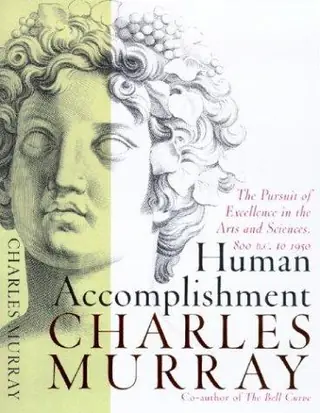
Human Accomplishment
by Charles A. Murray · first published 2003
30% recommend50% neutral20% critical
A sweeping cultural survey reminiscent of Barzun’s From Dawn to Decadence.“At irregular times and in scattered settings, human beings have achieved great things. Human Accomplishment is about those great things, falling in the domains known as the arts and sciences, and the people who did them.”So begins Charles Murray’s unique account of human excellence, from the age of Homer to our own time. Employing techniques that historians have developed over the last century but that have rarely been applied to books written for the general public, Murray compiles inventories of the people who have be
Affiliate links. As an Amazon Associate I earn from qualifying purchases.
Here's the book, it's an interesting premise. https://en.wikipedia.org/wiki/Human_Accomplishment Murray ranks the leading 4,000 innovators in several fields of human accomplishment from 800 BC to 1950. In each field Murray identifies a number of sources (leading encyclopedias, histories and surveys)…
on “The Most Common Error in Media Coverage of the Google Memo” ↗…of the tests, so ultimately you end up with a judgement call for which tests to include, and how much to gather from their results. A far more enlightening study of genius, I have found in the book "Human Accomplishment", by Charles Murray. When you're sample is all of those humans who have left a mark on history, and your measure is impact, and our remembrance of it, you learn far more about the heights of human capability,…
on “U.S. Team Wins First Place at International Math Olympiad” ↗This is the response to the reply above; I'm unable to directly respond to a comment that deep. I thought similar things about Charles Murray, and I don't think that the Human Accomplishment book is without flaws -- it has many. Nonetheless, the whole book is worth reading. Honestly, I think it faces some serious facts on the distribution of impact on civilization. The fact that some cultures,…
on “U.S. Team Wins First Place at International Math Olympiad” ↗Human Accomplishment: The Pursuit of Excellence in the Arts and Sciences, 800 B.C. to 1950 by Charles Murray. The author did statistical analysis to find the most influential figures in each field of endeavour, from philosophy…
on “Ask HN: What are some good (fiction/non-fiction) books about human progress?” ↗…in fact a racist"? https://www.currentaffairs.org/2017/07/why-is-charles-murray... > A far more illuminating piece of evidence about the Murray racial worldview is found in his little-read 2003 book Human Accomplishment, the text that substantiates point 2 on the above List Of Racist Charles Murray Beliefs: Black cultural achievements are almost negligible. > Human Accomplishment shows that Murray has a long obsession…
on “The Full 10-Page Anti-Diversity Screed Circulating Internally at Google” ↗…engage remotely with arguments from modernists who drove this change, or the scholarship on aesthetics,… very little substance for the length. It sort of read like a sanitized version of Charles Murray’s “Human Accomplishment”, which is a “quantitative” “argument” for why Western culture is superior that commits severe epistemic mistakes [1]. Scott Alexander has some good takes, but this is not one of them. And to give a…
It is a bit silly, but if you use a variety of encyclopedias and source texts with various temporal cutoffs (not just this one, but Simonton's work or Murray's _Human Accomplishment_ where he ignores any item after 1950 while drawing on published books), you do pretty consistently get the late 1800s as the apex for per capita.
on “The per capita rate of innovation (2004)” ↗…is no clustering at all! > Also, would any of these (suspiciously all European) super-geniuses have been as successful if there were born in a small backwater village? Many of them were. Murray in _Human Accomplishment_ notes that of his eminent figures, while they all tended to gravitate towards capital cities like London and Paris as young as possible and live and die there, they were often born in the countryside.…
on “Super-Intelligent Humans Are Coming” ↗…seem to have missed the thrust of the article which isn't that The Bell Curve proves Murray to be a racist (although it certainly has him winking strongly in that direction) but that his other book, "Human Accomplishment" is flagrantly and defiantly racist. > A far more illuminating piece of evidence about the Murray racial worldview is found in his little-read 2003 book Human Accomplishment, the text that substantiates…
on “The Full 10-Page Anti-Diversity Screed Circulating Internally at Google” ↗Charles Murray, author of * Human Accomplishment: The Pursuit of Excellence in the Arts and Sciences, 800 B.C. to 1950 * Losing Ground: American Social Policy, 1950–1980 * Real Education: Four Simple Truths for Bringing American Schools Back to Reality…
on “Taleb is wrong about IQ” ↗…financial center increased the expected number of significant figures by 64 percent, holding everything else constant, while having an elite university increased that expected number by 184 percent. Human Accomplishment: Charles Murray, page 369 More generally this critique ignores the second industrial revolution altogether. The U.K. shows progress outside universities is possible, as does the preceding industrious…
on “We Need a New Science of Progress” ↗You can't really believe this, as it's so obviously wrong. It is also a contention that has pretty racist adherents; Charles Murray's Human Accomplishment book comes to mind. This isn't a coincidence, as suggesting that non-western peoples have contribute nothing of value to this "we" is pure western chauvinism, which is racism's non-identical twin brother.
on “Remember them more honestly” ↗They left off Charles Murray who incidentally derived a novel way of measuring intellectual influence semi-objectively. http://en.wikipedia.org/wiki/Human_Accomplishment
on “Only one computer scientist in the world's top 100 public intellectuals” ↗