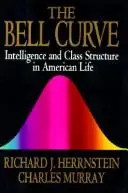
The bell curve
by Richard J. Herrnstein, Charles A. Murray · first published 1994
8% recommend76% neutral16% critical
Why HN recommends it
Argues that cognitive ability, socioeconomic outcomes and the links between them are measurable, drawing heavily on large-sample data. It serves as a central reference on IQ, class and wealth correlations in debate.
Common criticism: Heavily criticized as dated and methodologically flawed, with many calling its genetic claims debunked.
Summarised by Claude from recommending comments
Breaking new ground and old taboos, Richard J. Herrnstein and Charles Murray tell the story of a society in transformation. At the top, a cognitive elite is forming in which the passkey to the best schools and the best jobs is no longer social background but high intelligence. At the bottom, the common denominator of the underclass is increasingly low intelligence rather than racial or social disadvantage. The Bell Curve describes the state of scientific knowledge about questions that have been on people's minds for years but have been considered too sensitive to talk about openly -- among the
Affiliate links. As an Amazon Associate I earn from qualifying purchases.
Mentions per year
What Hacker News says
Related books
 2019–2022
Human Diversity
Charles Murray
Recommended by 1 · mentioned by 21 recommend · 2 mention1 recommend · 21 recommend
 2009–2014
Race, IQ and Jensen
James Robert Flynn
Recommended by 1 · mentioned by 21 recommend · 2 mention1 recommend · 21 recommend
 2009–2014
Assessing adolescent and adult intelligence
Alan S Kaufman
0 recommend · 2 mentioned0 recommend · 2 mention0 recommend · 20 recommend
 2009–2014
Assessing adolescent and adult intelligence
Kaufman, Alan S.
0 recommend · 2 mentioned0 recommend · 2 mention0 recommend · 20 recommend
 2020–2023
Superior
Angela Saini
Recommended by 3 · mentioned by 43 recommend · 4 mention3 recommend · 43 recommend
 2009–2026
The Mismeasure of Man
Stephen Jay Gould, Joandomènec Ros, Ricardo Pochtar, Antonio Desmonts
Recommended by 22 · mentioned by 5322 recommend · 53 mention22 recommend · 5322 recommend
 2012–2024
Losing ground
Charles A. Murray
Recommended by 1 · mentioned by 61 recommend · 6 mention1 recommend · 61 recommend
 2013–2026
Coming apart
Charles A. Murray
Recommended by 19 · mentioned by 3819 recommend · 38 mention19 recommend · 3819 recommend
…genetics. much further separated than kids of different ethnicities in the same country No. African-Americans, for example, have an average IQ of 85, very much like an up-market African country. Go read The Bell Curve. only extremely bad families have a major environmental effect The siblings in the adoptive families have nearly the full range of accomplishments of the general public. The possible explanations are…
on “Treating Students as Gifted Yields Impressive Academic Results, Study Finds” ↗The standard work is The Bell Curve. They studied many thousands of Americans of every race and subculture. They found that the only significant predictor of earned income was IQ. Race, location, parental income, and so forth did not matter…
on “American Dream Fades for Generation Y Professionals” ↗…so ably demonstrated. [1]: See, for example, The Blank Slate by Steven Pinker. Then, once you get over your knee-jerk "That's racist!!!" reflex, take a look—I mean actually read for comprehension—The Bell Curve by Herrnstein and Murray. Maybe add a little Cavalli-Sforza (via Steve Sailer) to the mix (http://www.vdare.com/articles/052400-cavalli-sforzas-ink-clo...). You can then graduate to basically anything…
on “A Way to Detect Bias” ↗I am talking about books like: - The Sovereign Individual by James Dale Davidson - How I Found Freedom in an Unfree World by Harry Browne - The Bell Curve by Charles A. Murray and Richard Herrnstein Books that make you go "hum....". It could be about Government, Money, Society, etc. Something very different from the modern-day "4 hour work week" garbage
on “Ask HN: What are some deep, mentality changing books?” ↗Murray was as far as can be determined acting in good faith. The general argument of the Bell Curve, that people from different parts of the world have wildly different distributions on many different attributes, is (or ought to be) completely non-controversial, consistent with almost all scientific…
on “Can progressives be convinced that genetics matters?” ↗…tests for instance were designed to find students from poorer and more marginalized backgrounds who nonetheless were still very smart and could achieve if given the chance. This is all covered in the Bell Curve, and well some professors thought that Murray exaggerated the degree of certainty, no one showed that his data was false, nor that the conclusion was false. Believe it or not, I used to be much more…
…which looked at a variety of things as the kids aged into adults and through their lives. The wealth and IQ correlation was one of the results, and if you're interested in reading more I'd recommend The Bell Curve by Herrnstein and Murray, who were Harvard professors who primarily followed this study and reported the results in regards to IQ, as well as the other majors studies and their results.
on “Students suing elite U.S. colleges seek 'wealth favoritism' information” ↗I realize this is getting off topic, but can you explain why you think that, "All available evidence strongly suggests that Charles Murray is in fact a racist"? I've read The Bell Curve and listened to a debate where Murray argued in favor of universal basic income. I came away from both thinking that he's been totally misrepresented. I just reviewed my notes for The Bell Curve to make…
on “The Full 10-Page Anti-Diversity Screed Circulating Internally at Google” ↗It's somewhat taboo to mention that though. Reminds me of a Charles Murray's The Bell Curve, which merely pointed out that various races have differing average intelligence. Despite clarifying that the standard deviation was much wider than any of the differences (so you cannot judge an individual…
on “Intel under investigation over age discrimination in massive job cuts” ↗…without biological meaning."^1 "Ashkenazi Jews ... have higher IQ scores than whites" is a nonsensical statement from that perspective. You are mixing categories of ancestry and skin color. The authors of Bell Curve made the same basic mistake and were rightly skewered for it. 1. https://www-scientificamerican-com/article/race-is-a-social-...
on “'Cancel Culture' Comes to Science?” ↗Regarding The Bell Curve, it being a poor academic work (i.e. technical critiques) is probably the main reason it is so heavily criticized. It used deeply flawed studies to back up its case, the conclusions did not logically…
on “Reinstating our SAT/ACT requirement for future admissions cycles” ↗…are irredeemably right-wing, what is she doing on their editorial page? Murray considers himself a libertarian; Ehrenreich is a socialist. Neither is strictly 'right-wing'. And which errors from The Bell Curve are repeated in his column? I didn't spot any glaring mistakes, but perhaps I did not read as carefully as you did.
on “For Most People, College Is a Waste of Time” ↗…and that someone is "inferior", as Murray does, probably isn't going to set them up for success. This statement seriously makes me doubt whether you've read Murray . The central thesis of his book The Bell Curve is that society needs to do a better job helping people on the lower end of cognitive ability lead fulfilling and productive lives. The notion that less intelligent people are inferior is the complete…
…Fortunately, nobody is claiming that, so you won’t have to put much effort to convince anyone otherwise. Oh, and I guess Herrnstein and Murray didn't publish that book? Because they definitely do so in The Bell Curve: They are literally plotting AFQT and SES (their bogus “socioeconomic factors”) against social outcome and since AFQT has a higher correlation than SES, they conclude that genetics must be the decisive…
on “Can progressives be convinced that genetics matters?” ↗You are right to be skeptical. Charles Murray is not the most reputable of scientists, and his book The Bell Curve is full of bad science to say the least, used to advocate for conservative (if not racist) policies. A fairly quick summary is available on the Wikipadia page for this book (https://en.wikipedia.org/wiki/The_Bell_Curve#Reception)…
on “Reinstating our SAT/ACT requirement for future admissions cycles” ↗