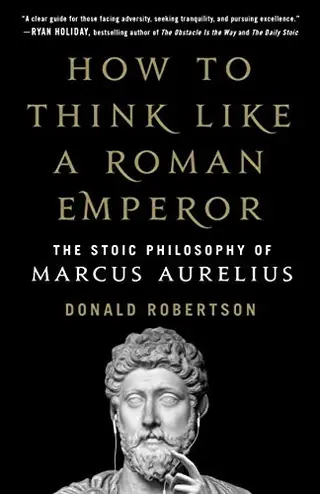
How to Think Like a Roman Emperor
by Donald Robertson · first published 2019
88% recommend13% critical
Why HN recommends it
Accessible introduction to Stoicism covering its history and Marcus Aurelius's Meditations, with links to modern CBT techniques; suited to beginners and readers wanting a practical companion to the original texts.
Summarised by Claude from recommending comments
Affiliate links. As an Amazon Associate I earn from qualifying purchases.
Mentions per year
What Hacker News says
Related books
 2012–2024
The discourses of Epictetus
Epictetus
Recommended by 7 · mentioned by 87 recommend · 8 mention7 recommend · 87 recommend
 2013–2026
The inner citadel
Pierre Hadot
Recommended by 8 · mentioned by 128 recommend · 12 mention8 recommend · 128 recommend
 2009–2026
The Enchiridion
Epictetus
Recommended by 47 · mentioned by 6647 recommend · 66 mention47 recommend · 6647 recommend
 2008–2026
Meditations by Marcus Aurelius
Marcus Aurelius, Meric Casaubon
Recommended by 184 · mentioned by 251184 recommend · 251 mention184 recommend · 251184 recommend
 2008–2026
Tao Te Ching
Stephen Mitchell
Recommended by 103 · mentioned by 204103 recommend · 204 mention103 recommend · 204103 recommend
Great video. I've read Meditations probably three times now. A really good book I recommend is How To Think Like A Roman Emperor by Donald Robertson.
on “Marcus Aurelius' Meditations: The Stoic Ideal” ↗…books on Stoicism read like that; I tend to avoid them altogether. Although I will say that Donald Robertson has done a great job with the two books I've read of his (Stoicism and the Art of Happiness, How to Think Like a Roman Emperor). The best modern book, in my opinion, is Pierre Hadot's The Inner Citadel. It's primarily about Marcus Aurelius' Meditations, but does a really good deep-dive into Stoicism (and frequently mentions…
on “What Is Stoicism?” ↗…core idea is simple. You separate what you can control from what you can't. Then you stop burning energy on the second category. Easier said than done, but the framework helps. I keep coming back to "How to Think Like a Roman Emperor" as a practical companion to the original texts. It's Marcus Aurelius filtered through modern psychology, with concrete exercises instead of just principles. The danger is treating Stoicism as emotional…
on “The Enchiridion by Epictetus” ↗If you're interested in philosophy, Stoicism might help. A lot of CBT is based off of stoic principles. In fact the book, "How to Think Like a Roman Emperor" goes through that history and teaches you some really useful CBT techniques.
on “Ask HN: Cognitive behaviour therapy, tried and tested resources” ↗I also suggest the "How to Think Like a Roman Emperor" as an introduction to the subject - it's a good read.
on ““Nihilism is OK” is not OK” ↗Hi. I know this is a fairly simple-sounding solution, but I highly recommend books on stoicism - one that i particularly find helpful is "How to think like a Roman Emperor". I re-listen to it (or certain chapters of it) from time to time, to help alleviate the effects of said thoughts. Hope this is useful.
on “How to remove ruminating thoughts?” ↗I like How To Think Like a Roman Emperor's analysis of Meditations but maybe it falls into pop self-help/psychology, it discusses the history around the text and how modern psychology has similarities with some of the techniques and aphorisms.
on “How to live an intellectually rich life” ↗People like to talk about and associate with Marcus Aurelius, because he was a Roman emperor, and thus books like these will sell: "How to think like a Roman Emperor". How about "How to think like a crippled Greek slave who was freed"? Doesn't sound that impressive. That is Epictetus, who has left an indelible mark on Marcus Aurelius, who copiously rephrases him.…
on “Seneca on The Shortness of Time (2017)” ↗…suggestions on robust English translations. Also, Marcus Aurelius is overtaken by macho guys and business people. Why not? It's nice to associate yourself with a Roman emperor (hence the book titles like "How to think like a Roman emperor" -- avoid this). How about associating with a crippled ex Greek slave, Epictetus, who had a profound influence on Marcus? Doesn't have the same ring to it. Further, many people don't know that Marcus…
on “How to Think about Pleasure” ↗> It doesn't help that nowadays Aurelius is being held up as some beacon of masculinity nowadays. Yeah, it's people like Tim Ferris, Ryan Holiday and others who write titles such as "how to think like a Roman emperor" (a terrible title if you know anything about Aurelius or Stoicism in some depth) and other tech bros are to blame. They drummed up excessive hype for Aurelius, he's good marketing material. Neoplatonists:…
on “Aristotle quotes on virtue, knowledge, and happiness” ↗