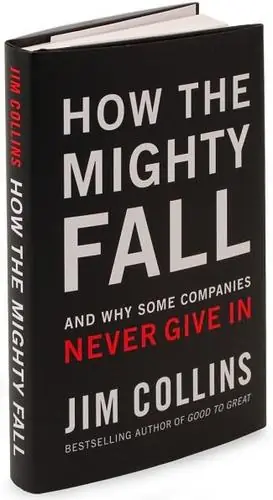
How the Mighty Fall
by Jim Collins · first published 2009
89% recommend11% neutral
Why HN recommends it
Frames company decline as a sequence of identifiable stages, such as lack of vision, misaligned revenue, and complacency. Cited for analyzing why firms fall; recommended to managers and students of strategy.
Summarised by Claude from recommending comments
Discusses signs pointing toward the decline of a business, how far the decline can proceed before failure becomes inevitable, and crucial steps companies can take to reverse course.
Affiliate links. As an Amazon Associate I earn from qualifying purchases.
Mentions per year
What Hacker News says
Related books
 2009–2019
The power of less
Leo Babauta
Recommended by 4 · mentioned by 64 recommend · 6 mention4 recommend · 64 recommend
 2009–2023
The Lost Symbol
Dan Brown
Recommended by 1 · mentioned by 141 recommend · 14 mention1 recommend · 141 recommend
 2010–2026
Open
Andre Agassi
Recommended by 12 · mentioned by 1612 recommend · 16 mention12 recommend · 1612 recommend
 2010–2025
Iron sunrise
Charles Stross
Recommended by 10 · mentioned by 2210 recommend · 22 mention10 recommend · 2210 recommend
 2007–2024
Shantaram
Gregory David Roberts
Recommended by 21 · mentioned by 2921 recommend · 29 mention21 recommend · 2921 recommend
 2008–2025
Losing My Virginity
Richard Branson
Recommended by 24 · mentioned by 3424 recommend · 34 mention24 recommend · 3424 recommend
 2008–2026
The Prophet
Kahlil Gibran
Recommended by 26 · mentioned by 3326 recommend · 33 mention26 recommend · 3326 recommend
 2007–2025
How the Mind Works
Steven Pinker
Recommended by 23 · mentioned by 3123 recommend · 31 mention23 recommend · 3123 recommend
…early adopters growing up, 2. decreasing marginal utility, 3. failure to directly align revenue with consumers, 4. lack of vision, 5. corporatism, 6. solipsism, 7. something better coming along. See: "How the Mighty Fall" by Jim Collins (http://www.amazon.com/How-Mighty-Fall-Companies-Never/dp/097...).
on “Ask HN: what could kill Facebook?” ↗…to 7 years most folks would have migrated to cloud computing completely without even realizing that they have transitioned into it. That is why folks at MSFT should seriously read Jim Collins new book "How the Mighty Fall" cuz they are stuck in time and unable to make the necessary changes. Cloud Computing will mean the focus will all be driven through the browser and the Operating System could pretty much be anything…
…networking and building relationships. "Trade-Off, Why Some Things Catch On, and Others Don't" "The Pixar Touch" Great history of Pixar and how they came about. "Call me Ted" - Ted Turner's autobiography "How the Mighty Fall" Jim Collins
on “Ask HN: Great books you read in 2009?” ↗How the Mighty Fall [1] is the book by Jim Collins that I'll never forget. The lessons within remain top of mind as a key mental check that has stuck with me over the years. The book begins with a study on hubris and how…
on “Ask HN: Is Getting Things Done still a book that HN recommends?” ↗Take a look at Jim Collins’ How the Mighty Fall. https://www.amazon.com/How-Mighty-Fall-Companies-Never/dp/09...
on “Berkshire Hathaway 2020 Annual report [pdf]” ↗…grace. Is it really the employees, or the managers? There could be dilapidated business processes still in place that even prevent the company from healing itself. An interesting take on this is the book How The Mighty Fall. Some relevant things to know might be if they have restructured a lot, and what their churn has looked like both in the executive suite and in engineering.
on “Gab.com banned from PayPal” ↗Or read the book by the same author that covers that exact question, _How The Mighty Fall: And Why Some Companies Never Give In_
on “Ask HN: What are you reading right now?” ↗…so, which way? Because great nations -- Athens, 500 BCE, Rome, Egyptian Old Kingdom, Egyptian New Kingdom, Minoans of Crete have fallen." This question was the inspiration for his fascinating book, "How the Mighty Fall" -- you can watch his interview with Charlie Rose on this here: http://www.charlierose.com/view/interview/10565 He said his research team found 5 stages of decline that were common among all the great…
on “Are America's best days behind us?” ↗…The AI mode they launched now after ChatGPT took the market by storm was what should've been 5 years ago. They are following the pattern exactly as described in the book we learned in our Masters' - "How the mighty fall" (really good book) and well deserved. You reap what you sow. /endrant (thanks for reading!)
on “Google has eliminated 35% of managers overseeing small teams in past year” ↗…He often quotes the Talmud saying, "We see things not as they are, but as we are.” And he often says, "We can't learn to see until we admit we are blind". When Jim Collins was doing his research for "How the Mighty Fall", he identified hubris as being the first stage of decline for great enterprises (http://www.charlierose.com/view/interview/10565). This is the concept of "pride goes before the fall," and I believe one…
on “What I've Learned About Smart People.” ↗Here's one that relates to your Socrates reference -- "true knowledge exists in knowing that you know nothing". It's a Charlie Rose segment where Jim Collins is discussing his book "How the Mighty Fall" (http://www.charlierose.com/view/interview/10565). He talks about the five stages of decline in any great enterprise. Stage 1 is hubris -- thinking you know it all.
on “You Don’t Truly Understand It Until You Think It’s Obvious” ↗Hubris born of success (overconfidence, arrogance) is "stage 1" in How the Mighty Fall by Jim Collins: https://charlierose.com/videos/12443 Humility (know you don't know, always be asking questions), a focus on the greater good (is it about you or something greater than you?), and having…
on “The Curse of Smart People (2014)” ↗Not true. While they may be broad, the authors still found common traits of the most historically successful companies. Collins wrote the follow-up "How the Mighty Fall" to then explain why/how they were unable to remain "Built to Last". The failure of companies mentioned in Good to Great does not necessarily mean Good to Great was wrong; it's possible those companies…
on “The three habits ... of highly irritating management gurus ” ↗