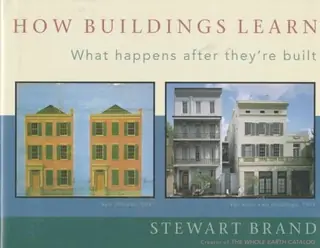
How Buildings Learn
What Happens After They're Built
by Stewart Brand · first published 1994
69% recommend30% neutral2% critical
Why HN recommends it
Looks at how occupants alter, repurpose and adapt buildings long after construction, with case studies like MIT's Building 20. Useful for software engineers seeking design lessons and the architecture-curious.
Summarised by Claude from recommending comments
Buildings have often been studies whole in space, but never before have they been studied whole in time. How Buildings Learn is a masterful new synthesis that proposes that buildings adapt best when constantly refined and reshaped by their occupants, and that architects can mature from being artists of space to becoming artists of time. From the connected farmhouses of New England to I.M. Pei's Media Lab, from "satisficing" to "form follows funding," from the evolution of bungalows to the invention of Santa Fe Style, from Low Road military surplus buildings to a High Road English classic like
Affiliate links. As an Amazon Associate I earn from qualifying purchases.
Mentions per year
What Hacker News says
Related books
 2007–2026
A pattern language
Christopher Alexander, Sara Ishikawa, Murray Silverstein, Max Jacobson
Recommended by 110 · mentioned by 226110 recommend · 226 mention110 recommend · 226110 recommend
 2014–2018
Thriving Systems Theory and Metaphor-Driven Modeling
Leslie J. J. Waguespack
Recommended by 1 · mentioned by 21 recommend · 2 mention1 recommend · 21 recommend
 2008–2026
The Timeless Way of Building
Christopher Alexander
Recommended by 67 · mentioned by 10367 recommend · 103 mention67 recommend · 10367 recommend
 2008–2026
The nature of order
Christopher Alexander
Recommended by 25 · mentioned by 4025 recommend · 40 mention25 recommend · 4025 recommend
 2013–2021
The city in history
Lewis Mumford
Recommended by 3 · mentioned by 53 recommend · 5 mention3 recommend · 53 recommend
…Feynman, and I agree. Godel Escher Bach: An Eternal Golden Braid has been recommended by multiple HN readers in most threads like this. Robert Pirsig's book Zen and the Art of Motorcycle Maintenance. How Buildings Learn by Stewart Brand. Founders at Work by Jessica Livingston. Tipping Point by Malcom Gladwell. Freakonomics, by Levitt and Dubner. Against the Gods by Peter Bernstein. The art of war by Sun Tzu. The…
on “Ask HN: Books That Gratify One's Intellectual Curiosity?” ↗I was a voracious reader of programming books prior to reading Stewart Brand's "How Buildings Learn: What Happens After They're Built." However, it was this book that made me (finally) realize that some of the best programming books are not about programming at all. As a result I've cut back drastically…
on “Ask HN: What book changed your life in 2014?” ↗I personally think that new uses for old spaces is quite cool. If you agree, you might enjoy the book "How Buildings Learn". http://www.amazon.com/How-Buildings-Learn-Happens-Theyre/dp/... HOWEVER. The cost of demolition and new construction is much lower than renovation, especially when the systems requirements (showers,…
on “Malls, the Future of Housing?” ↗…adopted by the design patterns movement in computer science, so it's familiar to most programmers. It's one of two building architecture books I recommend to programmers - the other is Stewart Brand's "How Buildings Learn".
on “Research: Cubicles Are the Absolute Worst” ↗…friction” by giving them a copy (almost always physical not digital)? I’d like to know your cherished favorites. I’ve bought many copies of “Impro: Improvisation and the Theatre” by Keith Johnstone and “How Buildings Learn” by Stewart Brand. The former is a brilliant book about thinking and reacting creatively while the latter is quite possibly the best book about building software that is not about building software specifically.
on “Ask HN: What books have you given to other people as gifts?” ↗That was in the BBC adaptation of "How Buildings Learn" by Stewart Brand. Both the book and the miniseries (which is on Youtube in segments) are excellent. I heard about Christopher Alexander from his renown in programming circles. I wonder how he is viewed…
on “If architects had to work like software developers” ↗"How Buildings Learn: What Happens After They're Built" by Stewart Brand. I've given away at least five as gifts.
on “Ask HN: The Primers on different subjects” ↗…Houses) were made cheaply, using community labor, from handmade local materials. He also believes that a building is never finished, and should be continually modified by its inhabitants. (Stewart Brand's How Buildings Learn is another book that should be read by both programmers and architects.)
on “Do You See a Pattern?” ↗Stewart Brand's book How Buildings Learn: What Happens After They're Built has a great chapter on MIT's Building 20. > Building 20 was a temporary wooden structure hastily erected during World War II on the central campus of the Massachusetts…
on “Still running strong after 1,532 days without a code change.” ↗I've seen this done several times previously with the original photograph above. From example page 16 of "How buildings Learn" by Stewart Brand from 1994 (a really great book) has this exact comparison with a photograph from 1981 (the tall building the the exact centre is missing). There is another example from last year here:…
on “Recreating the oldest aerial photo” ↗Non-code books for programmers? I always recommend How Buildings Learn, by Stewart Brand. It's a well-written and elegant study of the lifecycle of buildings, and holds many lessons for anyone who realizes their software continues to exist and change. http://amzn.com/B00AFZ3PI4…
on “Best development book I've read, has no code in it” ↗…for understanding failure. It deeply changed how I think and talk about software bugs, and especially how I do retrospectives. I strongly recommend it. And the article made me think of Stewart Brand's "How Buildings Learn": https://www.amazon.com/dp/0140139966 It changed my view of a building from a static thing to a dynamic system, changing over time. The BBC later turned it into a 6-part series, which I haven't seen,…
on “Structural engineers are unsung heroes” ↗Stewart Brand has done lots of good stuff. My favorite is the 6 part BBC series on "How Buildings Learn". It really opened my eyes to the importance of buildings. Very relevant to the frequent discussions here about zoning, design, etc. But also just an amazing, clear, well-informed amateur analysis of…
on “Whole Earth Software Catalog (1984)” ↗The Stewart Brand book How Buildings Learn mentioned in the article is excellent! The only architecture book you need. There's also a 1997 BBC TV series by the author on Youtube (https://www.youtube.com/playlist?app=desktop&list=PLxFD-wxU4...)
on “Mobile Home Skyscrapers: The Elusive Dream of Vertical Urban Trailer Parks” ↗…ever, the building will produce an economic return for its investors. I think the most thoughtful book I have ever read about architecture, published before Hacker News was founded, is Stewart Brand's How Buildings Learn: What Happens After They're Built. http://www.amazon.com/How-Buildings-Learn-Happens-Theyre/dp/... (Yes, the author is the same Stewart Brand who is famous among HN participants for saying "On the one…
on “Meet the Man Who Built a 30-Story Building in 15 Days” ↗