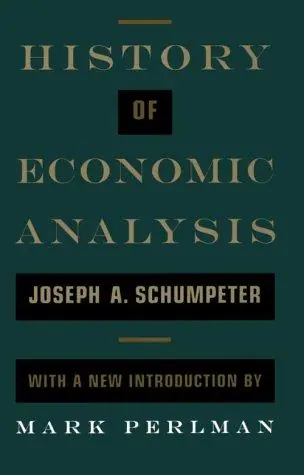
History of Economic Analysis
by Joseph Alois Schumpeter, Elizabeth Boody Schumpeter · first published 1954
33% recommend67% neutral
"At the time of his death in 1950, Joseph Schumpeter - one of the great economists of the first half of the 20th century - was working on his monumental History of Economic Analysis. A complete history of efforts to understand the subject of economics from ancient Greece to the present, this book is an important contribution to the history of ideas as well as to economics. Although never fully completed, it has gained recognition as a modern classic due to its broad scope and original examination of significant historical events." "Complete with a new introduction by Mark Perlman, who outlines
Affiliate links. As an Amazon Associate I earn from qualifying purchases.
…weighted heavily toward neo-classical economics and does not get into computational model based economics - specifically microeconomics, which comprises the bulk of economics education today: Schumpeter - History of economic analysis Adam Smith - Theory of Moral Sentiments Kaynes - The General Theory of Employment, Interest and Money Marx - Capital Benjamin Graham - The Intelligent Investor Galbraith - The Affluent Society Galbraith…
on “Ask HN: What are the must-read books about economics/finance?” ↗…somebody else and quote them.” > Further, Sowell notes: “The ‘trickle-down’ theory cannot be found in even the most voluminous scholarly studies of economic theories — including J.A. Schumpeter’s monumental History of Economic Analysis, more than a thousand pages long and printed in very small type.” No judgement implied on the economic matters at hand. Just on the matter that 'trickle down economics' is not a position actually held…
on “Returns to Scale in Broken Windows” ↗I'm a computer programmer that has started reading Schumpeter's "History of economic analysis", but I think not even a guy like Schumpeter could have explained why at some point in 2019 more than $17 trillion were returning negative rates (and I don't think that sum has decreased by all that much).
on “How this Ends” ↗…quite cool concept that had been almost completely forgotten starting with the '90s but which now is having a small resurgence (I've "re-discovered" it myself by first reading about it in Schumpeter's History of Economic Analysis and then by going through a Soviet dictionary of economics published sometime in the '70s).
on “Margaret Mead, Technocracy, and the origins of AI's ideological divide” ↗