Foundations of Logic Programming
33% recommend67% neutral
Affiliate links. As an Amazon Associate I earn from qualifying purchases.
Mentions per year
What Hacker News says
Related books
 2013–2022
AI algorithms, data structures, and idioms in Prolog, Lisp, and Java
George F. Luger
Recommended by 1 · mentioned by 21 recommend · 2 mention1 recommend · 21 recommend
 2010–2025
Warren's abstract machine
Hassan Aït-Kaci
Recommended by 5 · mentioned by 85 recommend · 8 mention5 recommend · 85 recommend
 2009–2026
Programming in Prolog
William F. Clocksin, Christopher S. Mellish
Recommended by 8 · mentioned by 148 recommend · 14 mention8 recommend · 148 recommend
 2009–2026
The craft of Prolog
Richard A. O'Keefe
Recommended by 18 · mentioned by 3018 recommend · 30 mention18 recommend · 3018 recommend
 2009–2026
Prolog programming for artificial intelligence
Ivan Bratko, Bratko, Ivan.
Recommended by 10 · mentioned by 1210 recommend · 12 mention10 recommend · 1210 recommend
 2008–2026
Clause and Effect
William F. Clocksin
Recommended by 7 · mentioned by 87 recommend · 8 mention7 recommend · 87 recommend
 2009–2026
The art of Prolog
Leon Sterling, Ehud Yehuda Shapiro
Recommended by 36 · mentioned by 6536 recommend · 65 mention36 recommend · 6536 recommend
 2007–2026
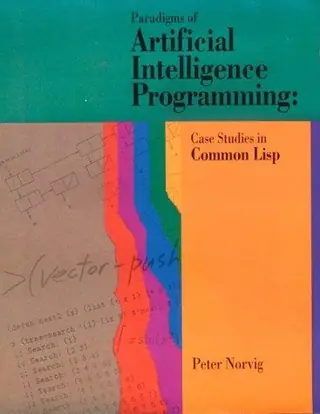
Paradigms of Artificial Intelligence
Peter Norvig
Recommended by 63 · mentioned by 10863 recommend · 108 mention63 recommend · 10863 recommend
…theoretical side, another commenter recommended Perreira & Shreiber, which I can't recommend enough. Also, for a more formal text on logic programming, with proofs and all, the classic reference is J. W. Lloyd, Foundations of Logic Programming. Again, you can probably find a copy in your friendly neighbourhood university library (or, er, google it for a very bad copy of dubious legitimacy, like).
on “The Birth of Prolog (1992) [pdf]” ↗And also "Prolog Programming for AI" by Bratko and "Programming in Prolog" by Clocksin and Mellish. Although these days I'd recommend anyone interested in Prolog starts in at the deep end with "Foundations of Logic Programming" by George W. Lloyd, because I've learned the hard way that teaching Prolog as a mere programming language, without explaining the whole logic programming thing, fails.
on “My Gripes with Prolog” ↗…declarative, which purely functional and logic programming languages are (to some extent). Interestingly, given the conclusions reached in the article, both Sterling and Shapiro's The Art of Prolog and Lloyd's Foundations of Logic Programming mention the Japanese fifth generation project as an example of Prolog's impending breakthrough into the mainstream.
on “Who killed Prolog?” ↗So this is a bit of a tangent, but your Santa Claus example really clarified something I've been reading about recently. I'm reading Lloyd's "Foundations of Logic Programming", which essentially explains the fundamentals behind logic languages like Prolog. We write programs using uninterpreted functions[0] to represent our data, and define predicates to drive the program.…
on “Logic is Metaphysics (2011) [pdf]” ↗…non-trivial understanding not only of its implementation but also of the substantial theoretical work that led to its implementation as the prototypical logic programming language (e.g. see J. W. Lloyd, Foundations of Logic Programming). The thing is, there is a lot more going on with Prolog than "here is a language that can be used to control a digital computer". Logic programming is the continuation of the work of the logicians…
on “APL deserves its renaissance too” ↗…entailed by a logic program S if there exists a clause C that can be derived from S and such that C subsumes D. Similar statements are also found in the logic programming literature, for example in Lloyd's Foundations of Logic Programming. There's a bit of a mystery about the origins of the Theorem. A series of similar papers by Ninenhuys-Cheng and de Wolf point out different definitions and apparent rediscoveries of the Theorem, and…
on “Why did Prolog lose steam? (2010)” ↗…parameter passing, data selection and data construction. The computation terminates when the empty goal is produced. And that's first-order SLD-Resolution, with unification, in a nutshell! From George Lloyd: Foundations of Logic Programming, second Ed. 1993. There's a copy of the book here: https://archive.org/details/foundationsoflog0000lloy_o7l2 But it's a limited preview :/ ________ [1] ... well, the substitution that makes the Horn…
on “Unification in Elixir” ↗