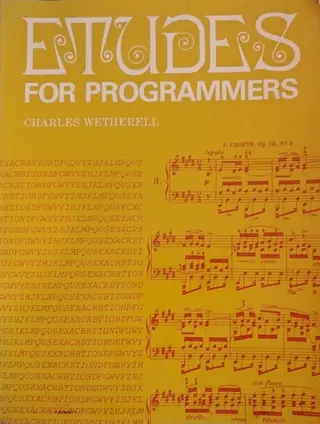
Etudes for programmers
by Charles Wetherell · first published 1978
10mentions
4recommended by
9HN commenters
2015–2026first – last mentioned
44% recommend56% neutral
Etudes for Programmers is a collection of large-scale problems for "learning by doing". Each problem includes a real world background, discussion of appropriate program and techniques, detailed requirements for correct solution, extensions, and annotated bibliography. These are realistic problems similar to those in countered an actual practice. Two of the problems are completely solved by the author. The solutions concentrate on good programming techniques, measuring the quality of the program and the output, and possible extensions of the problem. They are models of what solutions to any
Affiliate links. As an Amazon Associate I earn from qualifying purchases.
An older source of interesting projects is "Etudes for Programmers" by Charles Wetherell, in book form (out-of-print, unfortunately): https://www.amazon.com/Etudes-Programmers-Charles-Wetherell/...
on “To Learn Programming, Do Projects You Care About” ↗…important theorems without bogging down in the proofs. Finally, I think there is value in doing small interesting programming projects. Two older books, available used, with interesting projects are Etudes for Programmers by Wetherell [5] and Software Tools in Pascal by Kernighan and Plauger [6]. Etudes has my favorite exercise for trying out new programming languages, building an interpreter for the simple TRAC programming…
on “How I learned to program” ↗'Etudes for Programmers' itself remains an interesting read and entertaining problem set. And not a single one is about implementing a Red-Black tree from memory.
on “Norvig's Python programs to practice or demonstrate skills” ↗"Etudes for Programmers" is such a brilliant book. I first came across it 1991: https://openlibrary.org/books/OL4546158M/Etudes_for_Programm...
on “Pytudes: Python programs for perfecting particular programming skills” ↗It's an old topic, see, e.g. 'Etudes for Programmers', Charles Wetherell. Code dojos, code katas, code retreats, I suppose I should put together a list.
on “If you're busy, you're doing something wrong (2011)” ↗…can define other macros, etc. I learned about TRAC in the mid 1970s from Ted Nelson's book Computer Lib/Dream Machines [Nelson]. It was one of three languages featured in that book. A fun little book, Etudes for Programmers, which I bought in 1978 inspired me to implement a version of TRAC. It's a nice exercise. Many years later (I believe it was 1991), during an Open Software Foundation meeting in Cambridge, Massachusetts,…
on “Bitmap Indexes in Go: Search Speed (2019)” ↗Is 'Etudes for Programmers by Charles Wetherell' still relevant? What should a developer starting their career be practicing?
on “Etudes for Programmers by Charles Wetherell” ↗This is a reference to the older book, Etudes For Programmers by Charles Wetherell which Norvig is no doubt appreciative of.
on “Pytudes” ↗Link to the actual "etude" https://archive.org/details/wetherell-etudes-for-programmers... (Wetherell has a number of small, interesting programming "etudes", one of is to write a TRAC interpreter.) Some background. Calvin Mooers developed TRAC - the programming language - in the 1960s…
on “TRAC (64) Interpreter in JavaScript” ↗…so there's not much reuse benefit there. He qualifies that with performance concerns, but that's just one reason why it would have to be different. Another thing I was reminded of, from the intro of Etudes for Programmers: "Programming is a craft, and programmers must attain a standard of craftsmanship. Much programming is done in cottage shops -- that is, in small shops with meager tools, much work done by hand, and…
on “"Code was never the hard part" is an insult to all programmers” ↗