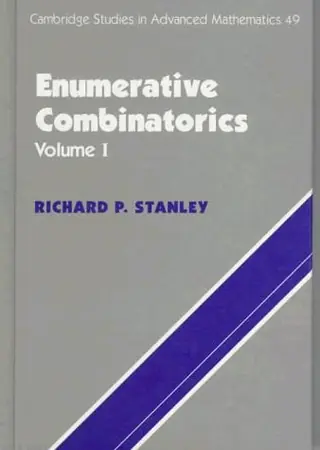
Enumerative combinatorics
by Richard P. Stanley · first published 1900
8mentions
4recommended by
8HN commenters
2009–2023first – last mentioned
50% recommend50% neutral
Publisher Description (unedited publisher data) This second volume of a two-volume basic introduction to enumerative combinatorics covers the composition of generating functions, trees, algebraic generating functions, D-finite generating functions, noncommutative generating functions, and symmetric functions. The chapter on symmetric functions provides the only available treatment of this subject suitable for an introductory graduate course on combinatorics, and includes the important Robinson-Schensted-Knuth algorithm. Also covered are connections between symmetric functions and representatio
Affiliate links. As an Amazon Associate I earn from qualifying purchases.
Combinatorial Problems and Exercises by Lovasz I don't know much in the way of more advanced expository combinatorics books, other than the more narrow Generatingfunctionology (Wilf) and the already mentioned Enumerative Combinatorics (Stanley).
on “I'm writing a book about algorithms and Lisp” ↗…directly relevant to additive combinatorics. Analysis background would be useful, such as to be found in Stein and Shakarchi's series. Some introductory combinatorics would also be good (e.g. Stanley's Enumerative Combinatorics, or Van Lint and Wilson). Finally, analytic number theory would also be good to learn. For example, you might read Davenport's Multiplicative Number Theory. (Especially if you want to see integrals come…
on “Mathematicians Catch a Pattern by Figuring Out How to Avoid It” ↗There are a few quite large sub-fields, but there are classic textbooks covering most of these. Here are some: For classical enumerative combinatorics, there is Richard Stanley's 'Enumerative Combinatorics'. For graph theory, Diestel's book 'Graph Theory' is popular for introductory courses, and Bollobas' 'Modern Graph Theory' is more advanced and…
on “What Is Combinatorics? (2013)” ↗The classic suggestion is Brualdi, there's also R. Stanley Enumerative Combinatorics http://www-math.mit.edu/~rstan/ec/ but right now I'm starting with basics on S. Gill Williamson Foundations of Combinatorics with Application. I don't mind pure reasoning, but I need practical programming…
on “I'm writing a book about algorithms and Lisp” ↗You mean this book by Leroux and Labelle? http://bergeron.math.uqam.ca/species/ (First 3 chapters: http://bergeron.math.uqam.ca/wp-content/uploads/2013/11/book...) "Enumerative Combinatorics" is a different book by a different author (Richard P. Stanley, https://en.wikipedia.org/wiki/Richard_P._Stanley).
on “Enumerative Combinatorics Volume 1, second edition [pdf]” ↗…"algebraic" from pure mathematics match up with finite state machines and push-down automata from computer science. One studies these most easily using generating functions. As Richard Stanley explains in Enumerative Combinatorics Vol. 2, there's a third class of generating functions beyond algebraic: D-Finite. Roughly, this corresponds to how one learns to expand the solution to a differential equation in ODEs as a power series.…
on “Lessons I wish I had learned before I started teaching differential equations [pdf] (1997)” ↗…Arrays: permutations, combinations, compositions, partitions, etc. The unifying (and very APL-like) principle for such a primitive is Gian-Carlo Rota's Twelvefold Way as described in Richard Stanley's "Enumerative Combinatorics", Knuth’s TAoCP, Vol. 4A, and Wikipedia among other references.
on “Permutation Iteration and Random Access” ↗…you want to apply it in the real world, a basics in Differential Equations, some Numerical Analysis. If you want to learn things closer to computer science then learn something of Number Theory, some Enumerative Combinatorics and Graph Theory as well. The list is extensive because I come from a mathematical background. If you learn at least a bit of these topics them the next step will be apparent for you.
on “Ask HN: Best Mathematics book for complete noobie?” ↗