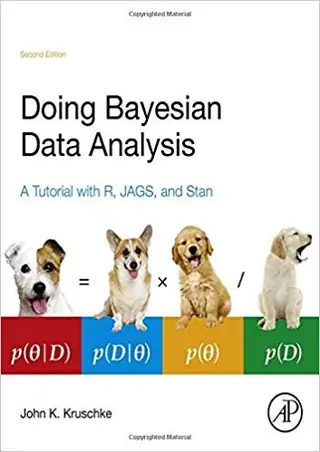
Doing Bayesian Data Analysis
by John K. Kruschke · first published 2010
88% recommend12% neutral
Why HN recommends it
Introduction to Bayesian inference from first principles, building intuition, then math, then code. Praised for clear MCMC explanations and practice problems; suits beginners and programmers new to stats.
Summarised by Claude from recommending comments
Doing Bayesian Data Analysis: A Tutorial with R, JAGS, and Stan, Second Edition provides an accessible approach for conducting Bayesian data analysis, as material is explained clearly with concrete examples. Included are step-by-step instructions on how to carry out Bayesian data analyses in the popular and free software R and WinBugs, as well as new programs in JAGS and Stan. The new programs are designed to be much easier to use than the scripts in the first edition. In particular, there are now compact high-level scripts that make it easy to run the programs on your own data sets. The bo
Affiliate links. As an Amazon Associate I earn from qualifying purchases.
Mentions per year
What Hacker News says
Related books
 2013–2026
Bayesian methods for hackers
Cameron Davidson-Pilon
Recommended by 24 · mentioned by 3524 recommend · 35 mention24 recommend · 3524 recommend
 2016–2026
Statistical Rethinking
Richard McElreath
Recommended by 81 · mentioned by 9281 recommend · 92 mention81 recommend · 9281 recommend
 2009–2025
Data analysis using regression and multilevel/hierarchical models
Andrew Gelman
Recommended by 10 · mentioned by 1210 recommend · 12 mention10 recommend · 1210 recommend
 2012–2026
Think Bayes
Allen B. Downey
Recommended by 37 · mentioned by 4537 recommend · 45 mention37 recommend · 4537 recommend
 2011–2025
Data analysis
D. S. Sivia, John Skilling
Recommended by 6 · mentioned by 76 recommend · 7 mention6 recommend · 76 recommend
 2010–2025
Probabilistic Graphical Models
Daphne Koller, Nir Friedman
Recommended by 16 · mentioned by 3716 recommend · 37 mention16 recommend · 3716 recommend
 2020–2025
Regression and Other Stories
Andrew Gelman, Jennifer Hill, Aki Vehtari
Recommended by 11 · mentioned by 1411 recommend · 14 mention11 recommend · 1411 recommend
 2014–2026
Introduction to Statistical Learning
Gareth James, Daniela Witten, Trevor Hastie, Robert Tibshirani
Recommended by 85 · mentioned by 10885 recommend · 108 mention85 recommend · 10885 recommend
Original title: Programmer, Teach Yourself Foundations of ML and AI with these 6 Books Books: - Ian Hacking - Introduction to probability and Inductive Logic - John Kruschke - Doing Bayesian Data Analysis - Gareth Williams - Linear Algebra with Applications, Alternate Edition - Matthew Scarpino - OpenCL in Action - Michael Nielsen - Neural Networks and Deep Learning - Goodfellow, Bengio, and Courville…
on “Foundations of ML and AI: Book recommendations” ↗…more than other ML researchers have. My recommendations here are probably less helpful...I've only ever toyed with Bayesian learning models, but never employed them professionally. But I would recommend Doing Bayesian Data Analysis by Kruschke. It was very helpful as an introductory material.
on “Logic Production Systems: A new mixed logic/imperative programming language” ↗…from having this stuff be usable by the broader public. Maybe not "build any model you like and it will just work out of the box" but definitely as a replacement for much frequentist statistics. See "Doing Bayesian Data Analysis" by Kruschke, for example.
on “The State of Probabilistic Programming” ↗…know the R language. The concepts are more important than the programming language and the code examples are kept simple. If you make it through Statistical Rethinking then you might consider picking up Doing Bayesian Data Analysis by John Kruschke (a.k.a. the puppies book). I've found DBDA to be heavier going than SR but Kruschke takes a different approach to McElreath which can be useful if you get stuck on a concept, need more…
on “PPX: Probabilistic Programming EXecution Protocol and API Based on Flatbuffers” ↗…Analysis: A Bayesian Tutorial" is awesome http://www.amazon.com/Data-Analysis-A-Bayesian-Tutorial/dp/0... And if you would like a little more exposition (but still a mathematically sophisticated treatment) "Doing Bayesian Data Analysis: A Tutorial with R and BUGS" is fantastic http://www.amazon.com/Doing-Bayesian-Data-Analysis-Tutorial/... The latter will also give you more details of how to approach classical, frequentest tests and…
on “P values are not as reliable as many scientists assume” ↗Doing Bayesian Data Analysis Interesting topics: MCMC, Gibbs Sampling F# for C# Developers This book seems to leave lot out in order to simplify but good starting book nonetheless TCP/IP Illustrated, Volume 1: The Protocols,…
on “Ask HN: What's the best programming book you've read recently?” ↗Also, John Kruschke's "Doing Bayesian Data Analysis", aka the "Puppy Book", is a gentle introduction to Bayesian inference. It is very readable, especially with regards MCMC.
on “Markov Chain Monte Carlo for Bayesian Inference – The Metropolis Algorithm” ↗Having read many books/online courses, I strongly recommend this: http://www.amazon.com/Doing-Bayesian-Data-Analysis-Second/dp... It gives a gentle but through introduction from first principles; lots of good intuition and 'why'. It works well with "Probabilistic Programming & Bayesian Methods for Hackers" also mentioned,…
on “Sorry ARIMA, but I’m Going Bayesian” ↗The only book accessible by beginners, while still dealing with real-world level analysis: https://www.amazon.com/Doing-Bayesian-Data-Analysis-Second/d...
on “Metropolis Algorithm and Bayesian posterior sampling” ↗If no one actually knowledgeable answers, I'll say I liked what I read of Doing Bayesian Data Analysis -- early partial draft here: https://faculty.washington.edu/jmiyamot/p548/kruschkejk%20ba... I didn't persevere because the R language rubs me the wrong way and I'd be comfier with Python or Haskell…
on “Most Winning A/B Test Results Are Illusory [pdf]” ↗…good book for introduction bayesian statistic. And it's super math/stat lite. If you really want to stick with Bayesian Statistic and need a comprehendsive stat for a foundation a better book would be: Doing Bayesian Data Analysis by John K. Kruschke.
on “Computer Age Statistical Inference: Algorithms, Evidence and Data Science” ↗This book is helpful - I went through it and did all the interactive examples. Having said that, I much prefer "Doing Bayesian Data Analysis" by Kruschke. It is extremely clear. It introduces concepts with intuition first, then math, then code, which I find to be an extremely useful order.
on “Probabilistic Programming and Bayesian Methods for Hackers (2013)” ↗> Would you recommend it as an introduction to topic? No. I would not recommend it unless you have a strong foundation in statistic. If you want an introduction, I like "Doing Bayesian Data Analysis: A Tutorial with R and BUGS" by John K. Kruschke. It's basically the Bayesian intro statistic version of Wackerly's statistic book (frequentist).
on “Bayesian Data Analysis, Third Edition [pdf]” ↗Think Bayes Doing Bayesian Data Analysis Statistical Rethinking A more complete coverage of Bayesian statistics is Bayesian Data Analysis by Gelman but it's far less accessible than the others.
on “Ask HN: Any accessible book recommendations to develop my Bayesian thinking?” ↗For beginners, I found Doing Bayesian Data Analysis by John Kruschke to be much better. Easier to read and comprehend.
on “Bayesian Data Analysis, Third edition (2013) [pdf]” ↗