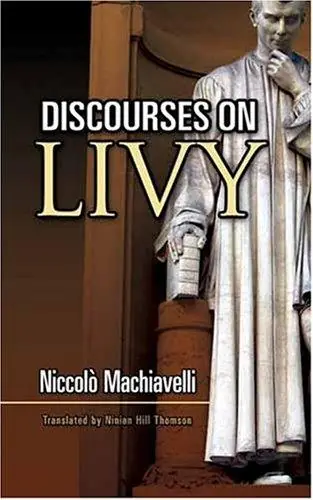
Discourses on Livy
by Niccolò Machiavelli, Harvey C. Mansfield, Nathan Tarcov, Alissa Ardito, Ninian Hill Thomson, Henry Neville · first published 1531
48% recommend48% neutral4% critical
Why HN recommends it
Offers a better window into Machiavelli's own political views than The Prince, closer to his considered thinking. It analyzes republics, institutions, and checks.
Summarised by Claude from recommending comments
<p>A very different work from his well-known <i><a href="https://standardebooks.org/ebooks/niccolo-machiavelli/the-prince/w-k-marriott">The Prince</a></i>, and posthumously published a year prior to it, <a href="https://standardebooks.org/ebooks/niccolo-machiavelli">Machiavelli’s</a> <i>Discourses on Livy</i> is one of his most debated works. Some critics see it as presenting a counterpoint or refutation of <i>The Prince</i>, calling it a key founding document of modern liberal republicanism. Others maintain that it is complementary, arguing that leaders of republics must act in the manner Mac
Affiliate links. As an Amazon Associate I earn from qualifying purchases.
Mentions per year
What Hacker News says
Related books
 2007–2026
The Prince
Niccolò Machiavelli
Recommended by 61 · mentioned by 19461 recommend · 194 mention61 recommend · 19461 recommend
 2009–2026
Democracy in America
Alexis de Tocqueville
Recommended by 27 · mentioned by 7627 recommend · 76 mention27 recommend · 7627 recommend
 2007–2026
A Book of Five Rings
Miyamoto Musashi
Recommended by 21 · mentioned by 5021 recommend · 50 mention21 recommend · 5021 recommend
Federalist PAPERS
Alexander Hamilton, John Jay, James Madison
Recommended by 8 · mentioned by 568 recommend · 56 mention8 recommend · 568 recommend
 2008–2026
Little Prince
Antoine de Saint-Exupéry
Recommended by 57 · mentioned by 10357 recommend · 103 mention57 recommend · 10357 recommend
 2007–2026
Liar's Poker
Michael Lewis, Blanca Ribera de Madariaga
Recommended by 61 · mentioned by 13161 recommend · 131 mention61 recommend · 13161 recommend
 2007–2026
The Art of War
孙武 (Sun Tzu)
Recommended by 57 · mentioned by 18057 recommend · 180 mention57 recommend · 18057 recommend
 2007–2026
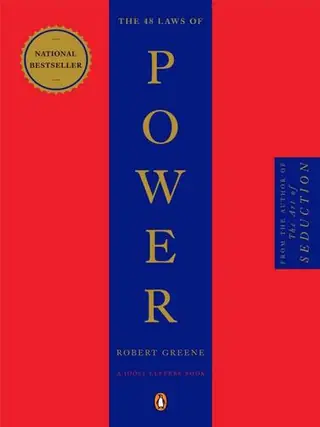
The 48 Laws of Power
Robert Greene
Recommended by 85 · mentioned by 19185 recommend · 191 mention85 recommend · 19185 recommend
…Prince was a job application, from an exiled and impoverished Machiavelli to the court of Medici. Parks seems to forget this inconvenient fact. Parks also forgets to mention that it was Machiavelli's Discourses on Livy, a book that disagrees with The Prince with numerological precision, that screams Machiavelli's love of a Republic over a monarchical or despotic rule, and that defines virtue in idealized, classical…
on “A No-Nonsense Machiavelli” ↗Agree, those wishing to actually understand Machiavelli should read "Discourses on Livy", rather than "Prince". He was an avid supporter of republicanism (not democracy, those didn't exist yet) and proven superiority of republican order vs aristocratic on many examples from his era as we…
on “On subversion and dissolution of opposition movements” ↗…pragmatic solution to these kinds of problems, based on the decades of first-hand experience some smart blokes like Madison and Jefferson had trying to run fledgling democratic states. (And Machiavelli’s Discourses on Livy is probably worth a read too.) For a more literary exploration, read some Balzac novels: early 19th century France was the beginning of the cross-over from aristocracy to bourgeoisie, and rapidly growing…
on “Medieval Iceland and the Absence of Government” ↗…which is responsive to the changing needs and circumstances of its citizens and responsive at a local level to local differences, etc. * * * The why is in my opinion best described in Machiavelli’s Discourses on Livy, Montesquieu’s Spirit of the Laws, Tocqueville’s Democracy in America, and Madison/Hamilton/Jefferson’s Federalist Papers (and you might look at Locke, Rousseau, Hobbes, etc. too if you’re feeling extra…
on “Too Rich to Live?” ↗…and Federalist #51, a pair of brilliant essays. http://www.constitution.org/fed/federa10.htm http://www.constitution.org/fed/federa51.htm (And if especially ambitious, should then read Machiavelli’s Discourses on Livy, and Tocqueville’s Democracy in America)
on “Increasing complexity: A day in the life of the president” ↗Reading first and second Dune trilogy would give you a lot of what you are asking for. Also I would recommend reading Alamut from Vladimir Bartol. For more serious works - I would offer Machiavelli's Discourses on Livy.
on “Ask HN: Good books?” ↗I would strongly advise reading Machiavelli's Discourses on Livy on the subject of emergent culture in sovereign institutions. These companies are small empires in their own right, creating a lasting and prosperous empire is an monumental undertaking where chasing…
on “Why I Am Leaving Goldman Sachs” ↗If you're interested, Machiavelli's "Discourses on Livy" is a good place to start. He explores the institutions within different societies that allowed them to grow and develop trust. It's one the first book in history that I'm aware of that explored the…
on “Pay No Attention to the Bloody Corpse in the Bathroom” ↗See Machiavelli: both The Discourses on Livy and The Prince are quite insightful on these topics. I recommend reading both near the same time.
on “UK intelligence forced to reveal secret policy for mass surveillance” ↗…instructions for how to achieve the goals of state it is far superior to the works that preceded it in the Western European tradition. If you want to read more Machiavelli after "The Prince" try the Discourses on Livy, often considered the greater work, and definitely closer to Machiavelli's own republican personal leanings. https://en.wikipedia.org/wiki/Niccol%C3%B2_Machiavelli#Disco...
on “Chanakya: India's Machiavelli” ↗…scholar is a clever and perceptive observer/analyst of human nature and political affairs. Anyone interested in any kind of human politics, institutions, or society should read both The Prince and The Discourses on Livy, which are both fantastically insightful.
on “A No-Nonsense Machiavelli” ↗Your comment reminds me of Machiavelli’s work “Discourses on Livy” in which he writes, among other things, that discord (between the nobility and the common people) produced the liberty enjoyed by the Roman Republic. Machiavelli’s views on republicanism are very insightful,…
on “Common-Knowledge Attacks on Democracy” ↗Interesting how everyone always focuses (almost) entirely on The Prince and (almost) completely ignores his Discourses on Livy. Here's the thing: if you read the Discourses first, Machiavelli comes off as a staunch republican — and then when you read The Prince you just have to conclude that it could only be a brilliant satire,…
on “The Machiavellian Maze” ↗Others in thread have mentioned this, but if you want to get a feel for Machiavelli the Prince is not the right place. Discourses on Livy is much more like his actual view. Here is why: The first existence of the Prince is supposedly from 1513, while NM was still alive. However, the first printed version (which had to be approved by his…
on “Teaching Machiavelli through his letters” ↗His "Discourses on Livy" is also a pretty solid book.
on “A No-Nonsense Machiavelli” ↗