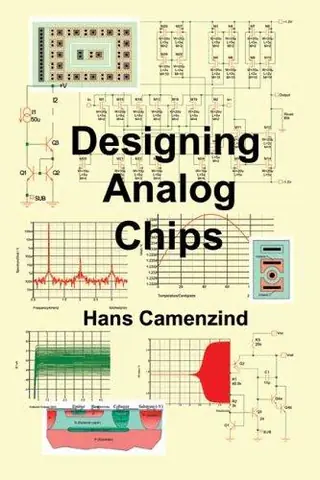
Designing Analog Chips
by Hans Camenzind · first published 2005
21mentions
12recommended by
13HN commenters
2011–2026first – last mentioned
92% recommend8% neutral
Why HN recommends it
Concise introduction to analog IC design from the designer of the 555 timer; explains how device physics such as base thickness affects circuit behavior. Suited to engineers and students moving from theory to real chips.
Summarised by Claude from recommending comments
Affiliate links. As an Amazon Associate I earn from qualifying purchases.
Read freeOnline edition
Mentions per year
What Hacker News says
Related books
 2009–2026
Practical Electronics for Inventors
Paul Scherz
Recommended by 51 · mentioned by 6451 recommend · 64 mention51 recommend · 6451 recommend
 2008–2026
The art of electronics
Paul Horowitz, Winfield Hill
Recommended by 153 · mentioned by 230153 recommend · 230 mention153 recommend · 230153 recommend
 2008–2026
The Feynman Lectures on Physics
Richard Phillips Feynman
Recommended by 69 · mentioned by 12669 recommend · 126 mention69 recommend · 12669 recommend
I would wholeheartedly second 'The Art of Electronics'---it is a perfect book to start with. I would add 'The art of designing analog chips' by Camenzind (the inventor of the 555 timer) and 'Multistage Transistor Circuits' (SEEC, vl 5). The last book is a good introduction into the design portion of the process. If one feels particularly…
on “How to Read a Schematic” ↗…then quantitatively with the ebers–moll model; they're focused on how to use this information to design working circuits from discrete components you can put together on a circuit board. camenzind's designing analog chips (available free online) goes into how to use this information to design actual chips (not only does nand2tetris get into things like metastability and noise margin, the authors seem to be confused about…
on “From Nand to Tetris (2017)” ↗The "electronics" list doesn't include Horowitz & Hill's "The Art of Electronics". It's one of the best, used at some prestigious universities (written by 2 professors at Harvard, used there among others). Sedra/Smith's book "Microelectronic Circuits" is listed, it's the other one I'd mention for a course on the fundamentals of electronics engineering. Camenzind's "Designing Analog Chips" also de
on “List of Great EE Books Suggested by Top Profs. From MIT, Stanford, Harvard,” ↗I stick to ICs from the 1970s and 1980s; after that, things get too hard to understand. Books from that era provide a reasonable description. For digital circuits, Mead and Conway's Introduction to VLSI Systems is a good source of information. It's available online: https://ai.eecs.umich.edu/people/conway/VLSI/VLSIText/VLSITe... (the link seems to be down right now, though.) For analog circuits,
on “Silicon die teardown: a look inside an early 555 timer chip” ↗Download his book about designing analog ICs: http://www.designinganalogchips.com/
on “RIP Hans Camenzind, Inventor Of The 555 Timer” ↗That's wonderful, thank you. I recommend Chapter 11 (starting at page 141 in the PDF file) for a detailed personal account of how he developed the 555 timer chip. I'm also finding that the first 30 pages of the book is a very readable introduction to how semiconductors and transistors work -- it's written from an engineering mindset as opposed to the usual physics point of view. Direct link to
on “RIP Hans Camenzind, Inventor Of The 555 Timer” ↗I don't know much about it myself, so I'm not the right person to ask. Much of the little I do know came from reading http://designinganalogchips.com/, a book by Hans Camenzind, one of the all-time great sandbenders.
on “Inside the Intel 1405: die photos of a shift register memory from 1970” ↗Link to the original chip designer's free book: http://www.designinganalogchips.com/
on “555 timer teardown: inside the world's most popular IC” ↗Hans Camenzind, the 555 designer, devoted most of a chapter in http://designinganalogchips.com/ to the 555; the beginning of chapter 11 tells the story of how it was born, and then he tells you how he'd design it "now" (02005, 17 years ago and 34 years after it originally came out, though I think he published one of the redesigns in 01997), either in bipolar or in CMOS, and, more importantly, why;
on “Silicon die teardown: a look inside an early 555 timer chip” ↗I give a thumbs up for Designing Analog Chips - I found it really helpful and interesting, and it's free online at the above link. And if you're interested in 1970s-era digital chips, I recommend Mead and Conway's "Introduction to VLSI systems"…
on “Inside the Intel 1405: die photos of a shift register memory from 1970” ↗Hello, I wouldn't recomment The Art of Electronics, at all. Sure, it's an amazing book, but TAOE breezes through foundations and OP says he only remembers Kirchhoff's law. I think OP wants a book that takes him from there: Tony Kuphaldt's series of books (available for free to download) titled: "Lessons in Electric Circuits". These babies are 6 books: DC, AC, Semiconductors, Digital. There's a
on “Ask HN: What are some nice electronics courses that blend theory and practice?” ↗They change a bit, but primarily at startup. After that they're controlled by the stability of the biasing. I'd recommend "Designing Analog Chips" by Hans Camenzind[0], the designer of the 555 timer. Particularly chapter 3, "Current Mirrors". [0] http://www.designinganalogchips.com/ has a free pdf
on “Reverse-engineering the TL431: the most common chip you’ve never heard of (2014)” ↗There's also Hans Camenzind's "Designing Analog Chips"[1]. Free on his website. "During his career at four different companies he designed the first integrated class D amplifier, introduced the phase-locked loop concept to ICs, invented the semicustom IC and created the 555 timer. He has designed 151 standard and custom ICs so far." [1] http://www.designinganalogchips.com/
on “An Analog IC Design Book Draft” ↗Have a look at Hans Camenzind's "Designing Analog Chips"[0][1]. - [0]: http://www.designinganalogchips.com/ - [1]: PDF here http://www.designinganalogchips.com/_count/designinganalogch...
on “Ask HN: Best Course on Chip Design?” ↗He actually published a book on analog circuit design, which is freely available here: http://www.designinganalogchips.com/_count/designinganalogch... In one of the later chapters he introduces an updated NE555 design.
on “Giant 555 Timer” ↗