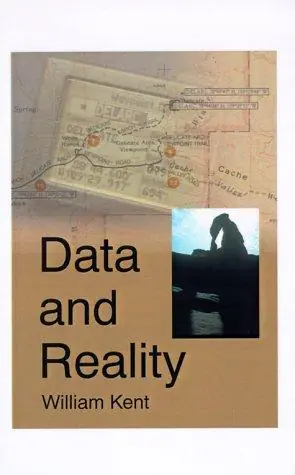
Data and Reality
by William Kent · first published 1978
63% recommend38% neutral
Why HN recommends it
Short, philosophical look at why messy reality resists being captured in a data model, covering identity, subjectivity and integrity. Suits engineers and database designers who want to think harder about modeling.
Summarised by Claude from recommending comments
Affiliate links. As an Amazon Associate I earn from qualifying purchases.
Mentions per year
What Hacker News says
Related books
 2010–2025
SQL antipatterns
Bill Karwin
Recommended by 31 · mentioned by 3731 recommend · 37 mention31 recommend · 3731 recommend
 2008–2025
Transaction processing
Gray, Jim
Recommended by 13 · mentioned by 1813 recommend · 18 mention13 recommend · 1813 recommend
Database Internals
Alex Petrov
Recommended by 31 · mentioned by 4631 recommend · 46 mention31 recommend · 4631 recommend
 2007–2026
The Practice of Programming
Brian W. Kernighan
Recommended by 90 · mentioned by 12890 recommend · 128 mention90 recommend · 12890 recommend
 2009–2026
How to Measure Anything
Douglas W. Hubbard
Recommended by 46 · mentioned by 5846 recommend · 58 mention46 recommend · 5846 recommend
 2008–2025
Mastering Regular Expressions
Jeffrey E. F. Friedl
Recommended by 58 · mentioned by 8458 recommend · 84 mention58 recommend · 8458 recommend
 2007–2026
Domain-Driven Design
Eric Evans
Recommended by 104 · mentioned by 191104 recommend · 191 mention104 recommend · 191104 recommend
 2014–2026
Designing Data-Intensive Applications
Martin Kleppmann
Recommended by 457 · mentioned by 659457 recommend · 659 mention457 recommend · 659457 recommend
…tagging, hierarchies, and parsing/subdividing). One book I have found interesting along those lines is "The Discipline of Organizing". https://berkeley.pressbooks.pub/tdo4p/ Tangentially, William Kent's "Data and Reality" (the first two editions especially) also explores the larger meta-issues of moving from human-ish nuanced thinking to more limited formal representations (i.e. "The map is not the territory"). http://www.bkent.net/Doc/darxrp.htm…
on “The PARA Method: A Universal System for Organizing Digital Information” ↗("Data and Reality")[https://www.goodreads.com/book/show/1753248.Data_and_Reality] - despite its age (written before SQL was mainstream) it remains a short, accessible read that lays out how to think about modeling an information…
on “Ask HN: Which books do you consider real gems in your field of work/study?” ↗…case of the relational model, but they all vary to the extent under which they enforce logical integrity vs. exposing the innards to muck with (same with all RDBMS' frankly). William Kent's 1978 book _Data and Reality_ is a great read to think of data modeling and integrity issues generically, irrespective of whether you use an RDBMS or a non-relational database. He highlights certain logical concepts as universal…
on “From 1.5 GB to 50 MB: The Story of my Redis Database” ↗…(https://clojure.org/about/state#_working_models_and_identity) -> "Identities are mental tools we use to superimpose continuity on a world which is constantly, functionally, creating new values of itself." The timeless book "Data and reality" is also priceless: https://www.amazon.com/Data-Reality-Perspective-Perceiving-I.... More specifically concerning the article, I do agree with the point of view of the author distinguishing access by…
on “Choosing between names and identifiers in URLs” ↗…Pearls, which is the clearest explanation of solving the actual problem needed; when I say "software engineering", PP is what I mean. William Kent, author of Data & Reality https://mdhughes.tech/2017/07/19/data-and-reality-william-ke... Kent Beck, author of Extreme Programming Explained, for making good engineering practices "go to 11".
on “Ask HN: Which programmer do you look up to?” ↗Data & Reality (Kent, 1978) https://www.goodreads.com/book/show/19305264-data-and-realit... 164 pages. This book has had a bigger impact on my professional work than any other. tl; dr: Any description of reality is subjective, which means that no data model can be an objectively correct description of reality. The book presents methods for reasoning about data in spite of this.
on “Ask HN: Best books under 200 pages for developers?” ↗It's possibly a bit more abstract or philosophical than what you're looking for, but William Kent's _Data and Reality_ is awesome on data modelling. Discussed by Hillel Wayne at https://buttondown.email/hillelwayne/archive/why-you-should-..., HN discussion at https://news.ycombinator.com/item?id=30251747.
on “Ask HN: Is DBA still a good job?” ↗Data and Reality, by William Kent. Earliest edition you can find. For general database design, Stephane Faroult is good. Although he comes from an Oracle background, and underuses domains as a result. Rules of thumb:…
on “Ask HN: What would you consider to be essential reading for database design?” ↗Ignores many decades of systems analysis literature, talks about epistemology when ontology, in practice, takes up the most mental effort. I recommend William Kent's Data and Reality, first or second editions (not so much the third).
on “Sorry to tell you this but your epistemology is showing” ↗For those interested in escaping the Hacker Prison where ‘Weeks of coding can save hours of thinking’ I strongly recommend William Kent’s book “Data and Reality’.
on “Good programmers worry about data structures and their relationships” ↗Data and Reality, by William Kent. A timeless classic on the computational representation of, well, anything and everything. The third and currently only published edition, published posthumously, insists on adding…
on “Older editions of which books were better than the new ones? (2010)” ↗…copy back then during a few conversations we had in his office. Before that, in high school circa 1980 I did an independent study project using Patrick Winston's book on AI. William Kent's 1978 book "Data and Reality" (the first edition -- the third edition was dumbed down by someone else) is another great inspiration. There is a sort of cross over between AI-inspired design and human-centric "augmenting" design.…
on “Email is your electronic memory” ↗Data and Reality (William Kent, 1978)
on “Ask HN: What are some older programming books that still hold up today?” ↗…working in & to ask questions of stakeholders who understand it better than you, but me saying that isn't at all doing it enough justice compared to how well the author elaborates on the point. (btw, Data And Reality is also good for this, though a lot more theoretical in approach) If you're really new to databases you'll want to supplement this with something that does normalization more formally, I don't have a…
on “Databases, Types, and the Relational Model: The Third Manifesto [pdf]” ↗…them, based on primary data with differing degrees of reliability. I've been through various iterations, painfully getting better at representing "what is true and what don't we know yet". Reading "Data and Reality" just now was like a distillation of my endeavour, all in one place. Plus lots of things I haven't properly considered yet. I can see why many people find it dull: if you haven't struggled with representing…
on “Read “Data and Reality”” ↗