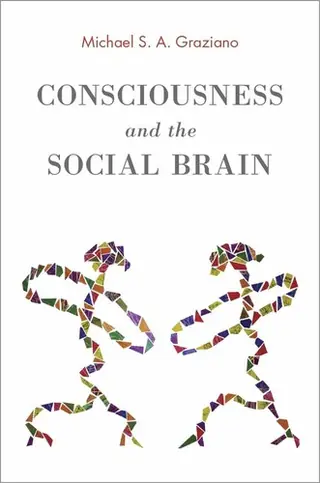
Consciousness and the Social Brain
by Michael S. A. Graziano · first published 2013
57% recommend43% neutral
"hat is consciousness and how can a brain, a mere collection of neurons, create it? In Consciousness and the Social Brain, Princeton neuroscientist Michael Graziano lays out an audacious new theory to account for the deepest mystery of them all. The human brain has evolved a complex circuitry that allows it to be socially intelligent. This social machinery has only just begun to be studied in detail. One function of this circuitry is to attribute awareness to others: to compute that person Y is aware of thing X. In Graziano's theory, the machinery that attributes awareness to others also attri
Affiliate links. As an Amazon Associate I earn from qualifying purchases.
Mentions per year
What Hacker News says
Related books
 2007–2026
The origin of consciousness in the breakdown of the bicameral mind
Julian Jaynes
Recommended by 52 · mentioned by 10652 recommend · 106 mention52 recommend · 10652 recommend
 2015–2026
Sapiens
Yuval Noah Harari
Recommended by 201 · mentioned by 376201 recommend · 376 mention201 recommend · 376201 recommend
 2007–2026
Gödel, Escher, Bach
Douglas R. Hofstadter
Recommended by 505 · mentioned by 1,055505 recommend · 1,055 mention505 recommend · 1,055505 recommend
... maybe by actively attributing those "experienced qualia" to an experiencing subject: it self. "Consciousness and the Social Brain" - Michael S. A. Graziano: provides a thesis on how and in what stages this could have developed via (social) evolution...
on “Are We Really Conscious?” ↗You may find "Consciousness and the Social Brain" by Michael S. A. Graziano quite interesting. It provides an evolutionary path of development for this phenomenon. In short: Consciousness is the "theory of mind"-"mechanisms" (which developed prob. first)…
on “Are We Really Conscious?” ↗…respectable with _A Cognitive Theory of Consciousness_ which is still a very good analysis of many of the issues. Currently I think the best theoretical grip on consciousness is summarized in Graziano's _Consciousness and the Social Brain_, interestingly discussed at (http://selfawarepatterns.com/2014/10/16/the-attention-schema...). These scientific approaches to understanding consciousness have the advantages of helping us understand…
on “Consciousness Is Worth Thinking About” ↗How about "The Attention Schema Theory", it even provides a thesis about the evolutionary development of the "phenomenon". Quite a read btw: "Consciousness and the Social Brain", 2013, Oxford University Press [1] http://www.princeton.edu/~graziano/Consciousness_Research.ht...
on “Why can’t the world’s greatest minds solve the mystery of consciousness?” ↗This book and Consciousness and the Social Brain by Graziano have changed the way I read any history book or world analysis. I see value in the viewpoint it informs even if it's not true.
on “The Origin of Consciousness in the Breakdown of the Bicameral Mind (1976)” ↗That’s a fair critique, and I appreciate the engagement. Thanks! My thinking is based on the Attention-Schema theory of consciousness (AST), by Michael Graziano. His book “Consciousness and the Social Brain” is, I believe, the right roadmap for AGI. AST is basically a variant of the Global Workspace theory of consciousness, distinguished by its deterministic account of the mechanics and utility of consciousness.…
on “Rogue superintelligence: Inside the mind of OpenAI's chief scientist” ↗“Consciousness and the Social Brain,” by Graziano is a great place to start.
on “Unconscious brain activity predicts decisions 11 seconds before action” ↗…is a side-effect of consciousness, or to be more precise, an exaptation of the modeling of other minds driven by the evolutionary pressure of being socially dependent creatures (mostly mammalian). See “Consciousness and the Social Brain” by Michael Graziano. Humans aren’t actually all that intelligent at the baseline: we require societies help in becoming educated and learning tools such as writing and arithmetic. It takes hard training…
on “Artificial General Intelligence Is Already Here” ↗…birth to mammalian glands that feed its comparatively feeble spawn. Sociality is built into the bodies of mammals. And the most social animal on earth is Homo Sapiens. From here I’ll just recommend “Consciousness and the Social Brain.” I’ve been beating this dead horse on HN for some time.
on “We were promised Strong AI, but instead we got metadata analysis” ↗…built into its biology: milk glands and placentas force mammals to be social from the start. A great book that doesn’t deal with intelligence and mammals directly, but provides a key connection, is “Consciousness and the Social Brain.” The book makes a strong argument that consciousness sprung from evolutionary pressures that were essentially social — that being able to model (and predict) the mind of another is essential for communication…
on “Dissolving the Fermi Paradox” ↗I just happened to be reading Consciousness and the Social Brain [1] which gives a theory of consciousness as the brain's representation of attention. One of their points was that if consciousness is just a representation it should be possible for your brain to alternate…
on “My Girlfriend Dissociated and Forgot Who I Was” ↗This isn't specifically explored here, but a theory put forth by Michael Graziano in Consciousness and the Social Brain makes it interesting to consider whether "being able to explain itself" ultimately corresponds to a kind of consciousness...
on “Can AI be taught to explain itself?” ↗So his attention schema theory is actually about consciousness as a whole, not just metacognition. Here's a quote from his book Consciousness and the Social Brain: >The attention schema theory could be said to lie half-way between two common views. In his groundbreaking book in 1991, Dennett explored a cognitive approach to consciousness, suggesting that the concept…
on “A New Theory of How Consciousness Evolved” ↗