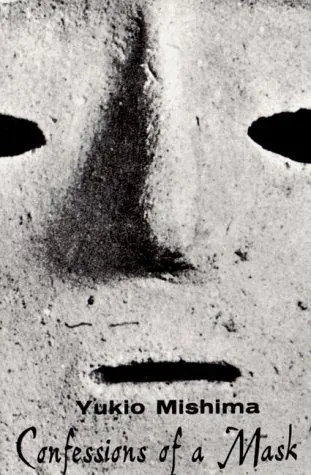
Confessions of a Mask
by San Dao You Ji Fu, Meredith Weatherby · first published 1958
63% recommend38% neutral
Why HN recommends it
Semi-autobiographical novel about a boy growing up gay in 1930s-50s Japan, valued for its raw, candid psychology and for showing the impulses behind the author's later work; suits readers of Japanese literature.
Summarised by Claude from recommending comments
Confessions of a Mask is Japanese author Yukio Mishima's second novel. Published in 1949, it launched him to national fame though he was only in his early twenties.
Affiliate links. As an Amazon Associate I earn from qualifying purchases.
Mentions per year
What Hacker News says
Related books
 2018–2024
Out
Natsuo Kirino
Recommended by 2 · mentioned by 42 recommend · 4 mention2 recommend · 42 recommend
The Temple of the Golden Pavilion
Yuko / translated by Ivan Morris Mishima
Recommended by 6 · mentioned by 76 recommend · 7 mention6 recommend · 76 recommend
 2008–2025
Norwegian Wood
Cun Shang Chun Shu
Recommended by 29 · mentioned by 4729 recommend · 47 mention29 recommend · 4729 recommend
…Japanese fiction, Kenzaburo Oe (Changeling, A Personal Matter) is a good starting point. If you want to go darker, a little more unhinged, and on the opposite end of the political spectrum, Yukio Mishima (Confessions of a Mask) is also good. If you want to go even further back, Junichiro Tanizaki's The Makioka Sisters is an oddly enjoyable story of adult sisters and their shifting relationships -- if Proust is like a jungle,…
on “Japanese Writing After Murakami” ↗…difficult book to read at that age—I can't imagine any age when it would be easy to read—and I appreciate that we were asked to sit with it. Another book that had a similar effect on me was Yukio Mishima's "Confessions of a Mask" about a boy growing up gay in 1930–50s Japan. I don't know that he ever actually says he's gay and you get this feeling that he doesn't even have the language to describe himself, let alone any kind…
on “Toni Morrison Has Died” ↗…of "bizarre," Yukio Mishima was quite a character -- aside from that, he was also quite a writer. Patriotism is a great short story from him that's pretty thought-provoking in a lot of ways. Mishima's Confessions of a Mask is also another book I'd immediately recommend to people looking at Japanese literature. The protagonist is homosexual and somewhat deviant in a number of ways; the book looks at what it means to be "abnormal"…
on “Haruki Murakami Introduces the Penguin Book of Japanese Short Stories” ↗Mishima's late-life militarism and his death tend to overshadow his early work. Both "Confessions of a Mask" and "Temple of the Golden Pavilion" are masterpieces, and you can see the raw impulses that motivated him, before he sublimated them to a political agenda.
on “Mishima in the Twenty First Century” ↗I second Mishima, who has not let me down. I enjoyed "Confessions of a Mask", and plan to read "Temple of the Golden Pavilion" next and the last 2 books of his tetralogy. By means of microscopic observation and astronomical projection the lotus flower can become the foundation…
on “Japanese Writing After Murakami” ↗…see the eventual politics as one natural way all that could have played out. But to me the root themes of Mishima's work aren't intrinsically political. This may also be biased because I've only read Confessions of a Mask and The Temple of the Golden Pavilion, which Wikipedia tells me pre-date his political writings, in the former case by quite a while.
on “Mishima in the Twenty First Century” ↗…tempting but generally unwise to use Mishima as an example of anything but his own tortured soul. From day one, his writings have been suffused with longing for a "beautiful death" (his autobiography Confessions of a Mask has a striking scene where he describes having his first ever orgasm when he sees a picture of St Sebastian pierced by arrows), and the military trappings he acquired towards the end of his life seem…
on “When the Emperor Is a Void (2020)” ↗…tetralogia, cui nomen est "Sea of Fertility" quae constat ex libris quattuor: "Spring Snow," "Runaway Horses," "The Temple of Dawn," et "The Decay of the Angel." Inter libros Mishimae celeberrimi sunt "Confessions of a Mask," "Thirst for Love," et "The Sailor Who Fell from Grace with the Sea." > Mishima erat etiam notus pro activismis suis politicis et socialibus, et obiit per seppukum (ritualis suicidium samurai) postquam…
on “ChatGPT should be considered a malevolent AI – and be destroyed” ↗