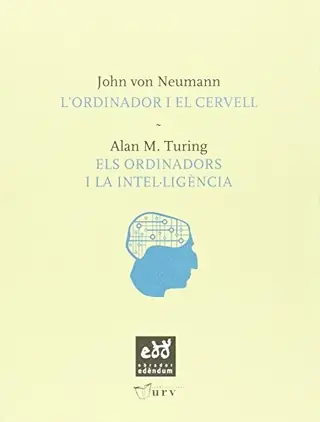
Computing machinery and intelligence
by Alan Mathison Turing, John von Neumann · first published 1981
19% recommend81% neutral
Why HN recommends it
Short, readable 1950 paper that introduces the Imitation Game and frames the question of machine thinking as a thought experiment; recommended for anyone in computing or philosophy, needing little technical background.
Summarised by Claude from recommending comments
Affiliate links. As an Amazon Associate I earn from qualifying purchases.
Mentions per year
What Hacker News says
Related books
Augmenting human intellect
D. C. Engelbart
Recommended by 10 · mentioned by 2110 recommend · 21 mention10 recommend · 2110 recommend
As We May Think
Vannevar Bush
Recommended by 23 · mentioned by 8523 recommend · 85 mention23 recommend · 8523 recommend
 2009–2026
The mathematical theory of communication
Claude Elwood Shannon
Recommended by 47 · mentioned by 10347 recommend · 103 mention47 recommend · 10347 recommend
The laws of thought
George Boole
Recommended by 1 · mentioned by 141 recommend · 14 mention1 recommend · 141 recommend
A symbolic analysis of relay and switching circuits
Claude Elwood Shannon
Recommended by 6 · mentioned by 166 recommend · 16 mention6 recommend · 166 recommend
 2009–2026
Parallel distributed processing
David E. Rumelhart
Recommended by 5 · mentioned by 185 recommend · 18 mention5 recommend · 185 recommend
 2009–2026
The Annotated Turing
Charles Petzold
Recommended by 56 · mentioned by 7056 recommend · 70 mention56 recommend · 7056 recommend
What computers can't do
Hubert L. Dreyfus
Recommended by 5 · mentioned by 235 recommend · 23 mention5 recommend · 235 recommend
It might be a cliche one to pick, but I really really really enjoy Alan Turing's "Computing Machinery and Intelligence"[1]. This paper straddles the line between CS and philosophy, but I think it's an important read for anyone in either field. And a bonus is that it's very well-written and readable. [1] https://www.csee.umbc.edu/courses/471/papers/turing.pdf
on “Ask HN: What is your favorite CS paper?” ↗I'd recommend reading the original Computing Machinery And Intelligence paper[1], rather than the Wikipedia article. It's extremely easy to follow, being that it's more of the nature of a thought experiment than of being hard computer science. You're quite right that he…
on “Google fires engineer who called its AI sentient” ↗"Computing Machinery and Intelligence", A.M. Turing, 1950. This is where the Turing Test comes from. Technically a journal paper, but reads more like an essay. If you're into computers at all, this is a must read. Alan Turing not only…
on “Ask HN: Reccomend essays to a young, inquiring mind” ↗"On Computable Numbers with an Application to the Entscheidungsproblem" (1936) http://draperg.cis.byuh.edu/archive/winter2014/cs320/Turing_... "Computing Machinery and Intelligence" (1950) http://www.csee.umbc.edu/courses/471/papers/turing.pdf "Recursive Functions of Symbolic Expressions and Their Computation by Machine" (1960) http://www.cs.cmu.edu/~crary/819-f09/McCarthy60.pdf…
on “Ask HN: Which essays/works would you recommend reading?” ↗Alan Turing's "Computing Machinery and Intelligence" (1950). Describes the "Imitation Game", aka Turing test. https://en.wikipedia.org/wiki/Computing_Machinery_and_Intell...
on “Ask HN: Older textbooks/papers you consider classics still worth studying today?” ↗Turing's 'Computing Machinery and Intelligence' is an eye-opening read. I don't know if he was prescient or if he simply saw his colleagues engaging in the same (then hypothetical but similarly) pointless arguments, but all this hand wringing of whether…
on “AI agent opens a PR write a blogpost to shames the maintainer who closes it” ↗I suggest Alan Turning's 1950 Computing Machinery and Intelligence. Many of the ideas first written in this paper are commonly referenced. It's good to have read the primary source. Do machines think? If you know what a theoretical Turning Machine is you'll have all…
on “Ask HN: What are some interesting papers in CS for a beginner?” ↗…always held Alan Turing as one of my all time hero's of Computer Science. If you can manage to get hold of it I highly recommend watching it. On a side note I decided to read his paper this morning 'Computing Machinery and Intelligence'. If you have some spare time today give the paper a read. Especially the 'Digital Computers' paragraph. As you're reading it think to yourself he is describing something that does not exist, nobody has…
on “The new Alan Turing docudrama is available for streaming” ↗I’m glad we have this result to confirm what’s obvious to some of us and completely absurd to others, but it’s also worth pointing out that the Turing test was never meant to be a literal test. He invoked the “Imitation Game” to make a philosophical point about intersubjective recognition, not to describe a technical benchmark. If you haven’t read Turing 1950 yet, I highly, highly recommend it -
on “UCSD: Large Language Models Pass the Turing Test” ↗> Maybe we need to start thinking less about building tests for definitively calling an LLM AGI and instead deciding when we can't tell humans aren't LLMs for declaring AGI is here. If you've never read the original paper [1] I recommend that you do so. We're long past the point of some human can't determine if X was done by man or machine. [1]: https://courses.cs.umbc.edu/471/papers/turing.pdf
on “The next phase of the Microsoft OpenAI partnership – OpenAI” ↗I'm barely holding it together here so you don't get the full spiel, but a quick skim of Turing's paper clarifies that it was never about a binary test. https://courses.cs.umbc.edu/471/papers/turing.pdf Specifically sections 1 & 6 dispell the common myths, and the conclusion is also quite powerful. Smart guy, that Turing. I wish he were still around... Linus but 114 years old and with 8 of that
on “GPT-6 Astra” ↗People forget that Alan Turing's essay "Computing Machinery and Intelligence" was published in Mind, a major philosophy journal. People forget that Boolean algebra comes from a work called "The Laws of Thought," where Boole tries to describe the algebraic operations underlying…
on “What, exactly, do philosophers do?” ↗…atomic bomb was based on science theory. Our study of (automated) intelligence is based on science too. > A computer ... will never be able to think by itself. Turing wrote an entire paper about this (Computing Machinery and Intelligence), where he rephrases your statement (because he finds it to be meaningless) and devises a test to answer it. He also directly attacks your phrasing of "but it will never": > I believe they are mostly…
on “Microsoft is investing $1B in OpenAI” ↗Alan Turing's 1950 article in Mind proposing the Turing Test (Computing Machinery and Intelligence) IRS Tax Form 1040 The 1948 United Nations Universal Declaration of Human Rights The US Constitution and Declaration of Independence The Treaty of Versailles The Paris Treaty The Kyoto Protocol…
on “The Bitcoin whitepaper is hidden in every copy of macOS” ↗I mean, you can read Turing's own definiton if his test - 'the Imitation Game' - on the first page of his 1950 paper Computing Machinery and Intelligence[1]. There's nothing in there about repetition, duration, or $10,000,000 prizes. It's a party game. And he just frames his question (which will "replace our original, 'Can machines think?'") as "Will the…
on “My deepfake DALL-E 2 vacation photos passed the Turing Test” ↗