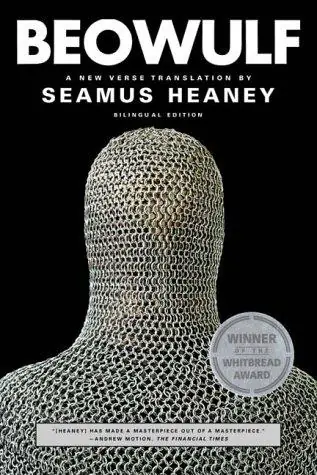
Beowulf
by Seamus Heaney · first published 2000
50% recommend38% neutral13% critical
Why HN recommends it
Praised as a vivid, muscular translation that keeps kennings and draws on Ulster dialect to recreate Old English sound and force; recommended for readers wanting a strong modern version of the epic.
Summarised by Claude from recommending comments
Composed toward the end of the first millennium, Beowulf is the elegiac narrative of the adventures of Beowulf, a Scandinavian hero who saves the Danes from the seemingly invincible monster Grendel and, later, from Grendel's mother. He then returns to his own country and dies in old age in a vivid fight against a dragon. The poem is about encountering the monstrous, defeating it, and then having to live on in the exhausted aftermath. In the contours of this story, at once remote and uncannily familiar at the beginning of the twenty-first century, Nobel laureate Seamus Heaney finds a resonance
Affiliate links. As an Amazon Associate I earn from qualifying purchases.
Mentions per year
What Hacker News says
Related books
 2009–2026
The Odyssey.
HOMER.
Recommended by 14 · mentioned by 2614 recommend · 26 mention14 recommend · 2614 recommend
 2017–2026
The Iliad
Homer, Emily Wilson
Recommended by 8 · mentioned by 168 recommend · 16 mention8 recommend · 168 recommend
Divine comedy
Dante.
Recommended by 16 · mentioned by 6416 recommend · 64 mention16 recommend · 6416 recommend
 2009–2026
Romeo and Juliet
William Shakespeare
Recommended by 9 · mentioned by 1049 recommend · 104 mention9 recommend · 1049 recommend
YouTube has Heaney reading his Beowulf translation (in 2 parts[0][1]) -- given that Beowulf was an oral epic, you may want to check it out. If you want your own copy, Audible has it[2] -- it's about $15 (but they also have a free trial and…
on “The Example of Seamus Heaney” ↗…complete translation that has any of the magic of the original. Dante's Divine Comedy, read the Clive James translation. This is the first one that captures some of the luminous quality of the Tuscan. Beowulf, get Seamus Heaney's translation. I don't read Spanish and cannot offer any insights on Cervantes, but maybe someone else can chime in. Likewise, do some research on translations of the Buddhist writings…
on “Ask HN: Books you plan to read in 2020?” ↗I’m no scholar, but have a distinct memory of reading the Heaney translation of Beowulf perhaps 20 years ago (it was new at the time). I don’t recall any of the language per se, but have the distinct memory of thinking “this is extremely badass”. It seems completely reasonable that a more…
on “Not the 'Beowulf' You Think You Know” ↗Heaney's traslation of Beowulf is a masterpiece in its own right.
on “The unnecessary demise of Barnes and Noble” ↗You might enjoy Ezra Pound's 'ABCs of Reading', which talks about reading the best examples available. The Odyssey and Illiad are certainly that. Also the Aeneid, the Divine Comedy, Beowulf...but sometimes there are acceptable translations and sometimes there aren't. We are fortunate to have Seamus Heaney's translation of Beowulf which is always solid and occasionally makes you feel the…
on “The First Woman to Translate the ‘Odyssey’ into English” ↗I'm also a huge fan of Heaney's Beowulf. While Headley chooses to vernacularise the language in the extreme, Heaney took a more sensitive approach, preserving kennings and searching for Ulster dialect cognates to Old English words to use in…
on “Not the 'Beowulf' You Think You Know” ↗…re-reading The Lord of the Rings for the same reason :). And I’ve read (Fagles, I think) The Iliad for the same reasons. You may have already, but if not check out the Seamus Heaney translation of ‘Beowulf.’ He doesn’t do “high diction” or “mythic tone”, but, imho, he’s managed to give the story a quite “epic tone” in a very contemporary and earthy fashion. It’s also a short / fun / fast read.
on “The Odyssey – Alexander Pope translation (1725)” ↗I'd also vouch for his translation of Beowulf, which is one of the modern great translations of a work. The Translations of Seamus Heaney book also provides some fantastic context for how his translation work and own writings informed each other.
on “The Example of Seamus Heaney” ↗Seamus Heaney's translation of Beowulf
on “Ask HN: What book have you given as a gift?” ↗Don't overlook how important cataloguing is. As the article mentions, Cotton (Robert Cotton 1571–1631), a proflific collector, also had Beowulf in his collection. That remains the only source of Beowulf known to exist - in fact, nobody heard of Beowulf (for centuries) until Cotton's manuscript of it was found. Beowulf is essential to history…
on “Cataloguing the Cotton Charters” ↗…article and saw that that was precisely the point. It's a lovely thought that, in this modern day, we might once again unlock our wordhoards! I once read a poem by Seamus Heaney (who also re-translated Beowulf) in which the language of the poem itself recapitulated the development of English over the centuries. It was really quite beautiful, though a bare five minutes of Googling has not turned up the name.…
on “Linguistic purism in English” ↗Heaney's translation is bloody awful too. Reading a chunk of Beowulf in the original was, along with learning Maxwell's equations and reading Gibbon one of the best things I ever did for myself. It's ... fairly obvious it's one person. The latter half with the dragon could…
on “Tolkien was right: Scholars conclude Beowulf likely the work of single author” ↗Beowulf starts with a "So", in the 1999 Seamus Heaney translation. He explains why in the foreword: 'so' operates as an expression that obliterates all previous discourse and narrative, and at the same…
on ““So, …” What?” ↗Seamus Heaney began his translation of Beowulf with "So", rendering the Old English "Hwaet" in a more natural way than the usual archaic "Listen!", "Lo!", "Hark!" kind of thing. In the introductory note, he explains: "'so' operates as an expression…
on ““So, …” What?” ↗…mammalian, not just human. We've felt a loss that's hard to describe all throughout history. Just because it was common doesn't mean it hurt any less. Here's the description of a man losing his son, from Beowulf, a thousand years ago: (lines 2444-2464 of Heaney's translation) ----------------------- It was like the misery felt by an old man Who has lived to see his son’s body Swing on the gallows.…
on “The day I accidentally killed a little boy” ↗