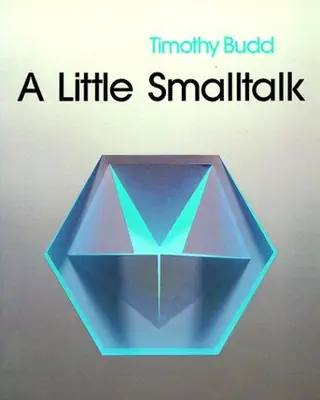
A Little Smalltalk
by Timothy Budd · first published 1987
15mentions
5recommended by
10HN commenters
2009–2025first – last mentioned
50% recommend40% neutral10% critical
Why HN recommends it
A short, approachable introduction to Smalltalk and its implementation. It works as a weekend read for starting Smalltalk and as a guide to building a small interpreter or VM.
Summarised by Claude from recommending comments
Affiliate links. As an Amazon Associate I earn from qualifying purchases.
First the last, There were always free ST versions as far as I can remember. The "little guy" could e.g. use "Little Smalltalk" by Budd which appeared before 1987. No one could write a commercial program with Little Smalltalk. Love the book, but the implementation is not going to work. Heck, Squeak could not do a program that…
on “Airbus Chooses GNAT Pro Ada for Development of Unmanned Aerial System” ↗Timothy Budd's Little Smalltalk book and implementation explain how to write such a VM. You can find a copy of the book at http://stephane.ducasse.free.fr/FreeBooks.html You can also google for the various version of the system. System…
on “Smalltalk on Mobile (2017)” ↗The literature on interpreters (vs. compilers) is pretty thin. I enjoyed reading these: 1. Peter John Brown. 1979. Writing Interactive Compilers and Interpreters. 2. Timothy Budd. 1987. A Little Smalltalk. 3. Ralph E. Griswold. 2000. The Icon Programming Language, 3e. 4. Pat Shaughnessy. 2013. Ruby Under a Microscope: An Illustrated Guide to Ruby Internals. This is a new one I haven't read yet, but…
on “Crafting Interpreters: A Review” ↗…"The Design and Evaluation of a High Performance Smalltalk System" making sure NOT to ignore Self and its literature, also spearheaded by Ungar (Start your Smalltalk hacking career with Timothy Budd's "A Little Smalltalk", should take you about a weekend and will absolutely prepare you for dynamic languages; a similar system is described by Griswold and Griswold, compiler, intermediate representation and VM, but that…
on “ACM 20 Most Influential Papers on Programming Languages [tarball]” ↗Little Smalltalk is great and I highly recommend it. But it and GNU Smalltalk only give you access to the bare language itself, while Smalltalks with graphical user interfaces given you a very different programming experience.…
on “A Little Smalltalk (1987)” ↗…languages that I probably didn't need to learn. Griswold's book on the Icon implementation was OK; it describes a complete compiler, intermediate instruction set and a VM in a compact book, but so did "A Little Smalltalk", in a far smaller frame and with class. Icon is a "modern" SNOBOL, if you want that sort of a thing. Most Icon books and publications are online as well: http://www.cs.arizona.edu/icon/books.htm
on “Learn Icon” ↗I wonder, if this is just an other version of a little Smalltalk. For those who want Smalltalk in JVM, look at: http://web.engr.oregonstate.edu/~budd/SmallWorld/ReadMe.html
on “Redline Smalltalk V1.0” ↗…of doing the same pricing that made it impractical to impossible for the little guy to use the language. There were always free ST versions as far as I can remember. The "little guy" could e.g. use "Little Smalltalk" by Budd which appeared before 1987.
on “Airbus Chooses GNAT Pro Ada for Development of Unmanned Aerial System” ↗Interesting. I did my CS Master's work on Little Smalltalk, adding a debugger and documentation mostly because it didn't seem like Budd was doing much with it anymore (this was early 90s). Is SmallWorld more feature-complete than Little Smalltalk?
on “Redline Smalltalk V1.0” ↗Unfortunately Budd started a new a little Smalltalk at least 5 times. None of them are for production use, but only to look, how a Smalltalk could be implemented.
on “Redline Smalltalk V1.0” ↗Lua itself is much faster then Python or Ruby. Both languages look, as if the author did read 'A little Smalltalk' by Timothy Budd, though that its easy to design a new language, and repeated all errors(simplifications) out of the book. I dont know the main problem of Ruby, but I would point to the garbage collector…
on “What Blocks Ruby and Python from Getting to JavaScript V8 Speed?” ↗…lovely architecture, and I'm not just saying that because I'm sick and twisted and like devices with 20-bit registers. An MSP430 with a whole megabyte of RAM would be awesome.] I do know of Timothy Budd's Little Smalltalk, which is an ultra-lightweight pedagogical Smalltalkish, which has a core image of ~90kB and 3500 objects; but that's still rather big...
on “ESP8266: A $5 microcontroller with wi-fi that runs Python” ↗Another book from back then was "A Little Smalltalk" by Tim Budd. http://web.engr.oregonstate.edu/~budd/Books/little/ http://rmod-files.lille.inria.fr/FreeBooks/LittleSmalltalk/A... It was a bit different than the Blue Book, though version 3 was a lot…
on “A Brief Introduction to Forth (1993)” ↗You are describing Tim Budd's Little Smalltalk. https://en.wikipedia.org/wiki/Little_Smalltalk
on “The Rise and Fall of Commercial Smalltalk (2020)” ↗…college that they did the memorization thing in German Universities. Code-wise, I spent a lot of time in college reading other people's code. But no memorization. I remember David Betz advsys, Tim Budd's "Little Smalltalk", and Matt Dillon's "DME Editor" and C compiler.
on “AWS CEO says using AI to replace junior staff is 'Dumbest thing I've ever heard'” ↗