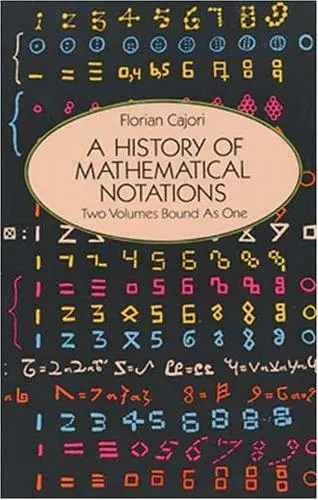
A history of mathematical notations
by Florian Cajori · first published 1928
12mentions
4recommended by
10HN commenters
2015–2023first – last mentioned
40% recommend60% neutral
Affiliate links. As an Amazon Associate I earn from qualifying purchases.
Florian Cajori's A History of Mathematical Notations goes into the history and notes examples of old written manuscripts showing the intermediate form in use, with one example where both were used interchangeably in a letter. He examined the question in…
on “Why Is the Dollar Sign a Letter S?” ↗The most comprehensive source about this kind of thing is Cajori’s History of Mathematical Notations. You should be able to find a used copy of both volumes for a reasonable price.
on “Do Teachers Need to Include the History of Mathematics in Their Teaching? (2003)” ↗I'm slowly reading through a book called the "History of Mathematical Notations" by Florian Cajori and it sounds like just what you're looking for. It goes into far more detail than probably anybody would wish for on the histories of various symbols and ways of writing addition,…
on “Cistercian Numerals” ↗If you find this interesting I'd recommend Florian Cajori's "A History of Mathematical Notations" (1930; I have the 2 volume combined one reprinted in 1993).
on “Bad but interesting mathematical notation idea” ↗…orthogonal tool until AI takes over most jobs from humans (In the end both 2d maths and programming languages might not matter—it might just be binary + AIs running the show). Recommended reading: - A History of Mathematical Notations by Florian Cajori (1929) - Syntax-Directed Recognition of Hand-Printed Two-Dimensional Mathematics https://dl.acm.org/doi/abs/10.1145/2402536.2402585 (1967) - A Review of Two-Dimensional Programming…
on “Ask HN: Why doesn't math look like a programming language?” ↗This is a project of mine that I take attempts at here and there. Another great book on this topic is "History of Mathematical Notations" https://www.amazon.com/History-Mathematical-Notations-Dover-...
on “Ask HN: Math books that made you significantly better at math?” ↗…because of history and inertia... Less than you may think. Leibniz and other mathematicians spent years debating notational forms in mathematics before settling on what we have. See Florian Cajori's _A History of Mathematical Notations_.
on “Study of non-programmers' solutions to programming problems [pdf]” ↗As others have mentioned, there is no standard. The closest thing would probably be A history of mathematical notations by Florian Cajori (2 volumes, 1928), but that illustrates how diverse, inconsistent and downright weird the notation can be. It's just as well that the precision of mathematics does not depend on it.
on “Ask HN: Where are the “docs” for mathematical notation?” ↗…instructive illustration of the fact that a mathematical topic may have an amount of symbolism that is a hindrance rather than a help, that becomes burdensome, that obstructs progress. A History of Mathematical Notations by Florian Cajori
on “Intel's plan to license x86 cores for chips with Arm, RISC-V and more (2022)” ↗…convenience for people who understand the concepts, but the concepts can be expressed in a natural language just as precisely, albeit less concisely. In fact, as Florian Cajori stated in his book "A History of Mathematical Notations", the rise of mathematical notation was opposed by people who preferred the older, natural language style of doing mathematics, what Cajori termed the "struggle between symbolists and rhetoricians." So,…
on “Lojban: Constructed language to eliminate ambiguity from communication” ↗I think the real answer is "Because the parentheses are mathematics notation for function application". (Grabs Cajori's History of Mathematical Notations.) Apparently the use of parentheses to indicate function application "occurs in Euler in 1734" and in D'Alembert in 1754. The commas to separate multiple arguments appear in Euler in 1753. The standardization…
on “How to help someone use a computer” ↗…algorists were unconstrained by ASCII and unicode so they may have balked at the aesthetics of these expressions, but's not inherently great practice to have ad-hoc invention of notation. Wolframs link to the history of mathematical notations starts to trail off, probably correlated with Church's rendering the need for new squiggles optional. Contemporaneously, (1930s) Turing contributes the idea of a turing machine, but this is an abstraction.…
on “What We’ve Built Is a Computational Language” ↗